Braga Andrea, Castronovo Fabiana, Caccia Giorgio, Papadia Andrea, Regusci Luca, Torella Marco, Salvatore Stefano, Scancarello Chiara, Ghezzi Fabio, Serati Maurizio
Department of Obstetrics and Gynecology, EOC-Beata Vergine Hospital, 6850 Mendrisio, Switzerland.
Faculty of Biomedical Sciences, Università della Svizzera Italiana, 6900 Lugano, Switzerland.
J Clin Med. 2022 May 16;11(10):2805. doi: 10.3390/jcm11102805.
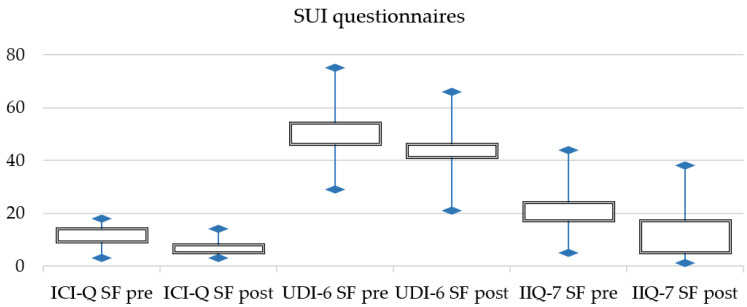
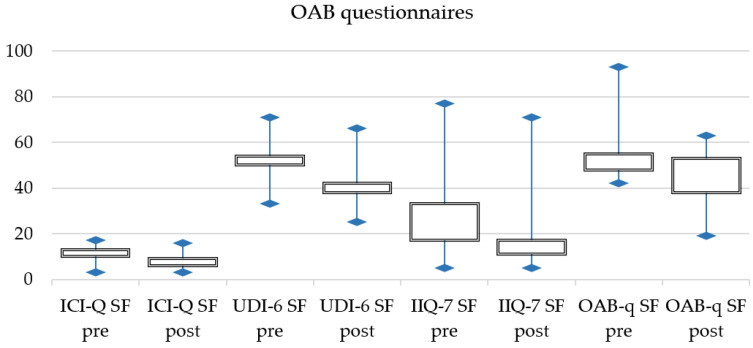
Functional magnetic stimulation (FMS) is a new technique for the conservative treatment of Urinary incontinence (UI), based on magnetic induction. It induces controlled depolarization of the nerves, resulting in pelvic muscle contraction and sacral S2-S4 roots neuromodulation. The aim of this study was to assess the efficacy of the new 3 Tesla FMS chair, both in patients with pure stress urinary incontinence (SUI) and in women with pure overactive bladder (OAB) symptoms. A prospective observational study was conducted in our urogynaecologic unit. All the patients involved were consecutive women with pure SUI or pure OAB symptoms treated by a 3 Tesla electromagnetic chair. The primary outcome was a subjective outcome evaluation by the PGI-I Scale and a patient-satisfaction scale. The secondary outcome was the change score of the UDI-6, IIQ-7, ICIQ-SF and OAB-q SF questionnaires from baseline to final visit. At 2 months follow-up, 28 out of 60 patients (47%) with SUI symptoms and 20 out of 40 patients (50%) with OAB symptoms declared themselves cured. Considering cured and improved patients, the subjective cure rates were 68.3% (41/60) and 70% (28/40) for patients with SUI and OAB symptoms, respectively. The results of this study showed that the 3 Tesla electromagnetic chair may be an effective option for the treatment of UI.
功能性磁刺激(FMS)是一种基于磁感应的用于保守治疗尿失禁(UI)的新技术。它可诱导神经的可控去极化,从而导致盆底肌肉收缩和骶神经S2 - S4神经根的神经调节。本研究的目的是评估新型3特斯拉FMS椅对单纯性压力性尿失禁(SUI)患者和单纯性膀胱过度活动症(OAB)症状女性患者的疗效。在我们的泌尿妇科单元进行了一项前瞻性观察研究。所有纳入的患者均为连续的患有单纯性SUI或单纯性OAB症状并接受3特斯拉电磁椅治疗的女性。主要结局是通过PGI - I量表和患者满意度量表进行主观结局评估。次要结局是从基线到末次随访时UDI - 6、IIQ - 7、ICIQ - SF和OAB - q SF问卷的变化得分。在2个月的随访中,60例有SUI症状的患者中有28例(47%)和40例有OAB症状的患者中有20例(50%)宣称自己已治愈。考虑治愈和改善的患者,SUI和OAB症状患者的主观治愈率分别为68.3%(41/60)和70%(28/40)。本研究结果表明,3特斯拉电磁椅可能是治疗UI的一种有效选择。