Frostad Stein, Rozakou-Soumalia Natalia, Dârvariu Ştefana, Foruzesh Bahareh, Azkia Helia, Larsen Malina Ploug, Rowshandel Ehsan, Sjögren Jan Magnus
Division of Psychiatry, Haukeland University Hospital, 5021 Bergen, Norway.
Research Unit Eating Disorders, Psychiatric Center Ballerup, Maglevænget 32, 2750 Ballerup, Denmark.
J Pers Med. 2022 May 20;12(5):836. doi: 10.3390/jpm12050836.
Anorexia nervosa (AN) has high rates of enduring disease and mortality. Currently, there is insufficient knowledge on the predictors of relapse after weight normalization and this is why a systematic literature review was performed.
PubMed, EMBASE, PsychInfo, and Cochrane databases were searched for literature published until 13 July 2021. All study designs were eligible for inclusion if they focused on predictors of relapse after weight normalization in AN. Individual study definitions of relapse were used, and in general, this was either a drop in BMI and/or reccurrence of AN symptoms.
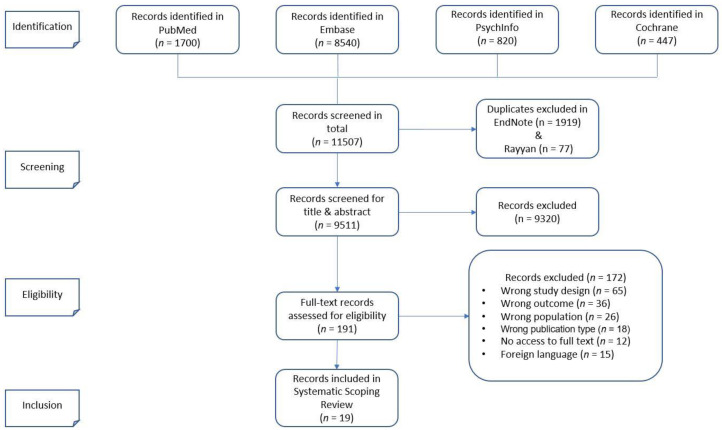
The database search identified 11,507 publications, leaving 9511 publications after the removal of duplicates and after a review of abstracts and titles; 191 were selected for full-text review. Nineteen publications met the criteria and included 1398 AN patients and 39 healthy controls (HC) from adults and adolescents (ages range 11-73 years). The majority used a prospective observational study design (12 studies), a few used a retrospective observational design (6 studies), and only one was a non-randomized control trial (NRCT). Sample sizes ranged from 16 to 191 participants. BMI or measures of body fat and leptin levels at discharge were the strongest predictors of relapse with an approximate relapse rate of 50% at 12 months. Other predictors included signs of eating disorder psychopathology at discharge.
BMI at the end of treatment is a predictor of relapse in AN, which is why treatment should target a BMI well above 20. Together with the time to relapse, these outcomes are important to include in the evaluation of current and novel treatments in AN and for benchmarking.
神经性厌食症(AN)的持久疾病率和死亡率很高。目前,关于体重恢复正常后复发的预测因素的知识不足,这就是进行系统文献综述的原因。
检索了PubMed、EMBASE、PsychInfo和Cochrane数据库中截至2021年7月13日发表的文献。如果所有研究设计关注的是AN体重恢复正常后复发的预测因素,则均符合纳入标准。采用了各研究对复发的个体定义,一般来说,这要么是体重指数下降和/或AN症状复发。
数据库检索共识别出11507篇出版物,在去除重复项并审查摘要和标题后,剩余9511篇出版物;191篇被选作全文审查。19篇出版物符合标准,纳入了1398例AN患者和39名健康对照(HC),来自成人和青少年(年龄范围11 - 73岁)。大多数研究采用前瞻性观察性研究设计(12项研究),少数采用回顾性观察性设计(6项研究),只有一项是非随机对照试验(NRCT)。样本量从16至191名参与者不等。出院时的体重指数或体脂测量值以及瘦素水平是复发的最强预测因素,12个月时的复发率约为50%。其他预测因素包括出院时饮食失调精神病理学的迹象。
治疗结束时的体重指数是AN复发的一个预测因素,这就是为什么治疗目标应该是使体重指数远高于20。连同复发时间一起,这些结果对于评估AN的现有和新型治疗方法以及进行基准测试都很重要。