Roškar Samo, Hafner-Bratkovič Iva
Valdoltra Orthopaedic Hospital, Jadranska Cesta 31, SI-6280 Ankaran, Slovenia.
Faculty of Medicine, University of Ljubljana, Zaloška 9, SI-1000 Ljubljana, Slovenia.
Life (Basel). 2022 May 13;12(5):731. doi: 10.3390/life12050731.
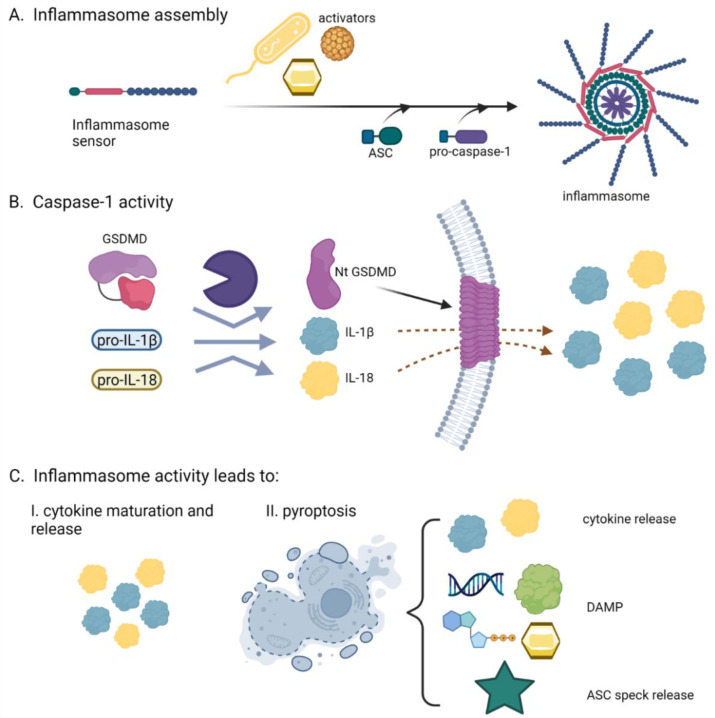
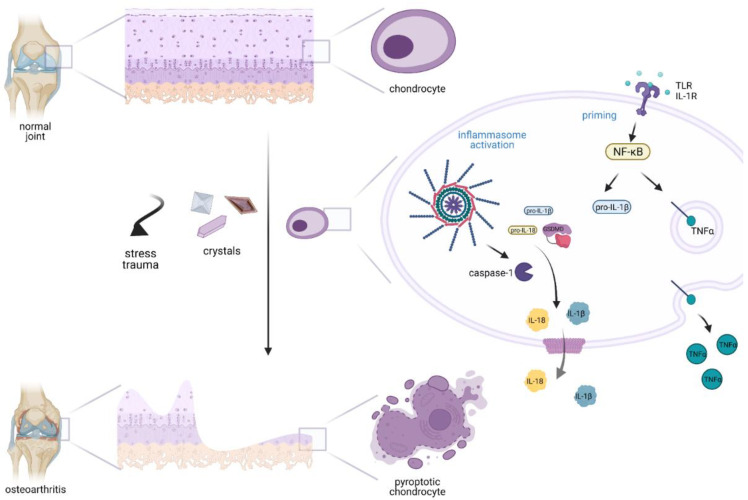
Osteoarthritis is age-related and the most common form of arthritis. The main characteristics of the disease are progressive loss of cartilage and secondary synovial inflammation, which finally result in pain, joint stiffness, and functional disability. Similarly, joint degeneration is characteristic of systemic inflammatory diseases such as rheumatoid arthritis and gout, with the associated secondary type of osteoarthritis. Studies suggest that inflammation importantly contributes to the progression of the disease. Particularly, cytokines TNFα and IL-1β drive catabolic signaling in affected joints. IL-1β is a product of inflammasome activation. Inflammasomes are inflammatory multiprotein complexes that propagate inflammation in various autoimmune and autoinflammatory conditions through cell death and the release of inflammatory cytokines and damage-associated molecule patterns. In this article, we review genetic, marker, and animal studies that establish inflammasomes as important drivers of secondary arthritis and discuss the current evidence for inflammasome involvement in primary osteoarthritis. The NLRP3 inflammasome has a significant role in the development of secondary osteoarthritis, and several studies have provided evidence of its role in the development of primary osteoarthritis, while other inflammasomes cannot be excluded. Inflammasome-targeted therapeutic options might thus provide a promising strategy to tackle these debilitating diseases.
骨关节炎与年龄相关,是最常见的关节炎形式。该疾病的主要特征是软骨进行性丧失和继发性滑膜炎,最终导致疼痛、关节僵硬和功能障碍。同样,关节退变也是类风湿关节炎和痛风等全身性炎症性疾病的特征,并伴有继发性骨关节炎。研究表明,炎症在很大程度上促进了该疾病的进展。特别是,细胞因子TNFα和IL-1β在受影响的关节中驱动分解代谢信号传导。IL-1β是炎性小体激活的产物。炎性小体是炎症性多蛋白复合物,通过细胞死亡以及炎性细胞因子和损伤相关分子模式的释放,在各种自身免疫和自身炎症性疾病中传播炎症。在本文中,我们综述了将炎性小体确立为继发性关节炎重要驱动因素的遗传学、标志物和动物研究,并讨论了炎性小体参与原发性骨关节炎的现有证据。NLRP3炎性小体在继发性骨关节炎发展中起重要作用,多项研究提供了其在原发性骨关节炎发展中作用的证据,而其他炎性小体也不能排除。因此,针对炎性小体靶向治疗方案可能为攻克这些使人衰弱的疾病提供一种有前景的策略。