The Wellcome-Wolfson Institute for Experimental Medicine, Queen's University Belfast, Belfast, Antrim, U.K.
Kennedy Institute of Rheumatology, Nuffield Department of Orthopaedics, Rheumatology and Musculoskeletal Sciences, University of Oxford, Oxford, U.K.
Biochem Soc Trans. 2021 Dec 17;49(6):2495-2507. doi: 10.1042/BST20200987.
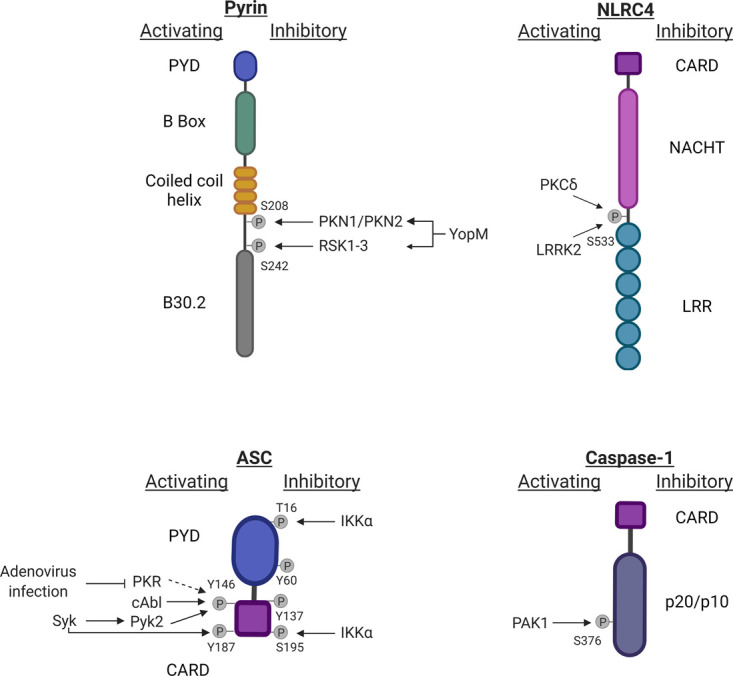
Inflammasomes are protein complexes in the innate immune system that regulate the production of pro-inflammatory cytokines and inflammatory cell death. Inflammasome activation and subsequent cell death often occur within minutes to an hour, so the pathway must be dynamically controlled to prevent excessive inflammation and the development of inflammatory diseases. Phosphorylation is a fundamental post-translational modification that allows rapid control over protein function and the phosphorylation of inflammasome proteins has emerged as a key regulatory step in inflammasome activation. Phosphorylation of inflammasome sensor and adapter proteins regulates their inter- and intra-molecular interactions, subcellular localisation, and function. The control of inflammasome phosphorylation may thus provide a new strategy for the development of anti-inflammatory therapeutics. Herein we describe the current knowledge of how phosphorylation operates as a critical switch for inflammasome signalling.
炎症小体是先天免疫系统中的蛋白质复合物,可调节促炎细胞因子的产生和炎症细胞死亡。炎症小体的激活和随后的细胞死亡通常在数分钟到数小时内发生,因此必须对该途径进行动态控制,以防止过度炎症和炎症性疾病的发展。磷酸化是一种基本的翻译后修饰,可实现对蛋白质功能的快速控制,并且炎症小体蛋白的磷酸化已成为炎症小体激活的关键调节步骤。炎症小体传感器和衔接蛋白的磷酸化调节它们的分子间和分子内相互作用、亚细胞定位和功能。因此,炎症小体磷酸化的控制可能为抗炎治疗药物的开发提供新策略。本文描述了目前关于磷酸化如何作为炎症小体信号的关键开关起作用的知识。