School of Food Science and Technology, Shihezi University, Shihezi 832003, China.
School of Food Science and Technology, Jiangnan University, Wuxi 214122, China.
Molecules. 2022 May 18;27(10):3236. doi: 10.3390/molecules27103236.
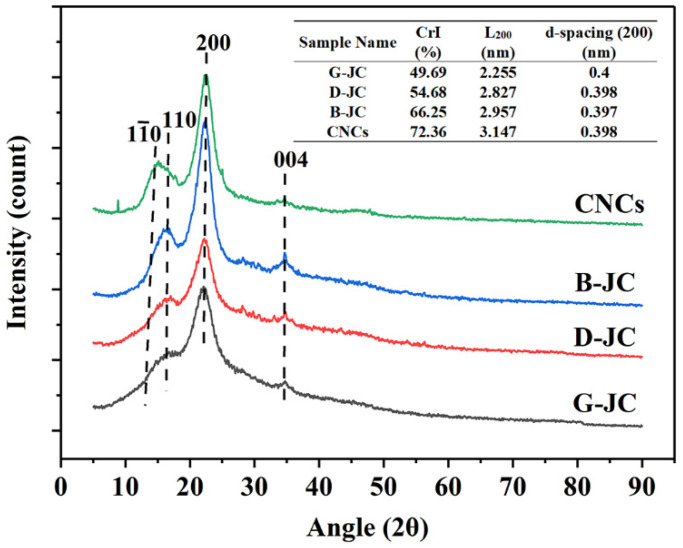
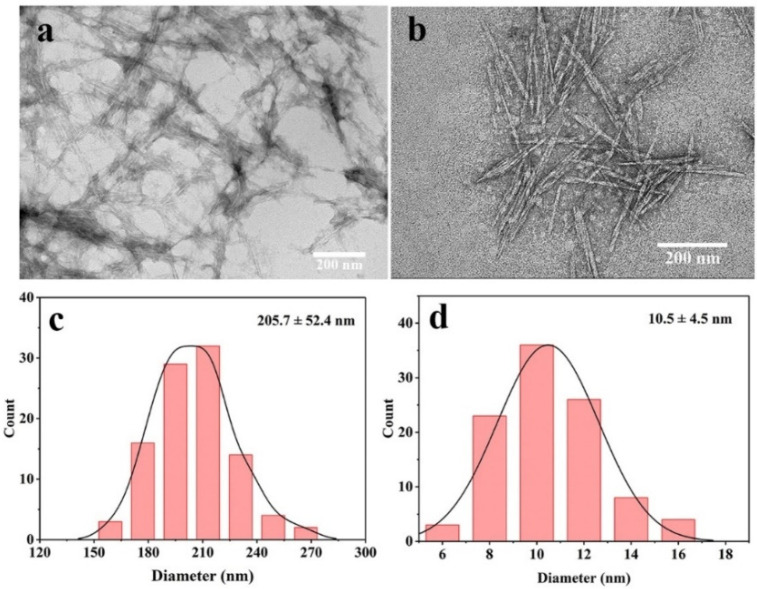
Jujube cores are fiber-rich industrial waste. Dewaxing, alkali treatment, bleaching, and sulfuric acid hydrolysis were used to generate cellulose nanocrystals (CNCs) from the jujube cores in this study. The morphological, structural, crystallinity, and thermal properties of the fibers were investigated using FE-SEM, TEM, AFM, FT-IR, XRD, and TGA under various processes. CNCs’ zeta (ζ) potential and water contact angle (WAC) were also investigated. The findings demonstrate that non-fibrous components were effectively removed, and the fiber particles shrunk over time because of many activities. CNCs had a rod-like shape, with a length of 205.7 ± 52.4 nm and a 20.5 aspect ratio. The crystal structure of cellulose Iβ was preserved by the CNCs, and the crystallinity was 72.36%. The temperature of the fibers’ thermal degradation lowered during the operations, although CNCs still had outstanding thermal stability (>200 °C). Aside from the CNCs, the aqueous suspension of CNCs was slightly agglomerated; thus, the zeta (ζ) potential of the CNCs’ suspension was −23.72 ± 1.7 mV, and the powder had high hydrophilicity. This research will be valuable to individuals who want to explore the possibility for CNCs made of jujube cores.
枣核是富含纤维的工业废料。本研究采用脱脂、碱处理、漂白和硫酸水解的方法从枣核中制备出纤维素纳米晶体(CNC)。采用 FE-SEM、TEM、AFM、FT-IR、XRD 和 TGA 等方法对纤维的形态、结构、结晶度和热性能进行了研究。还研究了 CNC 的 ζ 电位和水接触角(WAC)。结果表明,有效地去除了非纤维成分,并且由于多种作用,纤维颗粒随着时间的推移而收缩。CNC 呈棒状,长度为 205.7 ± 52.4nm,长宽比为 20.5。纤维素 Iβ 的晶体结构被 CNCs 保留,结晶度为 72.36%。尽管 CNCs 仍具有出色的热稳定性(>200°C),但在操作过程中纤维的热降解温度降低。除了 CNCs,CNC 水溶液还略微聚集,因此 CNCs 悬浮液的 ζ 电位为-23.72 ± 1.7mV,粉末具有高亲水性。这项研究对于那些希望探索枣核 CNCs 可能性的人将具有重要价值。