Institute of Agrochemistry and Food Technology-National Research Council (IATA-CSIC), 46980 Paterna, Valencia, Spain.
Section of Physiology, Department of Biochemistry and Physiology, Faculty of Pharmacy and Food Science, University of Barcelona (UB), 08028 Barcelona, Catalonia, Spain.
Nutrients. 2022 May 19;14(10):2117. doi: 10.3390/nu14102117.
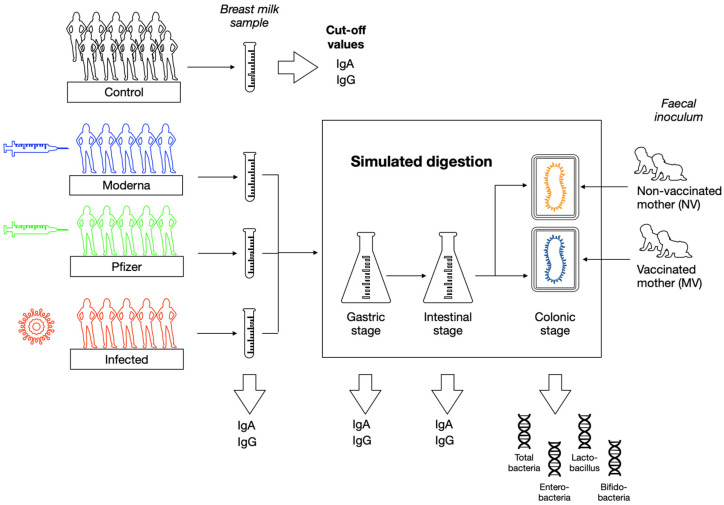
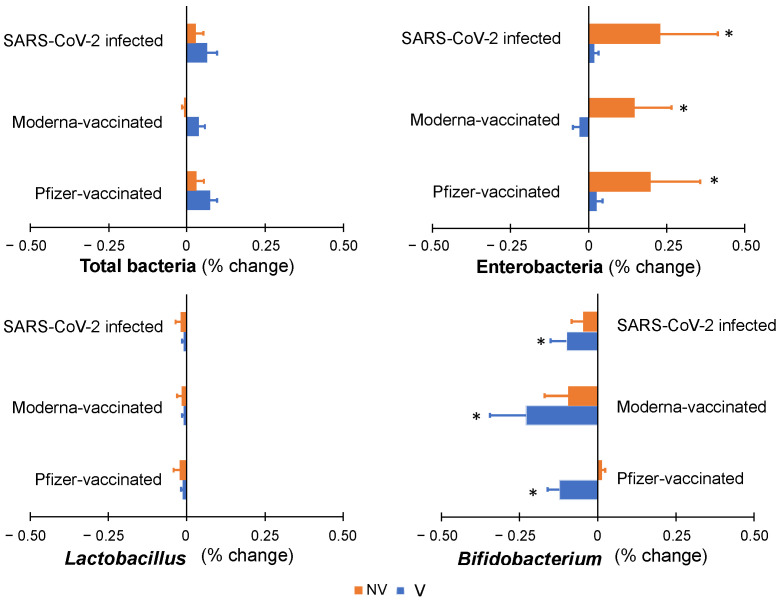
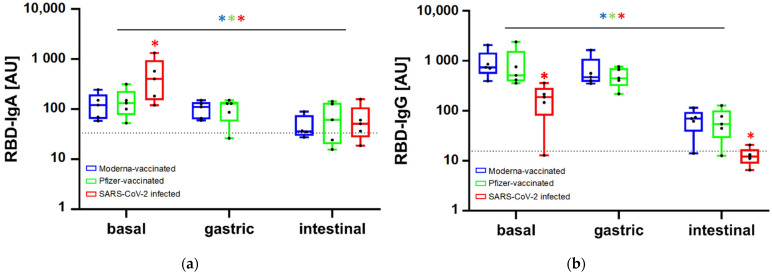
Breastfeeding is key for infant development and growth. Breast milk contains different bioactive compounds including antibodies. Recent studies have demonstrated the presence of breast milk SARS-CoV-2 antibodies after maternal infection and vaccination. However, the potential impact on the infant has not been explored yet. As a first step, we aimed at assessing the potential persistence of SARS-CoV-2 IgA and IgG antibodies from infected and vaccinated women in the gastrointestinal tract of the infants by means of an -simulated gastrointestinal digestion approach. Breast milk samples from 10 lactating women receiving mRNA vaccination against SARS-CoV-2 (n = 5 with BNT162b2 mRNA and n = 5 with mRNA-1273) and also, COVID-19 infected (n = 5) were included. A control group with women with no exposure to the virus (n = 10 pre-pandemic) were also studied. The presence of IgA and IgG SARS-CoV-2 antibody levels was determined by ELISA after the gastric and intestinal stages. The impact of digested antibodies on infant gut microbiota was tested by simulating colonic fermentation with two different fecal inoculums: infants from vaccinated and non-vaccinated mothers. Specific gut microbial groups were tested by targeted qPCR. infant gastrointestinal digestion significantly decreased the levels of both anti-SARS-CoV-2 IgA and IgG. However, both remained resistant in all the study groups except in that evaluating breast milk samples from infected women, in which IgG was degraded below the cut-off values in the intestinal phase. No effect of the antibodies on microbiota were identified after digestion. In conclusion, antibody levels against SARS-CoV-2 are reduced after -simulated gastrointestinal tract but remain present, so a positive biological effect could be expected from this infant immunization pathway.
母乳喂养对婴儿的发育和成长至关重要。母乳中含有不同的生物活性化合物,包括抗体。最近的研究表明,在母体感染和接种疫苗后,母乳中存在 SARS-CoV-2 抗体。然而,其对婴儿的潜在影响尚未得到探索。作为第一步,我们旨在通过模拟胃肠道消化的方法,评估感染和接种 SARS-CoV-2 mRNA 疫苗的女性的胃肠道中 SARS-CoV-2 IgA 和 IgG 抗体的潜在持久性。研究纳入了 10 名接受 mRNA 疫苗(n = 5 名接受 BNT162b2 mRNA 疫苗,n = 5 名接受 mRNA-1273 疫苗)接种和 COVID-19 感染(n = 5)的哺乳期妇女的母乳样本。还纳入了一组未接触病毒的对照组女性(n = 10 名大流行前)。通过 ELISA 在胃和肠阶段后测定 IgA 和 IgG SARS-CoV-2 抗体水平。通过用两种不同粪便接种物模拟结肠发酵来测试消化抗体对婴儿肠道微生物群的影响:接种和未接种母亲的婴儿。通过靶向 qPCR 测试特定的肠道微生物群。婴儿胃肠道消化显著降低了两种抗 SARS-CoV-2 IgA 和 IgG 的水平。然而,除了评估感染妇女母乳样本的研究组外,所有研究组的抗体都保持抵抗,在肠阶段 IgG 降解低于截断值。消化后未发现抗体对微生物群有影响。总之,SARS-CoV-2 抗体水平在模拟胃肠道后降低,但仍存在,因此可以预期这种婴儿免疫途径会产生积极的生物学效应。