Meng Fanying, Yin Zhifeng, Ren Xiaoxiang, Geng Zhen, Su Jiacan
Institute of Translational Medicine, Shanghai University, Shanghai 200444, China.
School of Medicine, Shanghai University, Shanghai 200444, China.
Pharmaceutics. 2022 May 17;14(5):1069. doi: 10.3390/pharmaceutics14051069.
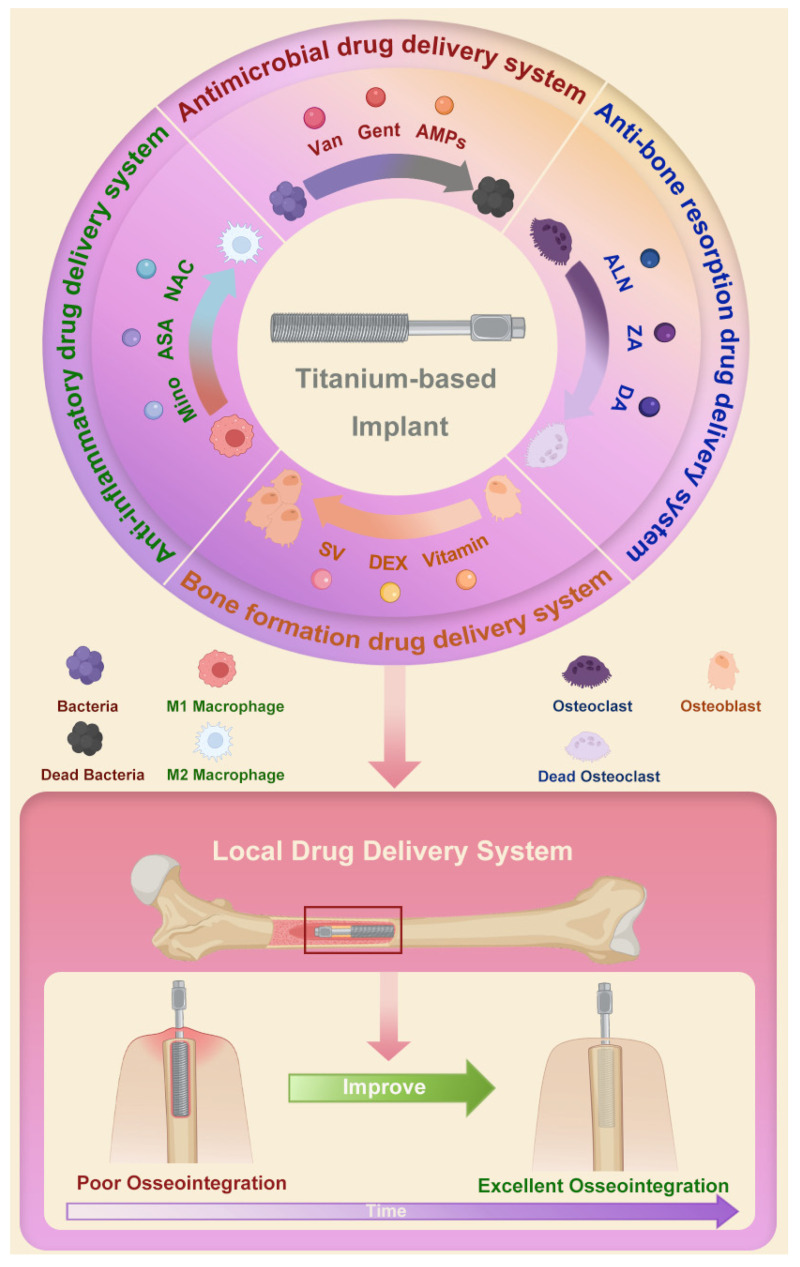
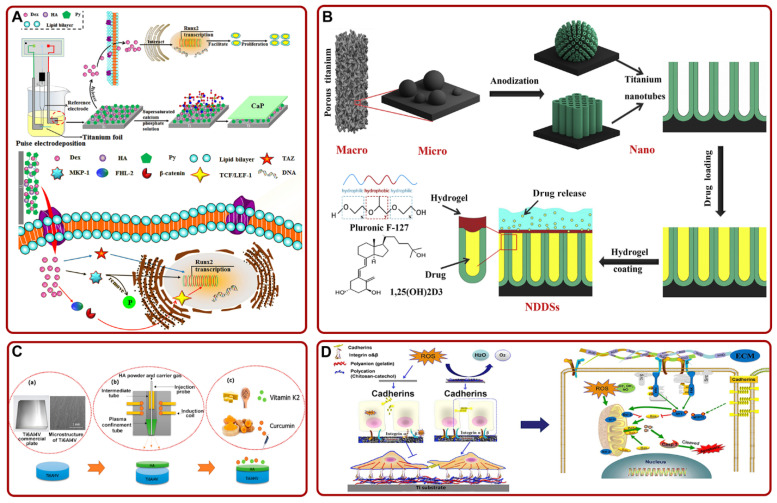
Titanium and its alloys are the most widely applied orthopedic and dental implant materials due to their high biocompatibility, superior corrosion resistance, and outstanding mechanical properties. However, the lack of superior osseointegration remains the main obstacle to successful implantation. Previous traditional surface modification methods of titanium-based implants cannot fully meet the clinical needs of osseointegration. The construction of local drug delivery systems (e.g., antimicrobial drug delivery systems, anti-bone resorption drug delivery systems, etc.) on titanium-based implants has been proved to be an effective strategy to improve osseointegration. Meanwhile, these drug delivery systems can also be combined with traditional surface modification methods, such as anodic oxidation, acid etching, surface coating technology, etc., to achieve desirable and enhanced osseointegration. In this paper, we review the research progress of different local drug delivery systems using titanium-based implants and provide a theoretical basis for further research on drug delivery systems to promote bone-implant integration in the future.
钛及其合金因其具有高生物相容性、优异的耐腐蚀性和出色的机械性能,是应用最为广泛的骨科和牙科植入材料。然而,缺乏优异的骨整合能力仍然是植入成功的主要障碍。以往基于钛的植入物的传统表面改性方法无法完全满足骨整合的临床需求。在钛基植入物上构建局部给药系统(如抗菌药物递送系统、抗骨吸收药物递送系统等)已被证明是改善骨整合的有效策略。同时,这些给药系统还可与传统表面改性方法(如阳极氧化、酸蚀、表面涂层技术等)相结合,以实现理想的、增强的骨整合。在本文中,我们综述了使用钛基植入物的不同局部给药系统的研究进展,并为未来进一步研究促进骨-植入物整合的给药系统提供理论依据。