Negm Amr, Gouda Mohamed, Ibrahim Hairul-Islam M
Department of Chemistry, College of Science, King Faisal University, Al-Ahsa 31982, Saudi Arabia.
Biochemistry Division, Chemistry Department, Faculty of Science, Mansoura University, Mansoura 35516, Egypt.
Polymers (Basel). 2022 May 15;14(10):2015. doi: 10.3390/polym14102015.
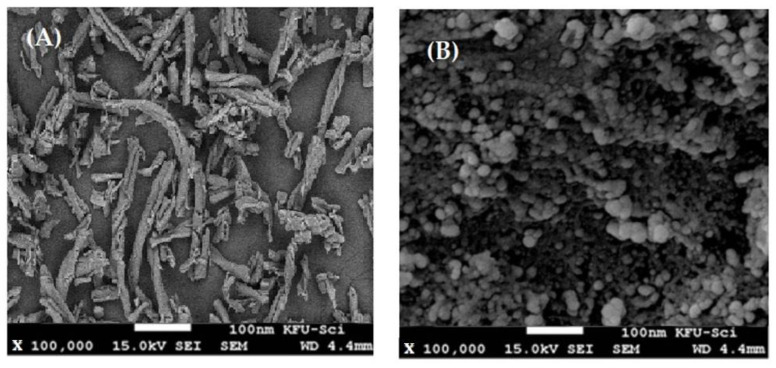
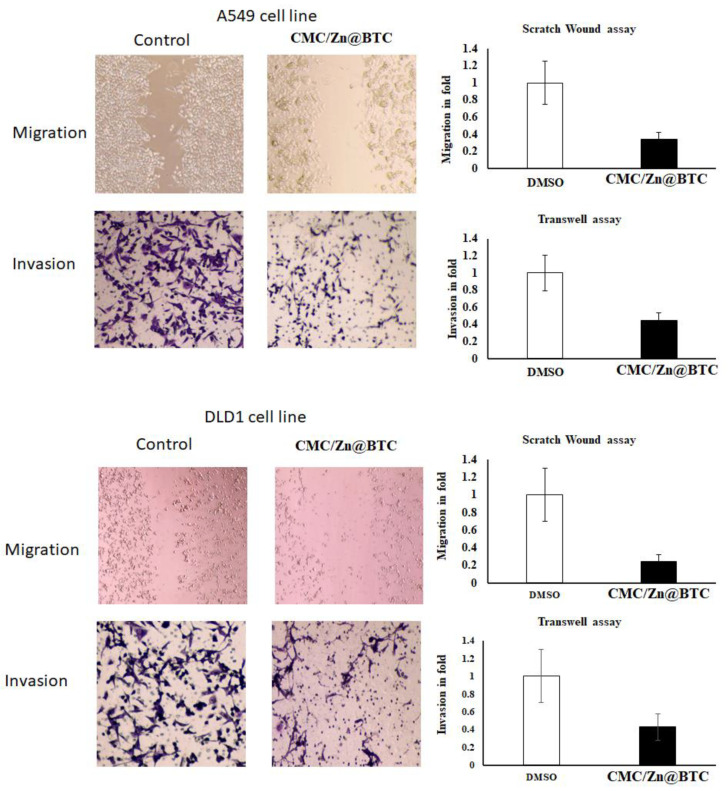
A solvothermal technique was used to prepare a Zn-benzenetricarboxylic acid (Zn@BTC) organic framework covered with a carboxymethyl cellulose (CMC/Zn@BTC). Fourier transform infrared spectroscopy (FTIR), field emission scanning electron microscope (FESEM), and Brunauer, Emmett, and Teller (BET) surface area were applied to characterize CMC/Zn@BTC. Moreover, the anticancer, anti-migrative, anti-invasive, and anti-proliferative action of CMC/Zn@BTC nanoparticles were assessed on cancer cell lines. Apoptotic markers and DNA damage were assessed to explore the cellular and biological changes induced by CMC/Zn@BTC nanoparticles. The microscopic observation revealed that CMC controls the surface morphology and surface characteristics of the Zn@BTC. The obtained BET data revealed that the Zn@BTC nanocomposite surface area lowers from 1061 m/g to 740 m/g, and the pore volume decreases from 0.50 cm/g to 0.37 cm/g when CMC is applied to Zn@BTC nanocomposites. The cellular growth of DLD1 and A549 was suppressed by CMC/Zn@BTC, with IC50 values of 19.1 and 23.1 μg/mL, respectively. P53 expression was upregulated, and Bcl-2 expression was downregulated by CMC/Zn@BTC, which promoted the apoptotic process. Furthermore, CMC/Zn@BTC caused DNA damage in both cancer cell lines with diverse impact, 66 percent (A549) and 20 percent (DLD1) compared to cisplatin's 52 percent reduction. CMC/Zn@BTC has anti-invasive properties and significantly reduced cellular migration. Moreover, CMC/Zn@BTC aims key proteins associated with metastasis, proliferation and programmed cellular death.
采用溶剂热法制备了一种覆盖有羧甲基纤维素的锌-苯三甲酸(Zn@BTC)有机框架材料(CMC/Zn@BTC)。运用傅里叶变换红外光谱(FTIR)、场发射扫描电子显微镜(FESEM)以及布鲁诺尔-埃米特-泰勒(BET)比表面积法对CMC/Zn@BTC进行表征。此外,还评估了CMC/Zn@BTC纳米颗粒对癌细胞系的抗癌、抗迁移、抗侵袭和抗增殖作用。通过评估凋亡标志物和DNA损伤来探究CMC/Zn@BTC纳米颗粒诱导的细胞和生物学变化。微观观察表明,CMC控制着Zn@BTC的表面形态和表面特性。获得的BET数据显示,当将CMC应用于Zn@BTC纳米复合材料时,Zn@BTC纳米复合材料的表面积从1061 m²/g降至740 m²/g,孔体积从0.50 cm³/g降至0.37 cm³/g。CMC/Zn@BTC抑制了DLD1和A549细胞的生长,其IC50值分别为19.1和23.1 μg/mL。CMC/Zn@BTC上调了P53表达,下调了Bcl-2表达,从而促进了凋亡过程。此外,CMC/Zn@BTC在两种癌细胞系中均造成了DNA损伤,且影响各异,与顺铂52%的降低率相比,A549细胞系为66%,DLD1细胞系为20%。CMC/Zn@BTC具有抗侵袭特性,并显著减少了细胞迁移。此外,CMC/Zn@BTC针对与转移、增殖和程序性细胞死亡相关的关键蛋白发挥作用。