Department of Engineering Science, University of Oxford, Oxford OX3 7DQ, UK.
Oxford University Clinical Research Unit, Ho Chi Minh City 710400, Vietnam.
Sensors (Basel). 2022 May 19;22(10):3866. doi: 10.3390/s22103866.
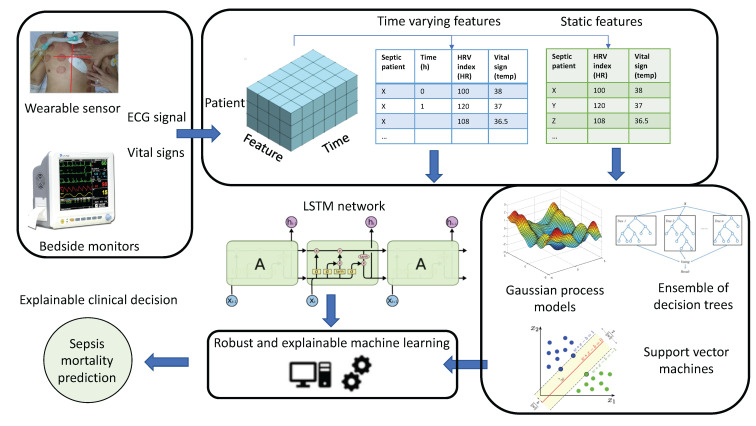
Sepsis is associated with high mortality-particularly in low-middle income countries (LMICs). Critical care management of sepsis is challenging in LMICs due to the lack of care providers and the high cost of bedside monitors. Recent advances in wearable sensor technology and machine learning (ML) models in healthcare promise to deliver new ways of digital monitoring integrated with automated decision systems to reduce the mortality risk in sepsis. In this study, firstly, we aim to assess the feasibility of using wearable sensors instead of traditional bedside monitors in the sepsis care management of hospital admitted patients, and secondly, to introduce automated prediction models for the mortality prediction of sepsis patients. To this end, we continuously monitored 50 sepsis patients for nearly 24 h after their admission to the Hospital for Tropical Diseases in Vietnam. We then compared the performance and interpretability of state-of-the-art ML models for the task of mortality prediction of sepsis using the heart rate variability (HRV) signal from wearable sensors and vital signs from bedside monitors. Our results show that all ML models trained on wearable data outperformed ML models trained on data gathered from the bedside monitors for the task of mortality prediction with the highest performance (area under the precision recall curve = 0.83) achieved using time-varying features of HRV and recurrent neural networks. Our results demonstrate that the integration of automated ML prediction models with wearable technology is well suited for helping clinicians who manage sepsis patients in LMICs to reduce the mortality risk of sepsis.
脓毒症与高死亡率相关 - 特别是在中低收入国家(LMICs)。由于缺乏医护人员和床边监测器成本高昂,中低收入国家的脓毒症重症监护管理具有挑战性。可穿戴传感器技术和医疗保健领域机器学习(ML)模型的最新进展有望提供新的数字监测方法,并与自动化决策系统集成,以降低脓毒症的死亡率风险。在这项研究中,我们首先旨在评估在医院收治的脓毒症患者的护理管理中使用可穿戴传感器代替传统床边监测器的可行性,其次,引入用于预测脓毒症患者死亡率的自动化预测模型。为此,我们连续监测了 50 名越南热带病医院收治的脓毒症患者近 24 小时。然后,我们比较了使用可穿戴传感器的心率变异性(HRV)信号和床边监测器的生命体征对脓毒症死亡率预测任务的最先进 ML 模型的性能和可解释性。我们的结果表明,所有基于可穿戴数据训练的 ML 模型在预测死亡率任务上的性能都优于基于床边监测器数据训练的 ML 模型,使用 HRV 的时变特征和递归神经网络最高性能(精度召回曲线下面积= 0.83)。我们的研究结果表明,将自动化 ML 预测模型与可穿戴技术相结合,非常适合帮助管理中低收入国家脓毒症患者的临床医生降低脓毒症的死亡率风险。