Choi Min Hyuk, Kim Dokyun, Jeong Seok Hoon, Lee Hyuk Min, Kim Heejung
Department of Laboratory Medicine and Research Institute of Bacterial Resistance, Yonsei University College of Medicine, Gangnam Severance Hospital, Seoul, South Korea.
Department of Laboratory Medicine and Research Institute of Bacterial Resistance, Yonsei University College of Medicine, Severance Hospital, Seoul, South Korea.
Front Microbiol. 2022 May 12;13:900681. doi: 10.3389/fmicb.2022.900681. eCollection 2022.
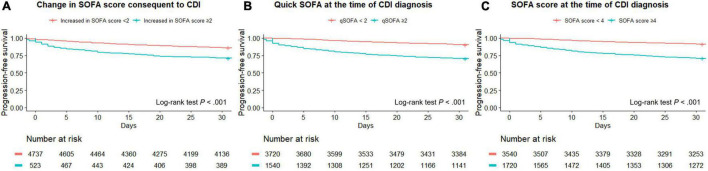
We aimed to determine whether the Sequential Organ Failure Assessment (SOFA) score predicts the prognosis of patients with infection (CDI). In addition, the association between the type of antibiotic used and PCR ribotypes was analyzed. We conducted a propensity score (PS)-matched study and machine learning analysis using clinical data from all adult patients with confirmed CDI in three South Korean hospitals. A total of 5,337 adult patients with CDI were included in this study, and 828 (15.5%) were classified as having severe CDI. The top variables selected by the machine learning models were maximum body temperature, platelet count, eosinophil count, oxygen saturation, Glasgow Coma Scale, serum albumin, and respiratory rate. After propensity score-matching, the SOFA score, white blood cell (WBC) count, serum albumin level, and ventilator use were significantly associated with severe CDI ( < 0.001 for all). The log-rank test of SOFA score ≥ 4 significantly differentiated severe CDI patients from the non-severe group. The use of fluoroquinolone was more related to CDI patients with ribotype 018 strains than to ribotype 014/020 ( < 0.001). Even after controlling for other variables using propensity score matching analysis, we found that the SOFA score was a clinical predictor of severe CDI. We also demonstrated that the use of fluoroquinolones in hospital settings could be associated with the PCR ribotype in patients with CDI.
我们旨在确定序贯器官衰竭评估(SOFA)评分是否能预测感染性腹泻(CDI)患者的预后。此外,还分析了所用抗生素类型与PCR核糖型之间的关联。我们利用韩国三家医院所有确诊为CDI的成年患者的临床数据进行了倾向评分(PS)匹配研究和机器学习分析。本研究共纳入5337例成年CDI患者,其中828例(15.5%)被归类为重症CDI。机器学习模型选择的首要变量为最高体温、血小板计数、嗜酸性粒细胞计数、血氧饱和度、格拉斯哥昏迷量表、血清白蛋白和呼吸频率。倾向评分匹配后,SOFA评分、白细胞(WBC)计数、血清白蛋白水平和使用呼吸机与重症CDI显著相关(均P<0.001)。SOFA评分≥4的对数秩检验显著区分了重症CDI患者与非重症组。与014/020核糖型相比,氟喹诺酮类药物的使用与018核糖型菌株的CDI患者更相关(P<0.001)。即使在使用倾向评分匹配分析控制其他变量后,我们发现SOFA评分是重症CDI的临床预测指标。我们还证明,医院环境中氟喹诺酮类药物的使用可能与CDI患者的PCR核糖型有关。