UCL Division of Psychiatry, London, UK.
Marie Curie Palliative Care Research Department, UCL Division of Psychiatry, London, UK.
Palliat Med. 2022 Jul;36(7):1047-1058. doi: 10.1177/02692163221099584. Epub 2022 May 30.
The efficacy of virtual reality for people living with a terminal illness is unclear.
To determine the feasibility and effectiveness of virtual reality use within a palliative care setting.
Systematic review and meta-analysis. PROSPERO (CRD42021240395).
Medline, Embase, AMED, PsycINFO, CINAHL, Cochrane Central Register of Controlled Trials and Web of Science were searched from inception to March 2021. Search terms included 'virtual reality' and 'palliative care'. Eligibility: (1) adult (>18 years old) with a terminal illness (2) at least one virtual reality session and (3) feasibility data and/or at least one patient outcome reported. The ROB-2 and ROBINS tools assessed risk of bias. The Grading of Recommendations, Assessment, Development and Evaluations (GRADE) tool assessed the quality of the evidence. Standardised mean differences (Hedges's ) were calculated from the pre- and post-data. A DerSimonian-Laird random effects model meta-analysis was conducted.
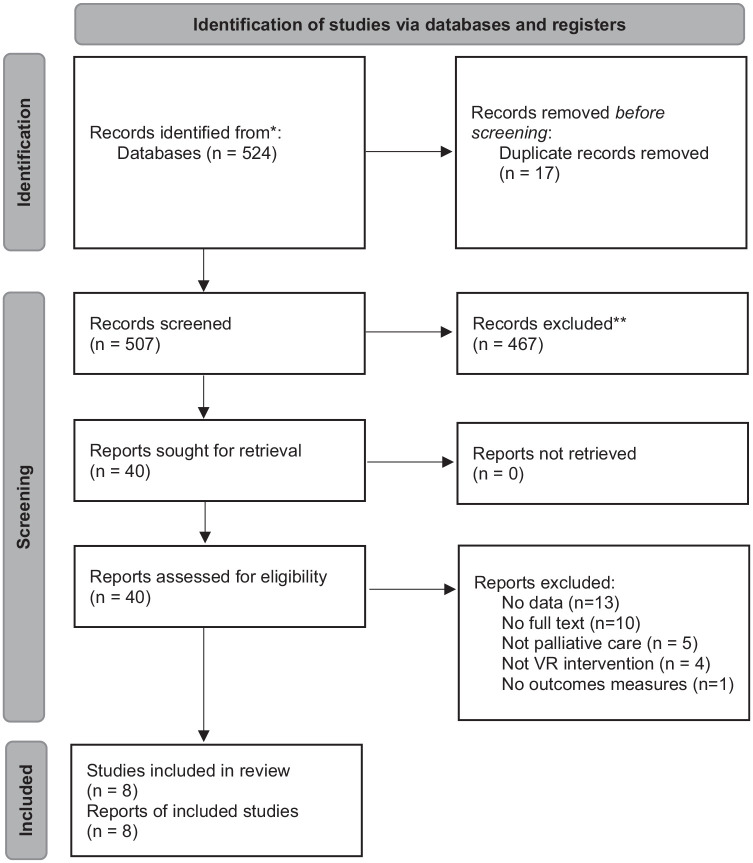
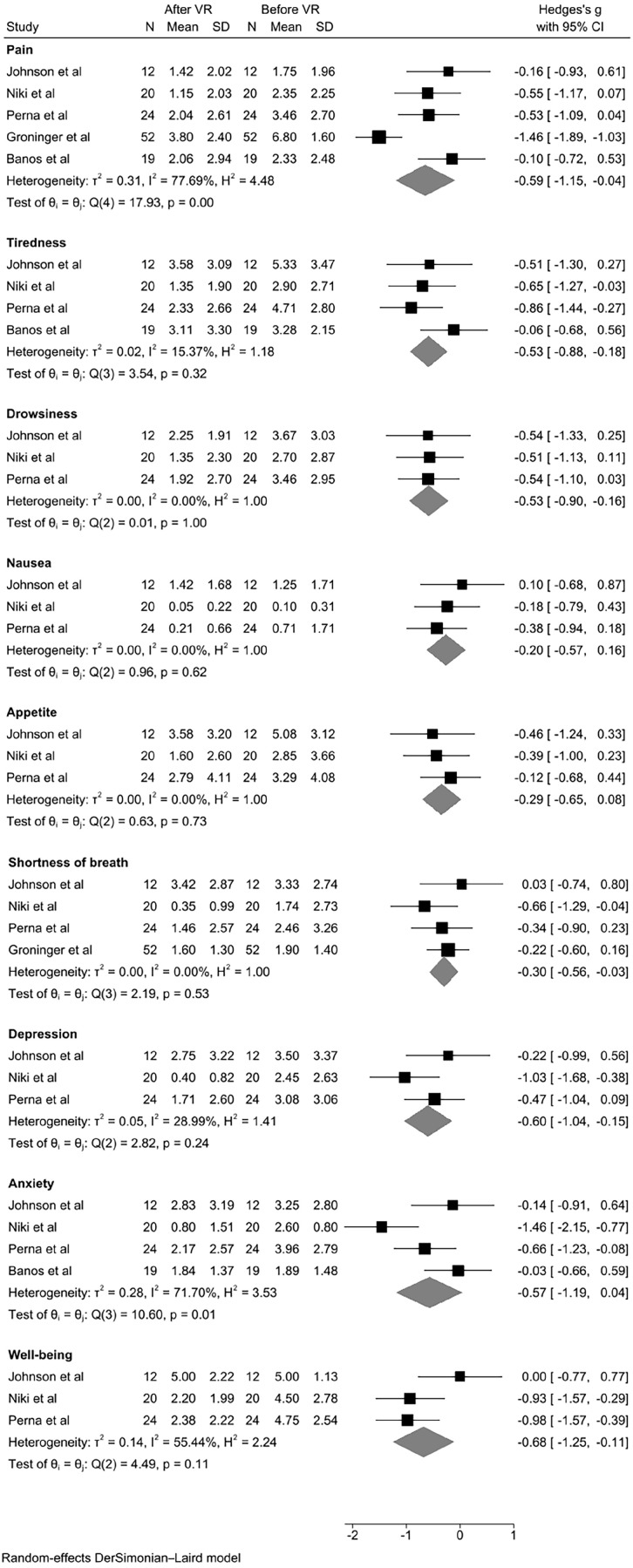
Eight studies were included, of which five were in the meta-analysis. All studies had at least some concern for risk of bias. Virtual reality statistically significantly improved pain ( = 0.0363), tiredness ( = 0.0030), drowsiness ( = 0.0051), shortness of breath ( = 0.0284), depression ( = 0.0091) and psychological well-being ( = 0.0201). The quality of the evidence was graded as very low due to small sample sizes, non-randomisation methods and a lack of a comparator arm.
Virtual reality in palliative care is feasible and acceptable. However, limited sample sizes and very low-quality studies mean that the efficacy of virtual reality needs further research.
虚拟现实对于绝症患者的疗效尚不清楚。
确定在姑息治疗环境中使用虚拟现实的可行性和效果。
系统评价和荟萃分析。PROSPERO(CRD42021240395)。
从建库到 2021 年 3 月,检索了 Medline、Embase、AMED、PsycINFO、CINAHL、Cochrane 中央对照试验注册库和 Web of Science。检索词包括“虚拟现实”和“姑息治疗”。纳入标准:(1)患有绝症的成年人(>18 岁);(2)至少进行一次虚拟现实治疗;(3)有可行性数据和/或至少有一个患者结局报告。ROB-2 和 ROBINS 工具评估偏倚风险。推荐评估、制定与评价分级(GRADE)工具评估证据质量。从治疗前后的数据中计算出标准化均数差(Hedges's )。采用 DerSimonian-Laird 随机效应模型进行荟萃分析。
共纳入 8 项研究,其中 5 项研究进行了荟萃分析。所有研究均存在一定程度的偏倚风险。虚拟现实在统计学上显著改善了疼痛( = 0.0363)、疲劳( = 0.0030)、嗜睡( = 0.0051)、呼吸急促( = 0.0284)、抑郁( = 0.0091)和心理幸福感( = 0.0201)。由于样本量小、非随机化方法和缺乏对照组,证据质量被评为极低。
姑息治疗中的虚拟现实是可行和可接受的。然而,由于样本量小和研究质量低,虚拟现实的疗效需要进一步研究。