• 文献检索
  • 文档翻译
  • 深度研究
  • 学术资讯
  • Suppr Zotero 插件Zotero 插件
  • 邀请有礼
  • 套餐&价格
  • 历史记录
应用&插件
Suppr Zotero 插件Zotero 插件浏览器插件Mac 客户端Windows 客户端微信小程序
定价
高级版会员购买积分包购买API积分包
服务
文献检索文档翻译深度研究API 文档MCP 服务
关于我们
关于 Suppr公司介绍联系我们用户协议隐私条款
关注我们

Suppr 超能文献

核心技术专利:CN118964589B侵权必究
粤ICP备2023148730 号-1Suppr @ 2026

文献检索

告别复杂PubMed语法,用中文像聊天一样搜索,搜遍4000万医学文献。AI智能推荐,让科研检索更轻松。

立即免费搜索

文件翻译

保留排版,准确专业,支持PDF/Word/PPT等文件格式,支持 12+语言互译。

免费翻译文档

深度研究

AI帮你快速写综述,25分钟生成高质量综述,智能提取关键信息,辅助科研写作。

立即免费体验

从患者生活中虚拟逃离:个体化虚拟现实对姑息治疗癌症住院患者的体验和获益的可行性研究。

My virtual escape from patient life: a feasibility study on the experiences and benefits of individualized virtual reality for inpatients in palliative cancer care.

机构信息

Department of Palliative Medicine, Heidelberg University Hospital, Im Neuenheimer Feld 305, 69120, Heidelberg, Germany.

Psychological Institute and Network Aging Research, Ruprecht Karls University of Heidelberg, Bergheimer Str. 20, 69115, Heidelberg, Germany.

出版信息

BMC Palliat Care. 2024 Oct 23;23(1):247. doi: 10.1186/s12904-024-01577-2.

DOI:10.1186/s12904-024-01577-2
PMID:39443900
原文链接:https://pmc.ncbi.nlm.nih.gov/articles/PMC11515567/
Abstract

BACKGROUND

Cancer patients benefit from Virtual Reality (VR) in burdensome situations, but evidence is scarce for palliative situations. Based on earlier work in palliative care, individualized VR interventions like seeing the patient's home may address a patient's wish to be at home and thus have a greater effect compared to standard VR content. Yet, some patients and relatives may be concerned about their privacy. Also, patient stakeholders raised concerns about triggering depressed mood or homesickness.

AIM

To test the feasibility and safety of individualized vs. standard 360°video VR interventions in palliative cancer inpatients.

METHODS

Prospective observational study with patient-reported outcome measurement using validated instruments of well-being (MDBF), symptoms and psychosocial burden (IPOS), cybersickness (SSQ), presence experience (SPES), subjective benefit (2 items), content analysis of interviews, and field notes. Individualized VR content was recorded with action camcorder-technology to protect the patients' privacy.

RESULTS

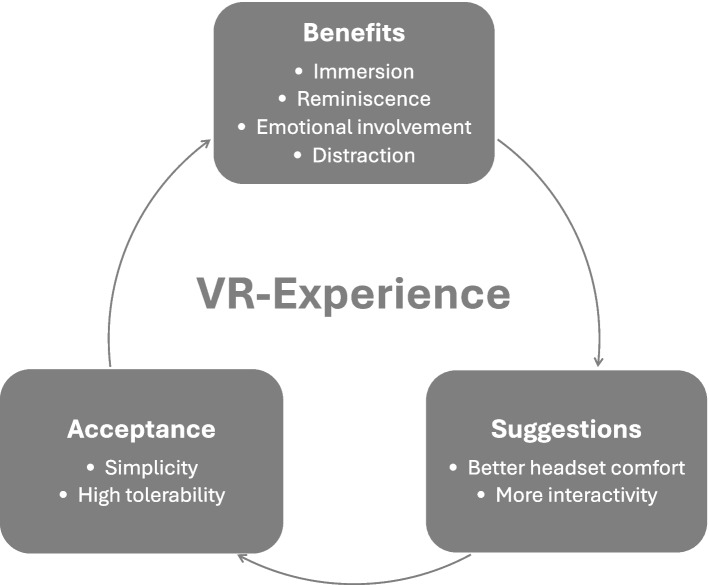
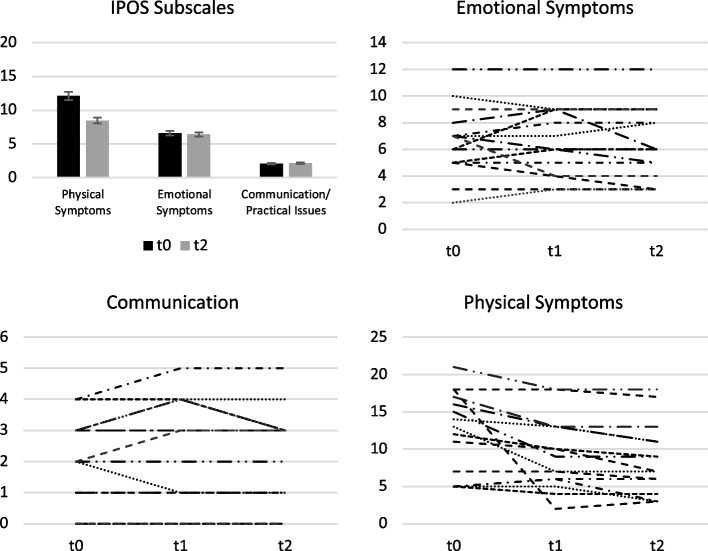
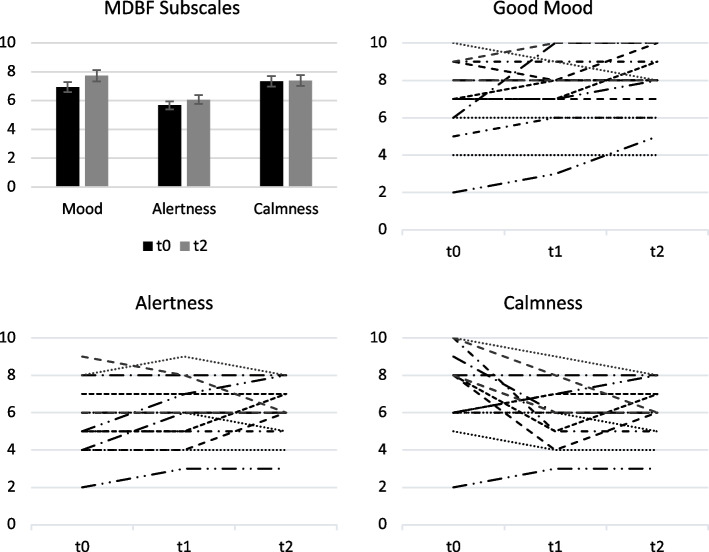
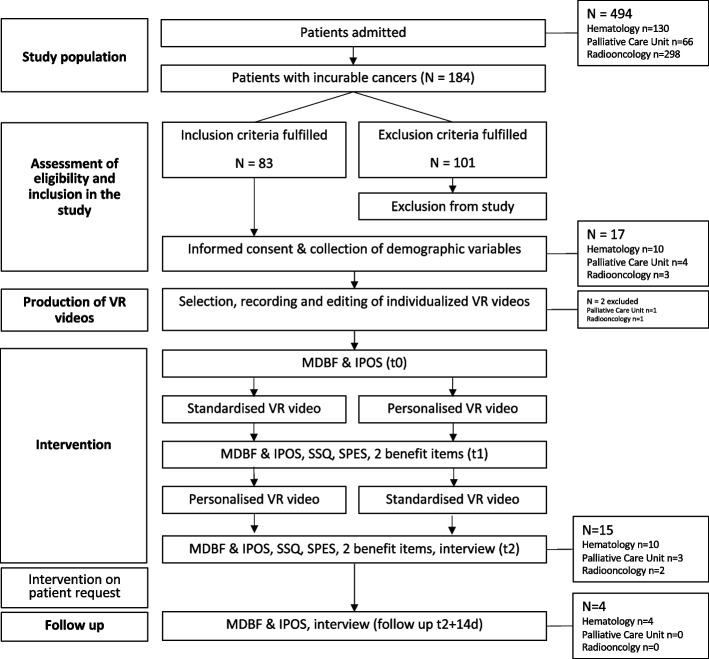
Seventeen patients participated, median age 65 years (range 20-82), 9 women (53%), 8 single or widowed (47%), 4 childless (23.5%), 4 academics (23.5%), with a median length of stay of 9 days (1-75) in the hematology (10), palliative care (3), or radiotherapy (2) unit of a German university hospital. Eight patients (53.3%) chose their own home environments or family for individualized VR-content. All participants enjoyed the intervention. Compared to standard VR content the individualized VR tended to have a stronger effect on well-being and emotional touch. It was not inferior in terms of psychosocial burden and cybersickness. No subjective and relevant side effects occurred. The patients well tolerated the assessments. However, most patients demanded a lighter headset and a desire for more interactivity.

CONCLUSIONS

Individualization of VR content shows potential for enhancement of immersion, which improves the VR experience and does not harm in terms of depressed mood or worsening of symptoms. The patients' and family desire for privacy is feasible with the support of family members who recorded the individualized videos, which is easily manageable today. We suggest a pragmatic randomized clinical trial to compare the effects of individualized vs. standard VR-content.

TRIAL REGISTRATION

Registered at German Clinical Trials Register (Deutsches Register Klinischer Studien; DRKS); registration number: DRKS00032172; registration date: 11/07/2023.

摘要

背景

癌症患者在负担过重的情况下受益于虚拟现实 (VR),但在姑息治疗情况下的证据有限。基于姑息治疗中的早期工作,像看到患者的家这样的个性化 VR 干预措施可能会满足患者在家的愿望,因此与标准 VR 内容相比效果更大。然而,一些患者和家属可能担心他们的隐私。此外,患者利益相关者对引发抑郁情绪或思乡之情表示担忧。

目的

测试个性化与标准 360°视频 VR 干预措施在姑息治疗癌症住院患者中的可行性和安全性。

方法

前瞻性观察研究,使用经过验证的幸福感量表(MDBF)、症状和心理社会负担量表(IPOS)、晕动症量表(SSQ)、存在体验量表(SPES)、主观受益量表(2 项)进行患者报告的结果测量,进行内容分析访谈和现场记录。个性化 VR 内容使用动作摄像机技术录制,以保护患者的隐私。

结果

17 名患者参与,中位年龄 65 岁(范围 20-82),9 名女性(53%),8 名单身或丧偶(47%),4 名无子女(23.5%),4 名学者(23.5%),在德国一所大学医院的血液科(10 例)、姑息治疗科(3 例)或放射治疗科(2 例)住院中位时间为 9 天(1-75)。8 名患者(53.3%)选择自己的家庭环境或家人作为个性化 VR 内容。所有参与者都喜欢这种干预措施。与标准 VR 内容相比,个性化 VR 更倾向于对幸福感和情感触动产生更强的影响。在心理社会负担和晕动症方面没有劣势。没有出现主观和相关的副作用。患者能够很好地耐受评估。然而,大多数患者要求使用更轻便的耳机,并希望增加互动性。

结论

VR 内容的个性化具有增强沉浸感的潜力,从而改善 VR 体验,并且不会在情绪低落或症状恶化方面造成伤害。在家庭成员的支持下,患者和家属对隐私的需求是可行的,这在今天是很容易管理的。我们建议进行一项实用的随机临床试验,以比较个性化与标准 VR 内容的效果。

试验注册

在德国临床试验注册处(Deutsches Register Klinischer Studien; DRKS)注册;注册号:DRKS00032172;注册日期:2023 年 7 月 11 日。
https://cdn.ncbi.nlm.nih.gov/pmc/blobs/d680/11515567/53cb20e023f7/12904_2024_1577_Fig4_HTML.jpg
https://cdn.ncbi.nlm.nih.gov/pmc/blobs/d680/11515567/b2e73f75b0a0/12904_2024_1577_Fig1_HTML.jpg
https://cdn.ncbi.nlm.nih.gov/pmc/blobs/d680/11515567/54c723c2ef9e/12904_2024_1577_Fig2_HTML.jpg
https://cdn.ncbi.nlm.nih.gov/pmc/blobs/d680/11515567/e88692056b88/12904_2024_1577_Fig3_HTML.jpg
https://cdn.ncbi.nlm.nih.gov/pmc/blobs/d680/11515567/53cb20e023f7/12904_2024_1577_Fig4_HTML.jpg
https://cdn.ncbi.nlm.nih.gov/pmc/blobs/d680/11515567/b2e73f75b0a0/12904_2024_1577_Fig1_HTML.jpg
https://cdn.ncbi.nlm.nih.gov/pmc/blobs/d680/11515567/54c723c2ef9e/12904_2024_1577_Fig2_HTML.jpg
https://cdn.ncbi.nlm.nih.gov/pmc/blobs/d680/11515567/e88692056b88/12904_2024_1577_Fig3_HTML.jpg
https://cdn.ncbi.nlm.nih.gov/pmc/blobs/d680/11515567/53cb20e023f7/12904_2024_1577_Fig4_HTML.jpg

相似文献

1
My virtual escape from patient life: a feasibility study on the experiences and benefits of individualized virtual reality for inpatients in palliative cancer care.从患者生活中虚拟逃离:个体化虚拟现实对姑息治疗癌症住院患者的体验和获益的可行性研究。
BMC Palliat Care. 2024 Oct 23;23(1):247. doi: 10.1186/s12904-024-01577-2.
2
Expected benefits and concerns regarding virtual reality in caring for terminally ill cancer patients - a qualitative interview study.关于虚拟现实在临终癌症患者护理中的预期获益和担忧:一项定性访谈研究。
BMC Palliat Care. 2024 Nov 4;23(1):254. doi: 10.1186/s12904-024-01557-6.
3
My virtual home: needs of patients in palliative cancer care and content effects of individualized virtual reality - a mixed methods study protocol.我的虚拟家园:癌症姑息治疗患者的需求和个体化虚拟现实内容效果的混合方法研究方案。
BMC Palliat Care. 2023 Oct 31;22(1):167. doi: 10.1186/s12904-023-01297-z.
4
Virtual reality reduces pain in palliative care-A feasibility trial.虚拟现实技术减轻姑息治疗中的疼痛:一项可行性试验。
BMC Palliat Care. 2022 Oct 5;21(1):169. doi: 10.1186/s12904-022-01058-4.
5
Evaluating the Impact of Virtual Reality on the Behavioral and Psychological Symptoms of Dementia and Quality of Life of Inpatients With Dementia in Acute Care: Randomized Controlled Trial (VRCT).评价虚拟现实对急性照护机构中痴呆患者的行为和心理症状及生活质量的影响:随机对照试验(VRCT)。
J Med Internet Res. 2024 Jan 30;26:e51758. doi: 10.2196/51758.
6
Virtual Reality-Applied Home-Visit Rehabilitation for Patients With Chronic Pain: Protocol for Single-Arm Pre-Post Comparison Study.虚拟现实应用于慢性疼痛患者的家庭访视康复:单臂前后比较研究方案
JMIR Res Protoc. 2024 Dec 30;13:e58734. doi: 10.2196/58734.
7
Effectiveness of smartphone-based virtual reality relaxation (SVR) for enhancing comfort in cancer patients undergoing chemotherapy: a randomized controlled trial.基于智能手机的虚拟现实放松(SVR)对增强化疗癌症患者舒适度的有效性:一项随机对照试验。
Support Care Cancer. 2024 Nov 26;32(12):824. doi: 10.1007/s00520-024-09036-7.
8
Virtual Reality-Based Music Therapy in Palliative Care: A Pilot Implementation Trial.基于虚拟现实的姑息治疗音乐疗法:一项初步实施试验
J Palliat Med. 2021 May;24(5):736-742. doi: 10.1089/jpm.2020.0403. Epub 2020 Nov 23.
9
A Novel Palliative Care Approach Using Virtual Reality for Improving Various Symptoms of Terminal Cancer Patients: A Preliminary Prospective, Multicenter Study.一种使用虚拟现实改善晚期癌症患者各种症状的新姑息治疗方法:一项初步前瞻性、多中心研究。
J Palliat Med. 2019 Jun;22(6):702-707. doi: 10.1089/jpm.2018.0527. Epub 2019 Jan 24.
10
Assessing the Feasibility and Acceptability of Virtual Reality for Remote Group-Mediated Physical Activity in Older Adults: Pilot Randomized Controlled Trial.评估虚拟现实在老年人远程群体介导身体活动中的可行性和可接受性: 试点随机对照试验。
JMIR Form Res. 2024 Nov 8;8:e53156. doi: 10.2196/53156.

引用本文的文献

1
A Systematic Review of Virtual Reality's Impact on Anxiety During Palliative Care.虚拟现实对姑息治疗期间焦虑影响的系统评价
Healthcare (Basel). 2024 Dec 12;12(24):2517. doi: 10.3390/healthcare12242517.

本文引用的文献

1
Virtual reality use and patient outcomes in palliative care: A scoping review.姑息治疗中虚拟现实的应用与患者结局:一项范围综述。
Digit Health. 2023 Nov 1;9:20552076231207574. doi: 10.1177/20552076231207574. eCollection 2023 Jan-Dec.
2
My virtual home: needs of patients in palliative cancer care and content effects of individualized virtual reality - a mixed methods study protocol.我的虚拟家园:癌症姑息治疗患者的需求和个体化虚拟现实内容效果的混合方法研究方案。
BMC Palliat Care. 2023 Oct 31;22(1):167. doi: 10.1186/s12904-023-01297-z.
3
Integrating knowledge, skills, and attitudes: professional training required for virtual reality therapists in palliative care.
整合知识、技能和态度:姑息治疗中虚拟现实治疗师所需的专业培训。
Front Med Technol. 2023 Oct 2;5:1268662. doi: 10.3389/fmedt.2023.1268662. eCollection 2023.
4
Inclusion and adaptation beyond disability: Using virtual reality to foster empathy.超越残疾的包容与适应:利用虚拟现实培养同理心。
Med Pr. 2023 Sep 8;74(3):171-185. doi: 10.13075/mp.5893.01386. Epub 2023 Aug 25.
5
Virtual Reality Images of the Home Are Useful for Patients With Hospital-Based Palliative Care: Prospective Observational Study With Analysis by Text Mining.家庭的虚拟现实图像对住院姑息治疗患者有用:基于文本挖掘分析的前瞻性观察研究
Palliat Med Rep. 2023 Aug 7;4(1):214-219. doi: 10.1089/pmr.2023.0017. eCollection 2023.
6
Effectiveness of Virtual Reality in Symptom Management of Cancer Patients: A Systematic Review and Meta-Analysis.虚拟现实在癌症患者症状管理中的有效性:一项系统评价和荟萃分析。
J Pain Symptom Manage. 2023 May;65(5):e467-e482. doi: 10.1016/j.jpainsymman.2023.01.023. Epub 2023 Feb 8.
7
Virtual reality reduces pain in palliative care-A feasibility trial.虚拟现实技术减轻姑息治疗中的疼痛:一项可行性试验。
BMC Palliat Care. 2022 Oct 5;21(1):169. doi: 10.1186/s12904-022-01058-4.
8
Virtual Reality in Palliative Care: A Systematic Review.姑息治疗中的虚拟现实:一项系统综述。
Healthcare (Basel). 2022 Jun 29;10(7):1222. doi: 10.3390/healthcare10071222.
9
"A Wanderer's Tale": The development of a virtual reality application for pain and quality of life in Australian burns and oncology patients.《流浪者的故事》:为澳大利亚烧伤和肿瘤患者的疼痛和生活质量开发虚拟现实应用程序。
Palliat Support Care. 2023 Jun;21(3):454-460. doi: 10.1017/S1478951522000530.
10
How effective is virtual reality technology in palliative care? A systematic review and meta-analysis.虚拟现实技术在姑息治疗中的有效性如何?系统评价和荟萃分析。
Palliat Med. 2022 Jul;36(7):1047-1058. doi: 10.1177/02692163221099584. Epub 2022 May 30.