Department of Molecular Chemistry and Materials Science, Weizmann Institute of Science, Rehovot 761000, Israel.
Magnetic Resonance Center, Max-Planck Institute for Biological Cybernetics, Tübingen 72076, Germany.
J Am Chem Soc. 2022 Jun 8;144(22):9836-9844. doi: 10.1021/jacs.2c02494. Epub 2022 May 30.
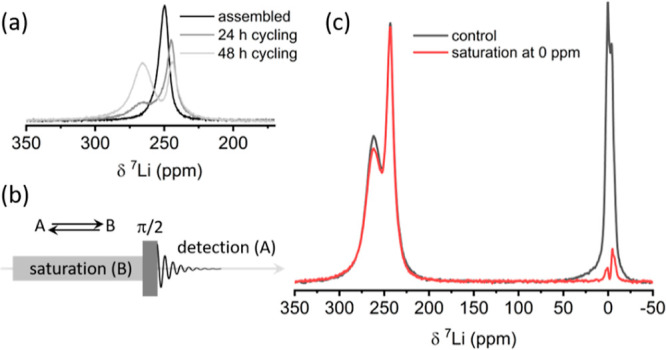
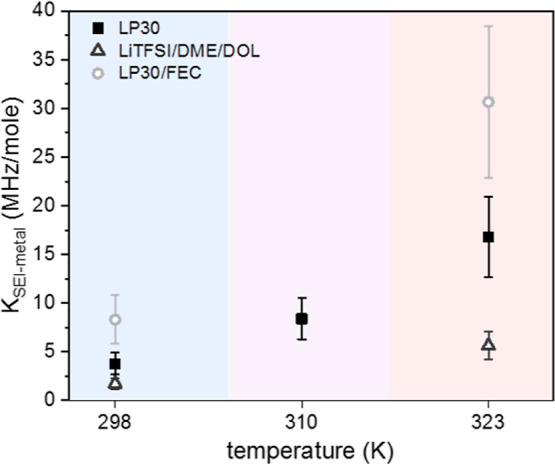
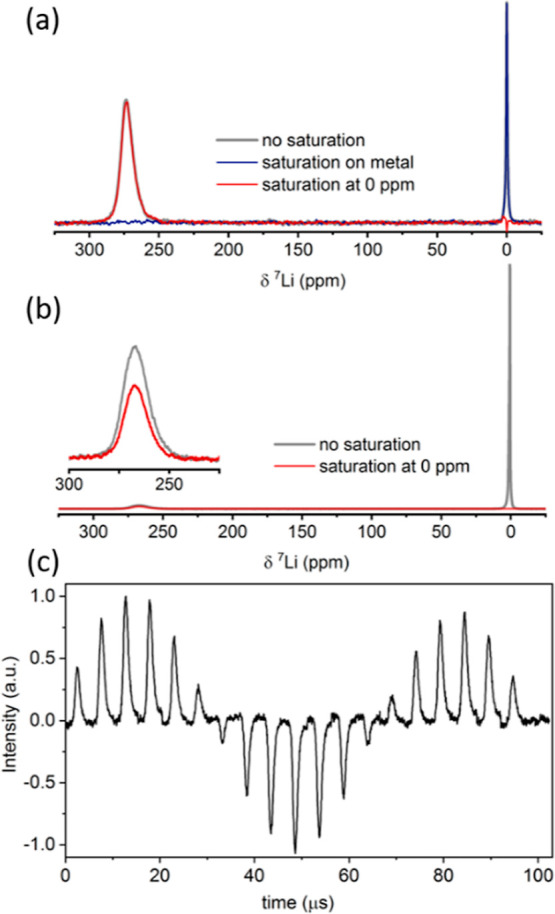
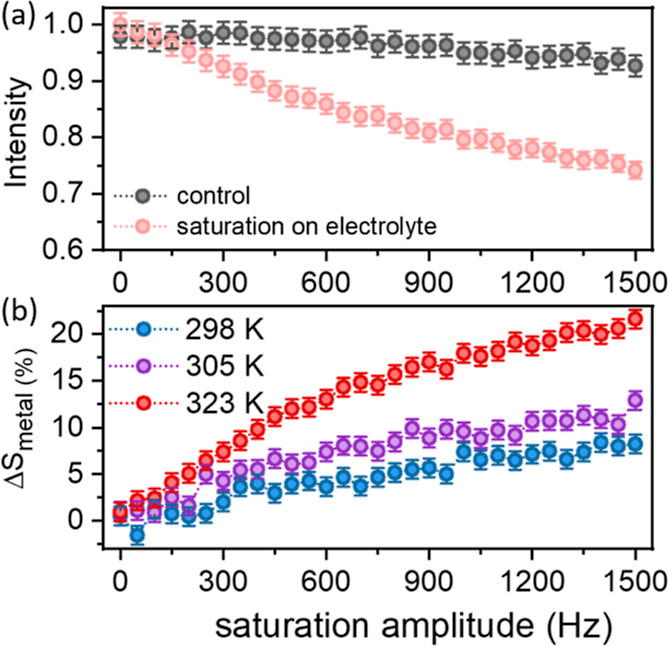
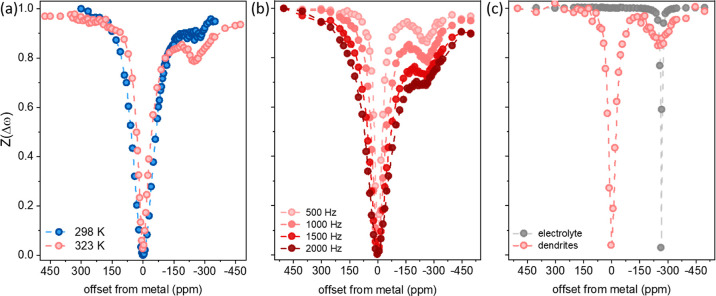
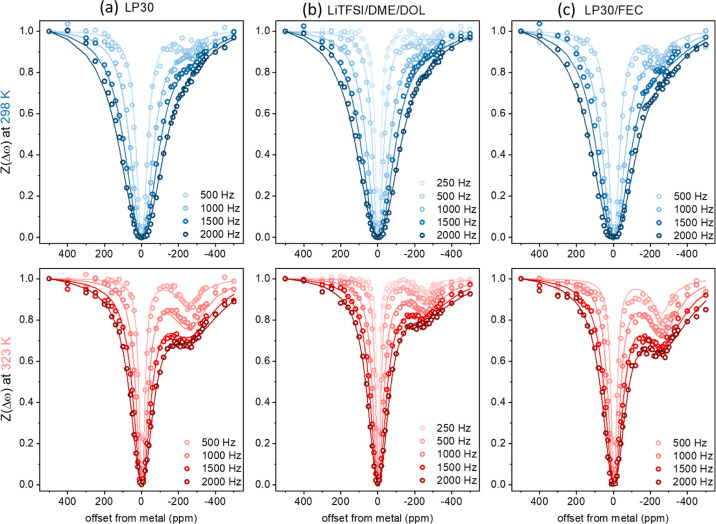
Lithium metal anodes offer a huge leap in the energy density of batteries, yet their implementation is limited by solid electrolyte interphase (SEI) formation and dendrite deposition. A key challenge in developing electrolytes leading to the SEI with beneficial properties is the lack of experimental approaches for directly probing the ionic permeability of the SEI. Here, we introduce lithium chemical exchange saturation transfer (Li-CEST) as an efficient nuclear magnetic resonance (NMR) approach for detecting the otherwise invisible process of Li exchange across the metal-SEI interface. In Li-CEST, the properties of the undetectable SEI are encoded in the NMR signal of the metal resonance through their exchange process. We benefit from the high surface area of lithium dendrites and are able, for the first time, to detect exchange across solid phases through CEST. Analytical Bloch-McConnell models allow us to compare the SEI permeability formed in different electrolytes, making the presented Li-CEST approach a powerful tool for designing electrolytes for metal-based batteries.
金属锂电池在电池能量密度方面有了巨大飞跃,但它们的应用受到固体电解质界面(SEI)形成和枝晶沉积的限制。在开发具有有益特性的电解质以形成 SEI 的过程中,面临的一个关键挑战是缺乏直接探测 SEI 离子渗透性的实验方法。在这里,我们引入锂化学交换饱和转移(Li-CEST)作为一种有效的核磁共振(NMR)方法,用于检测金属-SEI 界面上不可见的锂交换过程。在 Li-CEST 中,不可检测的 SEI 的特性通过其交换过程被编码在金属共振的 NMR 信号中。我们受益于锂枝晶的高表面积,并且能够首次通过 CEST 检测固相之间的交换。分析性 Bloch-McConnell 模型使我们能够比较不同电解质中形成的 SEI 渗透性,从而使所提出的 Li-CEST 方法成为设计基于金属电池电解质的有力工具。