Department of Cardiology, Manisa City Hospital, Manisa, Turkey.
Manisa Celal Bayar University Medical Faculty, Department of Cardiology, Manisa, Turkey.
Am J Emerg Med. 2022 Aug;58:66-72. doi: 10.1016/j.ajem.2022.05.034. Epub 2022 May 25.
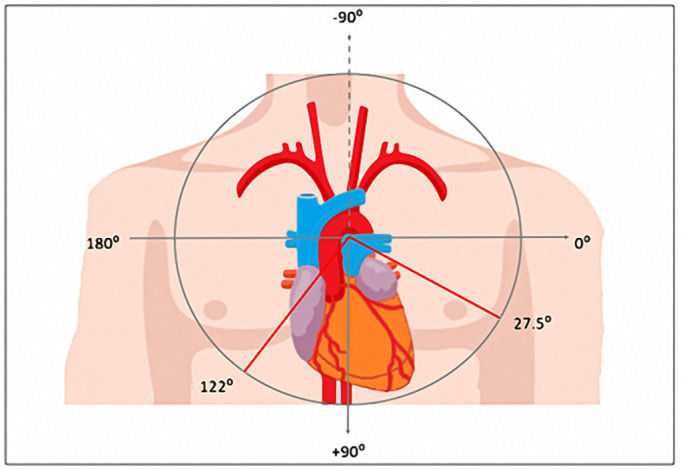
The frontal QRS-T (fQRS) angle has been investigated in the general population, including healthy people and patients with heart failure. The fQRS angle can predict mortality due to myocarditis, ischaemic and non-ischaemic cardiomyopathies, idiopathic dilated cardiomyopathy, and chronic heart failure in the general population. Moreover, no studies to date have investigated fQRS angle in coronavirus disease 2019 (COVID-19) patients. Thus, the purpose of this retrospective multicentre study was to evaluate the fQRS angle of COVID-19 patients to predict in-hospital mortality and the need for mechanical ventilation.
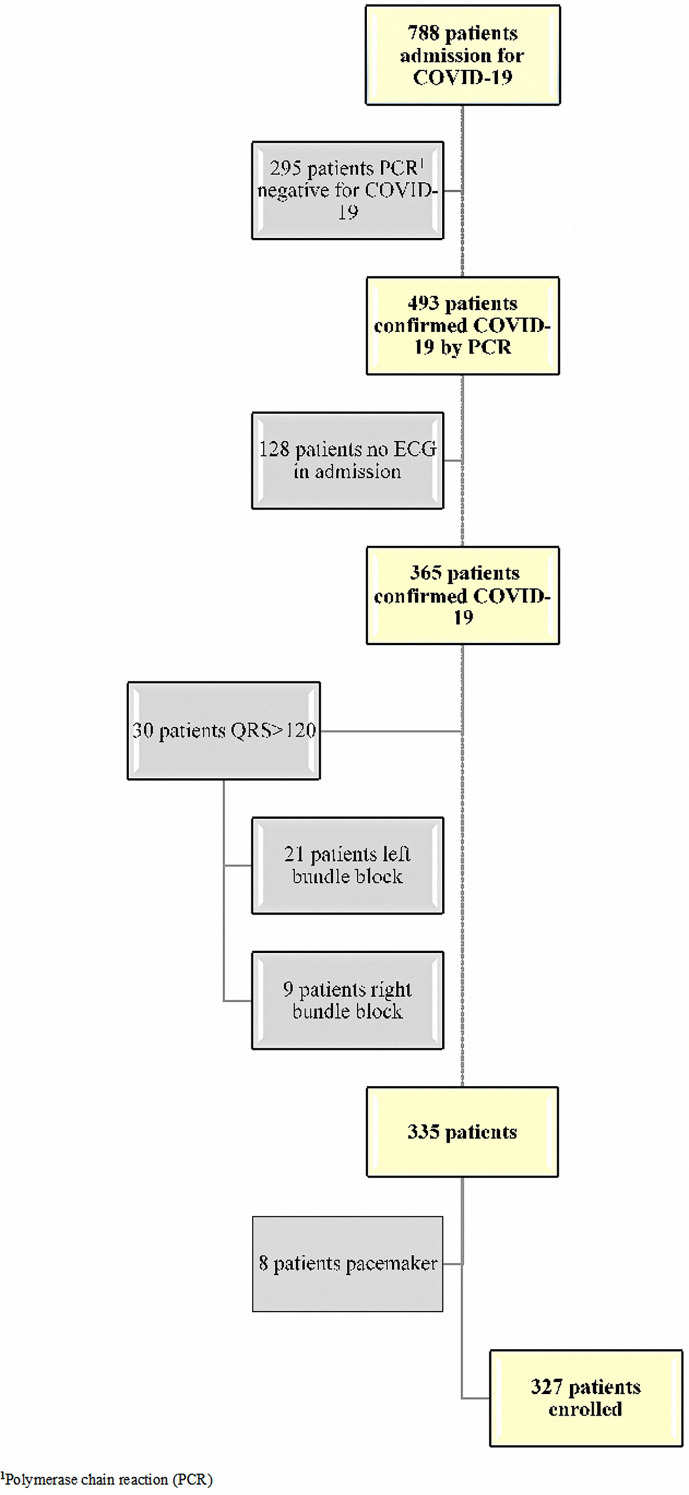
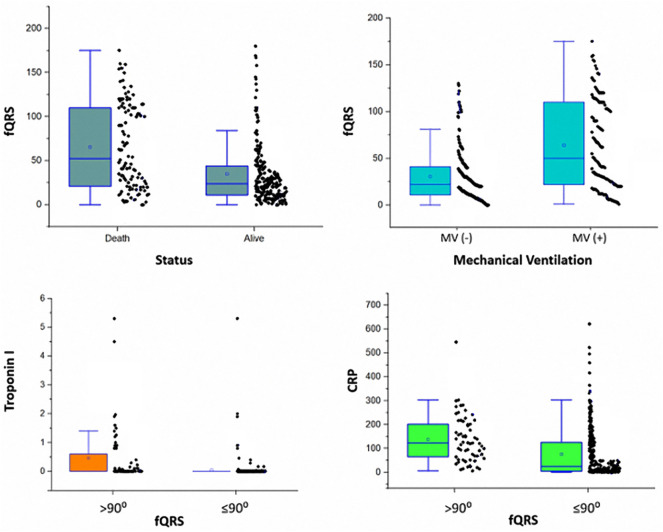
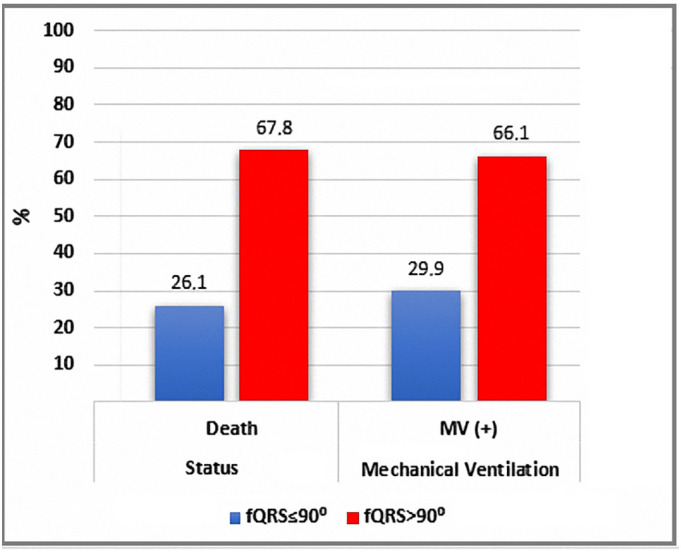
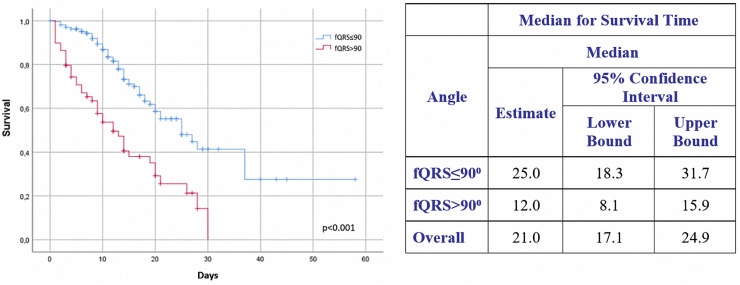
An electrocardiogram was performed for 327 COVID-19 patients during admission, and the fQRS angle was calculated. Mechanical ventilation was needed in 119 patients; of them, 110 died in the hospital. The patients were divided into two groups according to an fQRs angle >90° versus an fQRS angle ≤90°. The percentages of mortality and the need for mechanical ventilation according to fQRS angle were 67.8% and 66.1%, respectively, in the fQRs >90° group and 26.1% and 29.9% in the fQRS ≤90°group. Heart rate, oxygen saturation, fQRS angle, estimated glomerular filtration rate, and C-reactive protein level were predictors of mortality on the multivariable analysis. The mortality risk increased 2.9-fold on the univariate analysis and 1.6-fold on the multivariate analysis for the fQRS >90° patient group versus the fQRS ≤90° group.
In conclusion, a wide fQRS angle >90° was a predictor of in-hospital mortality and associated with the need for mechanical ventilation among COVID-19 patients.
额面 QRS-T(fQRS)角已在普通人群中进行了研究,包括健康人群和心力衰竭患者。fQRS 角可预测心肌炎、缺血性和非缺血性心肌病、特发性扩张型心肌病以及普通人群中慢性心力衰竭患者的死亡率。此外,迄今为止,尚无研究调查过 2019 年冠状病毒病(COVID-19)患者的 fQRS 角。因此,本回顾性多中心研究的目的是评估 COVID-19 患者的 fQRS 角,以预测住院死亡率和机械通气的需求。
对 327 例 COVID-19 患者入院时进行心电图检查,并计算 fQRS 角。119 例患者需要机械通气;其中 110 例患者在医院死亡。根据 fQRS 角>90°与 fQRS 角≤90°,将患者分为两组。fQRS 角>90°组的死亡率和机械通气需求百分比分别为 67.8%和 66.1%,fQRS 角≤90°组分别为 26.1%和 29.9%。多变量分析显示,心率、氧饱和度、fQRS 角、估计肾小球滤过率和 C 反应蛋白水平是死亡率的预测因素。在单变量分析中,fQRS 角>90°组的死亡风险增加 2.9 倍,在多变量分析中,fQRS 角>90°组的死亡风险增加 1.6 倍。
总之,宽 fQRS 角>90°是 COVID-19 患者住院死亡率的预测指标,并与机械通气需求相关。