Department of Neurology, Medical University of Vienna, Währinger Guertel 18-20, Vienna 1090, Austria.
Department of Neurology, Medical University of Vienna, Währinger Guertel 18-20, Vienna 1090, Austria.
Mult Scler Relat Disord. 2022 Jul;63:103912. doi: 10.1016/j.msard.2022.103912. Epub 2022 May 23.
Social distancing measures during the Covid-19 pandemic reduced access to health care and concerns were raised over the safety of immunosuppressive disease modifying treatments (DMT) for multiple sclerosis (MS).
To investigate changes in DMT prescription before and during the pandemic in a large and well-characterized real-world cohort of MS patients.
From the Vienna MS database (VMSD) we extracted MS patients who were initiated on a new DMT (both treatment-naïve and switching) between January 1st 2017 and December 31st 2021. Two time periods were defined: 1) the preCovid-19 era (January 1st 2017 to March 15th 2020, i.e. the day of the first lockdown in Austria) and the Covid-19 era (March 16th 2020 to December 31st 2021). Average annualized DMT prescription rates were descriptively compared between the two periods.
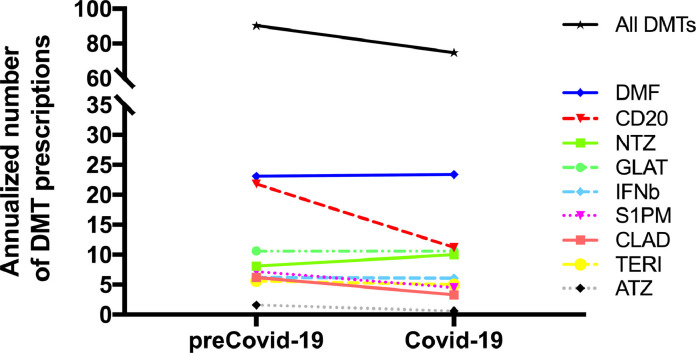
The average annualized number of prescriptions in the preCovid-19 era was 90.3/year and dropped to 74.8/year (-17.2%) in the Covid-19 era, driven by a marked reduction to 41.7/year (-54%) in the first nine months of the Covid-19 era, partly offset by a rise to 101 in 2021. Use of alemtuzumab (-64%), antiCD20 (-49%), cladribine (-46%), and S1PM (-38%) was reduced, while natalizumab increased by 24%. Lower efficacy treatments remained stable.
The pandemic coincides with a drop in DMT prescription, most markedly for immunosuppressive high-efficacy treatments, strongly suggesting the pandemic as the causal factor. If and how much this affects long-term outcome is yet to be determined.
在 COVID-19 大流行期间实施的社交距离措施减少了人们获得医疗保健的机会,人们对多发性硬化症(MS)的免疫抑制性疾病修正治疗(DMT)的安全性表示担忧。
在一个大型且特征明确的 MS 患者真实世界队列中,调查大流行前后 DMT 处方的变化。
我们从维也纳 MS 数据库(VMSD)中提取了 2017 年 1 月 1 日至 2021 年 12 月 31 日期间新开始使用 DMT(包括治疗初治和转换)的 MS 患者。定义了两个时间段:1)新冠前时期(2017 年 1 月 1 日至 2020 年 3 月 15 日,即奥地利首次封锁的那一天)和新冠时期(2020 年 3 月 16 日至 2021 年 12 月 31 日)。在这两个时期之间,描述性地比较了平均年化 DMT 处方率。
新冠前时期的平均年化处方数为 90.3/年,在新冠时期降至 74.8/年(-17.2%),主要是由于新冠时期的前九个月处方数降至 41.7/年(-54%),部分被 2021 年的 101 张处方所抵消。阿仑单抗(-64%)、抗 CD20(-49%)、克拉屈滨(-46%)和 S1PM(-38%)的使用率下降,而那他珠单抗增加了 24%。疗效较低的治疗方法保持稳定。
大流行恰逢 DMT 处方减少,免疫抑制性高效治疗方法的降幅最大,强烈表明大流行是导致这一结果的原因。这将如何以及在多大程度上影响长期结果还有待确定。