Division of Biological Sciences, University of Missourigrid.134936.a-Columbia, Columbia, Missouri, USA.
Laboratory for Molecular Infection Medicine, Department of Molecular Biology, Umeå University, Umeå, Sweden.
Appl Environ Microbiol. 2022 Jun 28;88(12):e0033322. doi: 10.1128/aem.00333-22. Epub 2022 May 31.
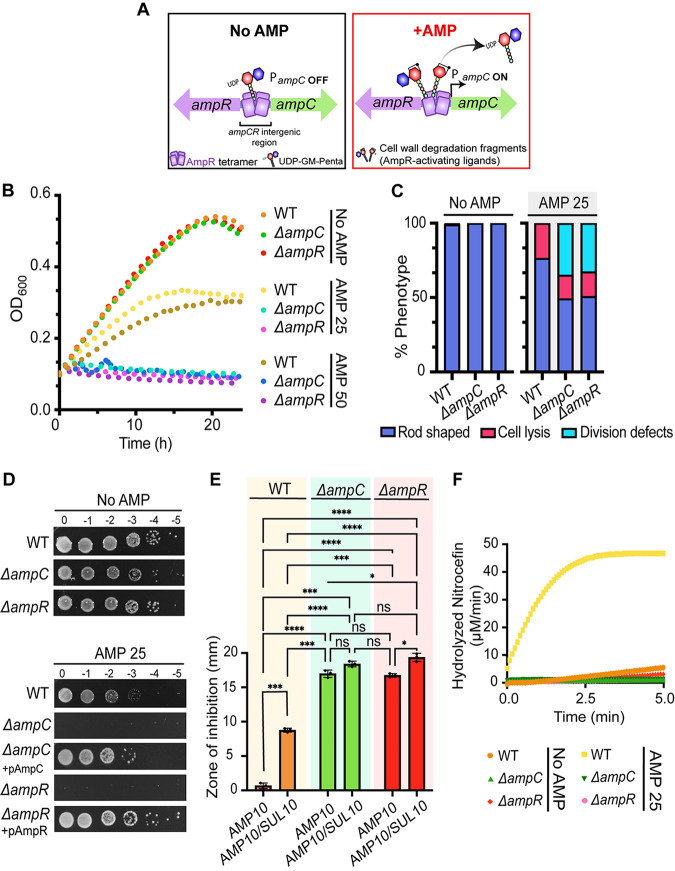
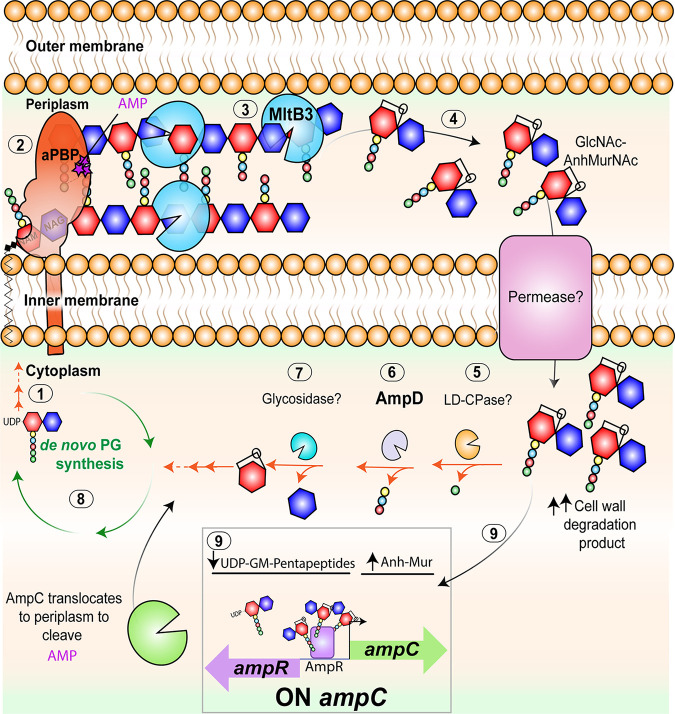
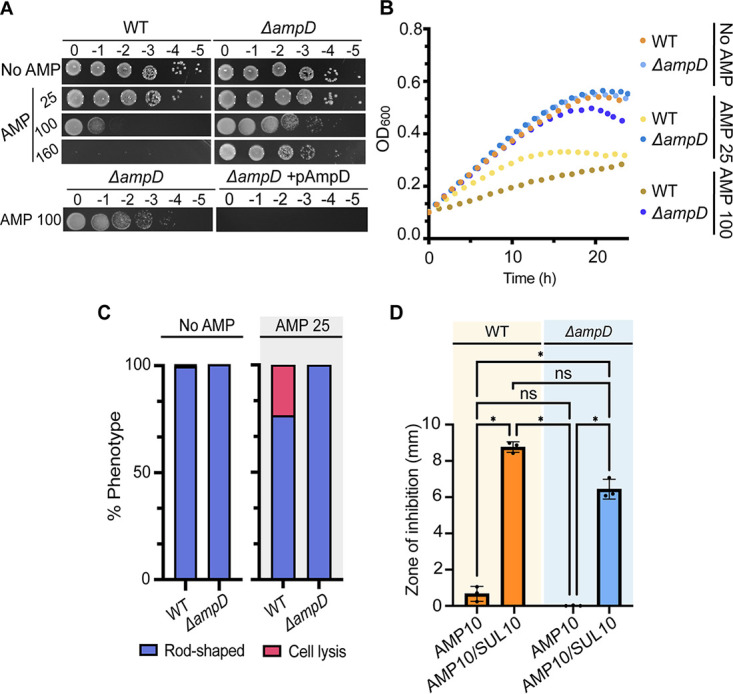
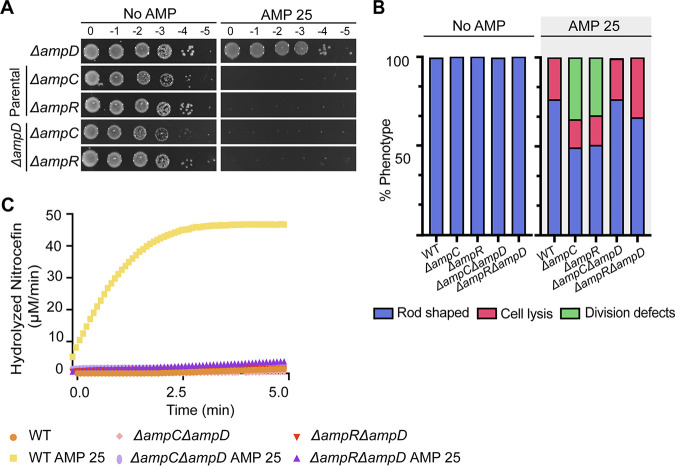
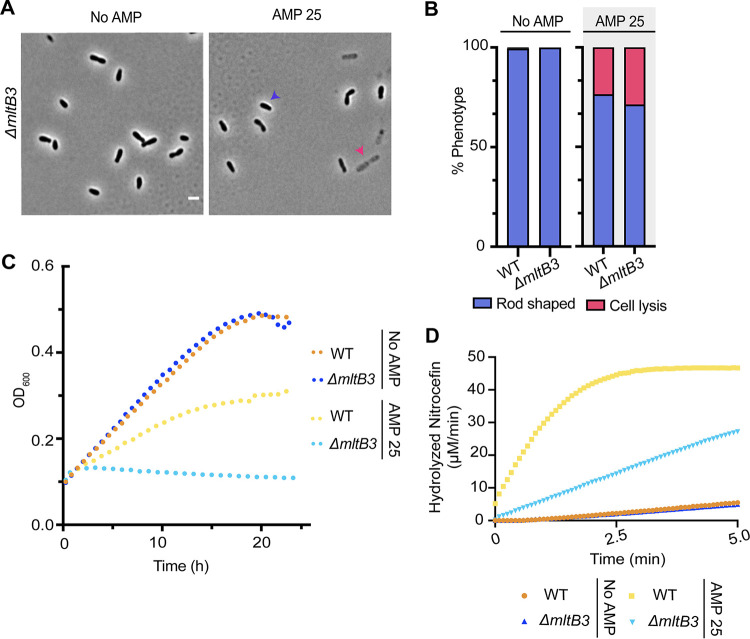
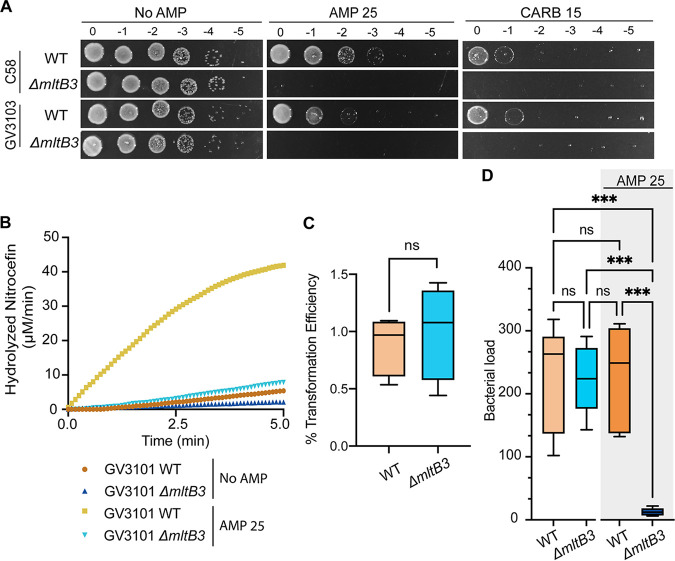
The remarkable ability of Agrobacterium tumefaciens to transfer DNA to plant cells has allowed the generation of important transgenic crops. One challenge of A. tumefaciens-mediated transformation is eliminating the bacteria after plant transformation to prevent detrimental effects to plants and the release of engineered bacteria to the environment. Here, we use a reverse-genetics approach to identify genes involved in ampicillin resistance, with the goal of utilizing these antibiotic-sensitive strains for plant transformations. We show that treating A. tumefaciens C58 with ampicillin led to increased β-lactamase production, a response dependent on the broad-spectrum β-lactamase AmpC and its transcription factor, AmpR. Loss of the putative orthologue led to constitutive production of AmpC-dependent β-lactamase activity and ampicillin resistance. Finally, one cell wall remodeling enzyme, MltB3, was necessary for the AmpC-dependent β-lactamase activity, and its loss elicited ampicillin and carbenicillin sensitivity in the A. tumefaciens C58 and GV3101 strains. Furthermore, GV3101 Δ transforms plants with efficiency comparable to that of the wild type but can be cleared with sublethal concentrations of ampicillin. The functional characterization of the genes involved in the inducible ampicillin resistance pathway of A. tumefaciens constitutes a major step forward in efforts to reduce the intrinsic antibiotic resistance of this bacterium. Agrobacterium tumefaciens, a significant biotechnological tool for production of transgenic plant lines, is highly resistant to a wide variety of antibiotics, posing challenges for various applications. One challenge is the efficient elimination of A. tumefaciens from transformed plant tissue without using levels of antibiotics that are toxic to the plants. Here, we present the functional characterization of genes involved in β-lactam resistance in A. tumefaciens. Knowledge about proteins that promote or inhibit β-lactam resistance will enable the development of strains to improve the efficiency of mediated plant genetic transformations. Effective removal of from transformed plant tissue has the potential to maximize crop yield and food production, improving the outlook for global food security.
根癌农杆菌将 DNA 高效转移至植物细胞的能力使其成为重要的转基因作物生产工具。然而,根癌农杆菌介导的转化存在一个挑战,即需要在植物转化后消除细菌,以防止其对植物产生有害影响,并避免工程菌释放到环境中。在这里,我们采用反向遗传学方法鉴定了与氨苄青霉素抗性相关的基因,旨在利用这些抗生素敏感菌株进行植物转化。我们发现,用氨苄青霉素处理根癌农杆菌 C58 会导致β-内酰胺酶产量增加,这种反应依赖于广谱β-内酰胺酶 AmpC 及其转录因子 AmpR。缺失假定的同源物导致 AmpC 依赖性β-内酰胺酶活性和氨苄青霉素抗性的组成型产生。最后,一种细胞壁重塑酶 MltB3 对于 AmpC 依赖性β-内酰胺酶活性是必需的,其缺失会使根癌农杆菌 C58 和 GV3101 菌株对氨苄青霉素和卡那青霉素敏感。此外,GV3101Δ菌株转化植物的效率与野生型相当,但可以用亚致死浓度的氨苄青霉素清除。根癌农杆菌诱导型氨苄青霉素抗性途径相关基因的功能表征,是减少该细菌固有抗生素抗性的重要一步。根癌农杆菌是生产转基因植物品系的重要生物技术工具,对多种抗生素具有高度抗性,这给各种应用带来了挑战。其中一个挑战是在不使用对植物有毒的抗生素水平的情况下,从转化的植物组织中有效去除根癌农杆菌。在这里,我们对根癌农杆菌中参与β-内酰胺抗性的基因进行了功能表征。了解促进或抑制β-内酰胺抗性的蛋白质将使我们能够开发菌株来提高介导植物遗传转化的效率。从转化的植物组织中有效去除根癌农杆菌有可能最大限度地提高作物产量和粮食产量,从而改善全球粮食安全前景。