Clinical Epidemiology Unit, School of Medicine, Makerere University College of Health Sciences, Kampala, Uganda.
Department of Obstetrics and Gynecology, School of Medicine, Makerere University College of Health Sciences, Kampala, Uganda.
PLoS One. 2022 May 31;17(5):e0267015. doi: 10.1371/journal.pone.0267015. eCollection 2022.
Perinatal mortality remains high globally and remains an important indicator of the quality of a health care system. To reduce this mortality, it is important to provide the recommended care during the perinatal period. We assessed the prevalence and factors associated with appropriate perinatal care (antenatal, intrapartum, and postpartum) in Bunyoro region, Uganda. Results from this study provide valuable information on the perinatal care services and highlight areas of improvement for better perinatal outcomes.
A cross sectional survey was conducted among postpartum mothers attending care at three district hospitals in Bunyoro. Following consent, a questionnaire was administered to capture the participants' demographics and data on care received was extracted from their antenatal, labour, delivery, and postpartum records using a pre-tested structured tool. The care received by women was assessed against the standard protocol established by World Health Organization (WHO). Poisson regression with robust standard errors was used to assess factors associated with appropriate postpartum care.
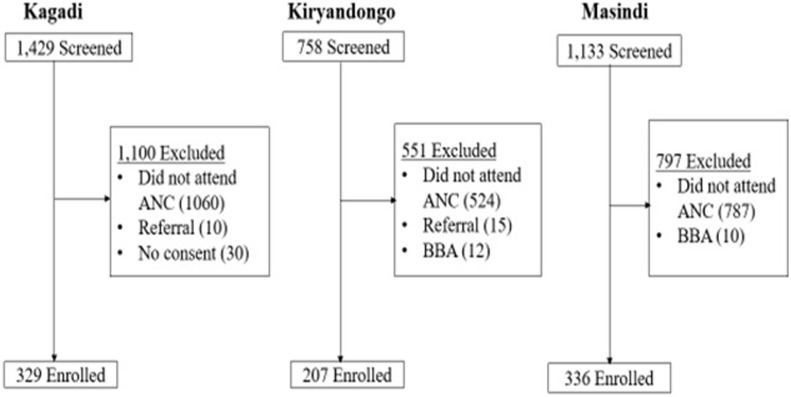
A total of 872 mothers receiving care at the participating hospitals between March and June 2020 were enrolled in the study. The mean age of the mothers was 25 years (SD = 5.95). None of the mothers received appropriate antenatal or intrapartum care, and only 3.8% of the participants received appropriate postpartum care. Factors significantly associated with appropriate postpartum care included mothers being >35 years of age (adjusted prevalence ratio [aPR] = 11.9, 95% confidence interval [CI] 2.8-51.4) and parity, with low parity (2-3) and multiparous (>3) mothers less likely to receive appropriate care than prime gravidas (aPR = 0.3, 95% CI 0.1-0.9 and aPR = 0.3, 95% CI 0.1-0.8 respectively).
Antenatal, intrapartum, and postpartum care received by mothers in this region remains below the standard recommended by WHO, and innovative strategies across the continuum of perinatal care need to be devised to prevent mortality among the mothers. The quality of care also needs to be balanced for all mothers irrespective of the age and parity.
全球围产期死亡率仍然很高,仍是医疗保健系统质量的重要指标。为降低这一死亡率,重要的是在围产期提供建议的护理。我们评估了乌干达布尼奥罗地区适当围产期保健(产前、产时和产后)的流行情况和相关因素。这项研究的结果提供了有关围产期保健服务的宝贵信息,并突出了改善围产期结局的改进领域。
在布尼奥罗地区的 3 家区医院对产后母亲进行了横断面调查。在征得同意后,向参与者发放了一份问卷,以获取他们的人口统计学信息和他们在产前、分娩、分娩和产后记录中获得的护理数据,使用经过预测试的结构化工具。妇女获得的护理是根据世界卫生组织(WHO)制定的标准方案进行评估的。使用稳健标准误差的泊松回归来评估与适当产后护理相关的因素。
共有 2020 年 3 月至 6 月期间在参与医院接受护理的 872 名母亲参加了这项研究。母亲的平均年龄为 25 岁(SD=5.95)。没有母亲接受过适当的产前或产时护理,只有 3.8%的参与者接受过适当的产后护理。与适当产后护理显著相关的因素包括年龄>35 岁的母亲(调整后患病率比[aPR]为 11.9,95%置信区间[CI]为 2.8-51.4)和生育次数,低生育次数(2-3)和多产(>3)母亲比初产妇接受适当护理的可能性更小(aPR=0.3,95%CI 0.1-0.9 和 aPR=0.3,95%CI 0.1-0.8)。
该地区母亲接受的产前、产时和产后护理仍低于世卫组织建议的标准,需要在围产期护理的连续体上制定创新战略,以防止母亲死亡。还需要平衡所有母亲的护理质量,而不论其年龄和生育次数如何。