Alexander Silberman Institute of Life Science, Hebrew University of Jerusalem, Jerusalem 9190401, Israel.
Rachel and Selim Benin School of Computer Science, Hebrew University of Jerusalem, Jerusalem 9190401, Israel.
Nucleic Acids Res. 2022 Jun 10;50(10):5864-5880. doi: 10.1093/nar/gkac411.
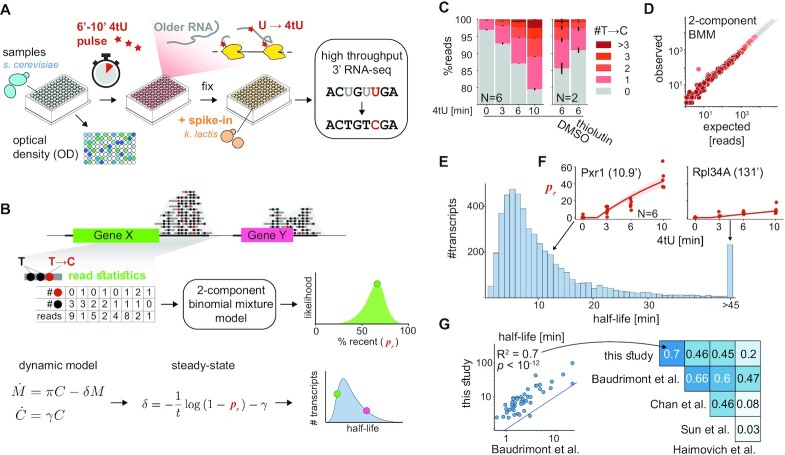
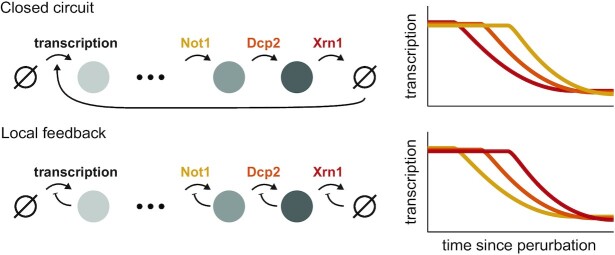
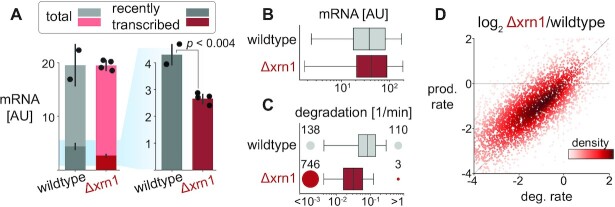
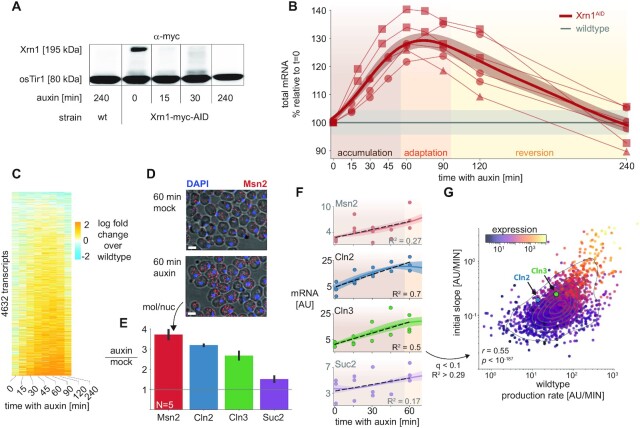
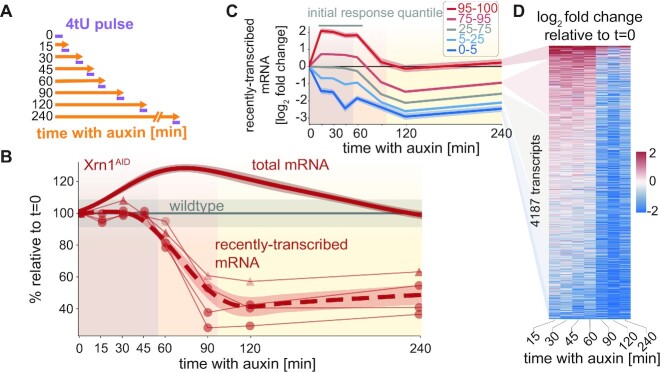
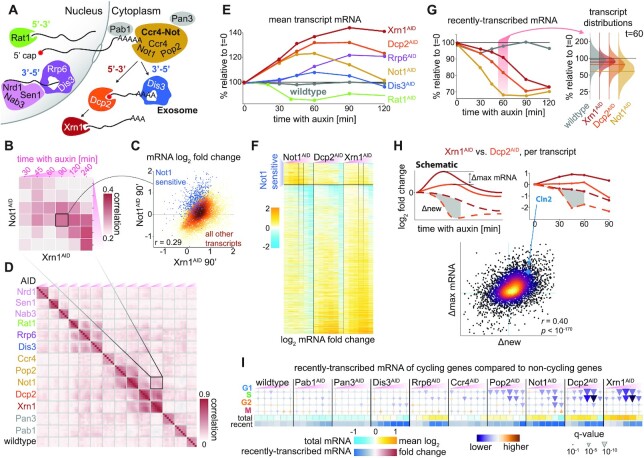
In the last decade, multiple studies demonstrated that cells maintain a balance of mRNA production and degradation, but the mechanisms by which cells implement this balance remain unknown. Here, we monitored cells' total and recently-transcribed mRNA profiles immediately following an acute depletion of Xrn1-the main 5'-3' mRNA exonuclease-which was previously implicated in balancing mRNA levels. We captured the detailed dynamics of the adaptation to rapid degradation of Xrn1 and observed a significant accumulation of mRNA, followed by a delayed global reduction in transcription and a gradual return to baseline mRNA levels. We found that this transcriptional response is not unique to Xrn1 depletion; rather, it is induced earlier when upstream factors in the 5'-3' degradation pathway are perturbed. Our data suggest that the mRNA feedback mechanism monitors the accumulation of inputs to the 5'-3' exonucleolytic pathway rather than its outputs.
在过去的十年中,多项研究表明细胞维持 mRNA 产生和降解的平衡,但细胞实施这种平衡的机制尚不清楚。在这里,我们在急性耗尽 Xrn1(主要的 5'-3' mRNA 外切核酸酶)后立即监测细胞的总 mRNA 和最近转录的 mRNA 谱,Xrn1 先前被认为参与平衡 mRNA 水平。我们捕捉到了快速降解 Xrn1 适应的详细动态,并观察到 mRNA 的大量积累,随后转录的全局延迟减少和逐渐恢复到基线 mRNA 水平。我们发现,这种转录反应并非 Xrn1 耗竭所特有;相反,当 5'-3' 降解途径中的上游因素受到干扰时,它会更早地被诱导。我们的数据表明,mRNA 反馈机制监测 5'-3' 外切核酸酶途径输入的积累,而不是其输出。