Stark Anna Lea, Krayter Stephan, Dockweiler Christoph
Department Digital Health Sciences and Biomedicine, School of Life Sciences, University of Siegen, Siegen, Germany.
Digit Health. 2023 Dec 11;9:20552076231218841. doi: 10.1177/20552076231218841. eCollection 2023 Jan-Dec.
Telerehabilitation offers patients alternative access to therapy and has become more prominent during the COVID-19 pandemic. Despite the increasing attractiveness of such programs, there are research gaps regarding the required competencies in the demand-oriented technology use in rehabilitative care.
The study aims at collecting evidence on competencies required by patients and health professionals for using telerehabilitation. We analyse tasks and requirements associated with telerehabilitation and derive and systematise relevant competencies.
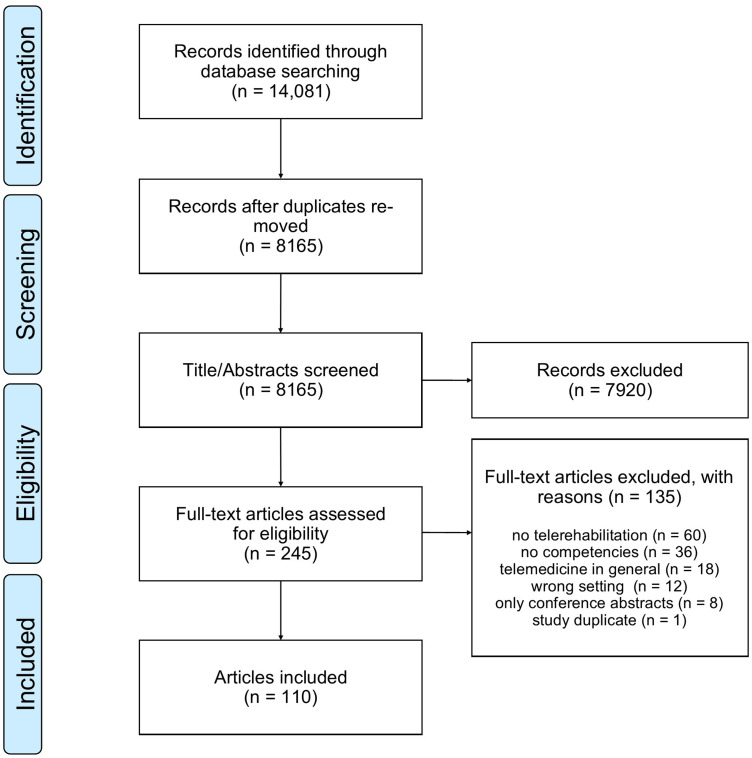
We conducted a scoping review and analysed MEDLINE, Psyndex, EMBASE, Cochrane Library, and Web of Science for empirical studies and grey literature from 2017 to May 2022. Articles had to be in English/German and refer to medical rehabilitation accompanied by health professionals taking place in the patient's home.
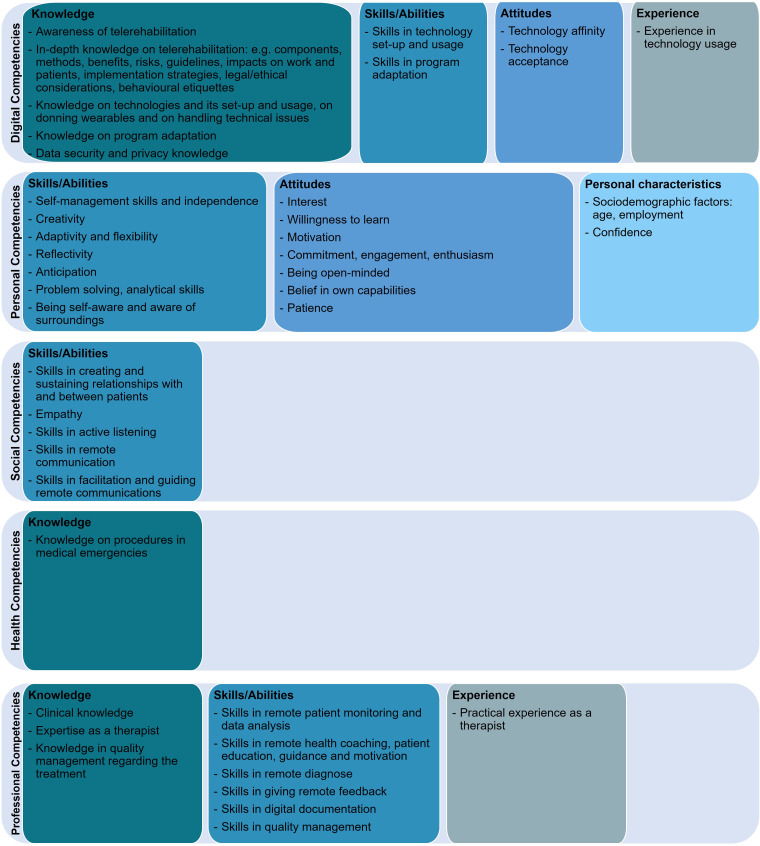
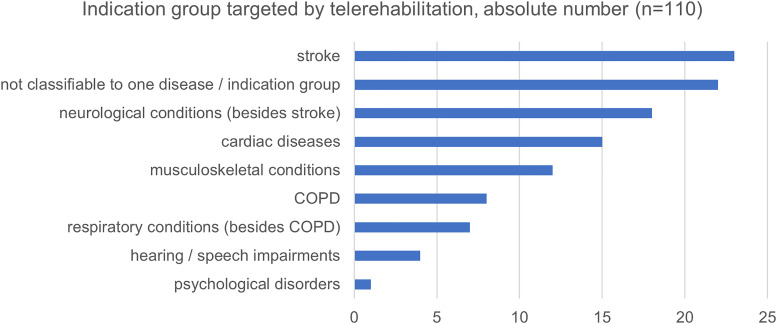
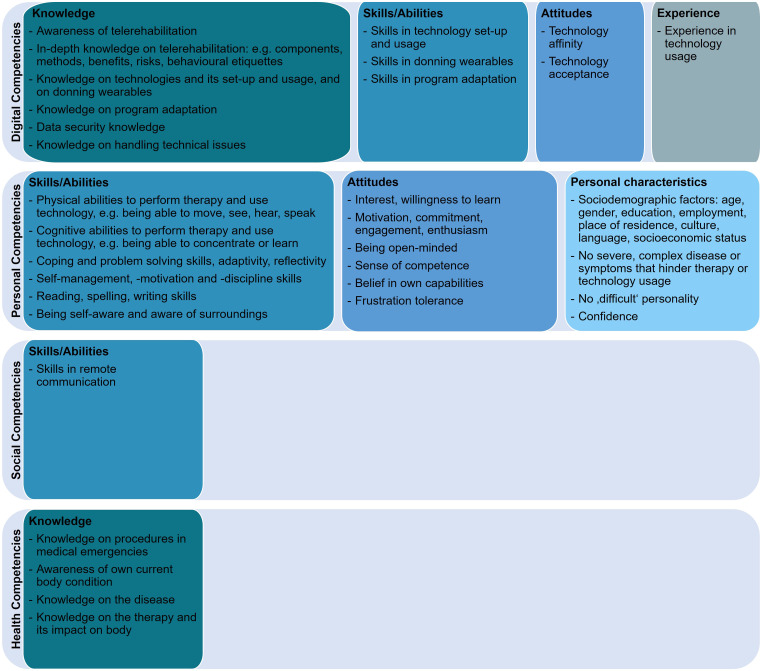
One hundred ten articles were included, covering video conferencing systems, applications with video, audio, or visual therapy content, or wearables. Depending on the program, tasks before, during, and after therapy sessions differ, as do whether these are performed by health professionals, patients, or the technology. Users need digital, health-related, social, personal, and health professionals also professional competencies. This comprises telerehabilitation, technical, health-related, and clinical knowledge, a range of physical, cognitive, social-interactive, technical, and clinical skills, a positive attitude towards telerehabilitation and experience. Whether sociodemographic factors promote successful use is unclear.
Telerehabilitation requires a variety of different competencies from patients and health professionals - going beyond the sphere of technical skills. This highlights the need for an evaluation of existing programs for promoting competencies in the use of telerehabilitation and refinement of the programs in line with demands.
远程康复为患者提供了获得治疗的替代途径,并且在新冠疫情期间变得更加突出。尽管此类项目越来越有吸引力,但在康复护理中以需求为导向的技术使用所需的能力方面仍存在研究空白。
本研究旨在收集患者和卫生专业人员使用远程康复所需能力的证据。我们分析与远程康复相关的任务和要求,并推导和系统化相关能力。
我们进行了一项范围综述,分析了MEDLINE、Psyndex、EMBASE、Cochrane图书馆和科学网2017年至2022年5月的实证研究和灰色文献。文章必须为英文/德文,且涉及在患者家中由卫生专业人员提供的医学康复。
纳入了110篇文章,涵盖视频会议系统、包含视频、音频或视觉治疗内容的应用程序或可穿戴设备。根据项目的不同,治疗前、治疗期间和治疗后的任务也有所不同,这些任务是由卫生专业人员、患者还是技术来执行也有所不同。用户需要具备数字、健康相关、社交、个人能力,卫生专业人员还需要具备专业能力。这包括远程康复、技术、健康相关和临床知识,一系列身体、认知、社交互动、技术和临床技能,对远程康复的积极态度和经验。社会人口统计学因素是否促进成功使用尚不清楚。
远程康复要求患者和卫生专业人员具备多种不同的能力——超出技术技能范畴。这凸显了有必要对现有项目进行评估,以提升远程康复使用能力,并根据需求对项目进行完善。