Horinouchi Takayuki, Watanabe Tatsunori, Matsumoto Takuya, Yunoki Keisuke, Kuwabara Takayuki, Ito Kanami, Ishida Haruki, Kirimoto Hikari
Department of Sensorimotor Neuroscience, Graduate School of Biomedical and Health Sciences, Hiroshima University, Hiroshima, Japan.
Faculty of Health Sciences, Aomori University of Health and Welfare, Aomori, Japan.
Heliyon. 2022 May 20;8(5):e09469. doi: 10.1016/j.heliyon.2022.e09469. eCollection 2022 May.
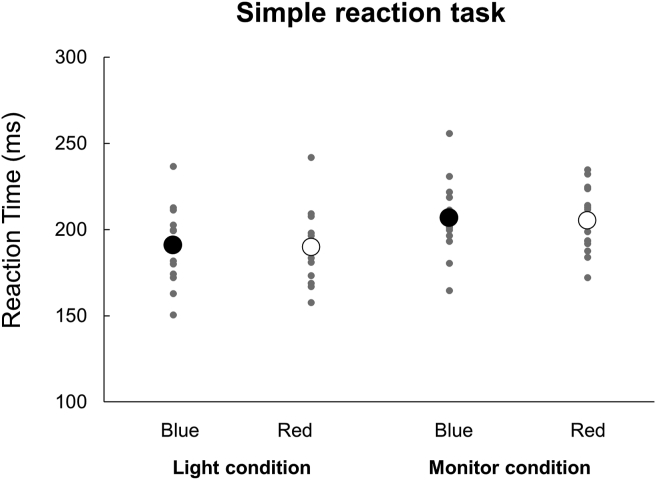
Prior knowledge of color, such as traffic rules (blue/green and red mean "go" and "stop" respectively), can influence reaction times (RTs). Specifically, in a Go/No-go task, where signals were presented by a light-emitting diode (LED) lighting device, RT has been reported to be longer when responding to a red signal and withholding the response to a blue signal (Red Go/Blue No-go task) than when responding to a blue signal and withholding the response to a red signal (Blue Go/Red No-go task). In recent years, a driving simulator has been shown to be effective in evaluation and training of driving skills of dementia and stroke patients. However, it is unknown whether the change in RT observed with the LED lighting device can be replicated with a monitor presenting signals that are different from the real traffic lights in terms of depth and texture. The purpose of this study was to elucidate whether a difference in visual modality (LED and monitor) influences the effect of prior knowledge of color on RTs. Fifteen participants performed a simple reaction task (Blue and Red signals), a Blue Go/Red No-go task, and a Red Go/Blue No-go task. Signals were presented from an LED lighting device (Light condition) and a liquid crystal display (LCD) monitor (Monitor condition). The results showed that there was no significant difference in simple RT by signal color in both conditions. In the Go/No-go task, there was a significant interaction between the type of signal presentation device and the color of signal. Although the RT was significantly longer in the Red Go/Blue No-go than Blue Go/Red No-go task in the Light condition, there was no significant difference in RT between the Blue Go/Red No-go and Red Go/Blue No-go tasks in the Monitor condition. It is interpreted that blue and red signals presented from the LCD monitor were insufficient to evoke a perception of traffic lights as compared to the LED. This study suggests that a difference in the presentation modality (LED and monitor) of visual information can influence the level of object perception and consequently the effect of prior knowledge on behavioral responses.
对颜色的先验知识,如交通规则(蓝色/绿色和红色分别表示“通行”和“停止”),会影响反应时间(RTs)。具体而言,在一个“是/否”任务中,信号由发光二极管(LED)照明设备呈现,据报道,对红色信号做出反应并抑制对蓝色信号的反应(红色通行/蓝色禁止任务)时的反应时间,比在对蓝色信号做出反应并抑制对红色信号的反应(蓝色通行/红色禁止任务)时更长。近年来,驾驶模拟器已被证明在评估和训练痴呆症和中风患者的驾驶技能方面是有效的。然而,尚不清楚用LED照明设备观察到的反应时间变化,是否能用在深度和纹理方面与真实交通信号灯不同的显示器呈现信号时复制出来。本研究的目的是阐明视觉模态(LED和显示器)的差异是否会影响颜色先验知识对反应时间的作用。15名参与者进行了简单反应任务(蓝色和红色信号)、蓝色通行/红色禁止任务以及红色通行/蓝色禁止任务。信号由LED照明设备(灯光条件)和液晶显示器(LCD)呈现(显示器条件)。结果表明,在两种条件下,简单反应时间在信号颜色方面均无显著差异。在“是/否”任务中,信号呈现设备类型与信号颜色之间存在显著交互作用。虽然在灯光条件下,红色通行/蓝色禁止任务中的反应时间显著长于蓝色通行/红色禁止任务,但在显示器条件下,蓝色通行/红色禁止任务与红色通行/蓝色禁止任务之间的反应时间无显著差异。这被解释为,与LED相比,从LCD显示器呈现的蓝色和红色信号不足以唤起对交通信号灯的感知。本研究表明,视觉信息呈现模态(LED和显示器)的差异会影响物体感知水平,进而影响先验知识对行为反应的作用。