Ruggiero Fernando M, Springer Sebastian
School of Science, Jacobs University Bremen, Campus Ring 1, D-28759, Bremen, Germany.
Curr Res Immunol. 2022 May 23;3:85-99. doi: 10.1016/j.crimmu.2022.05.001. eCollection 2022.
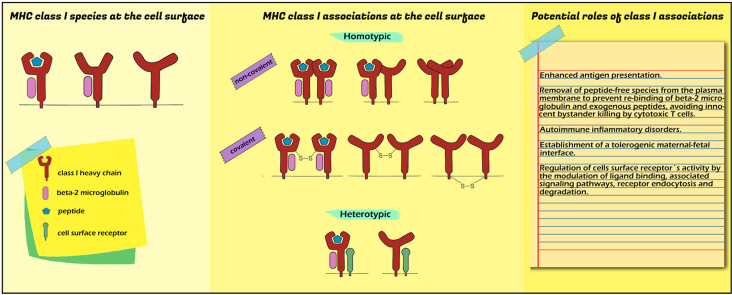
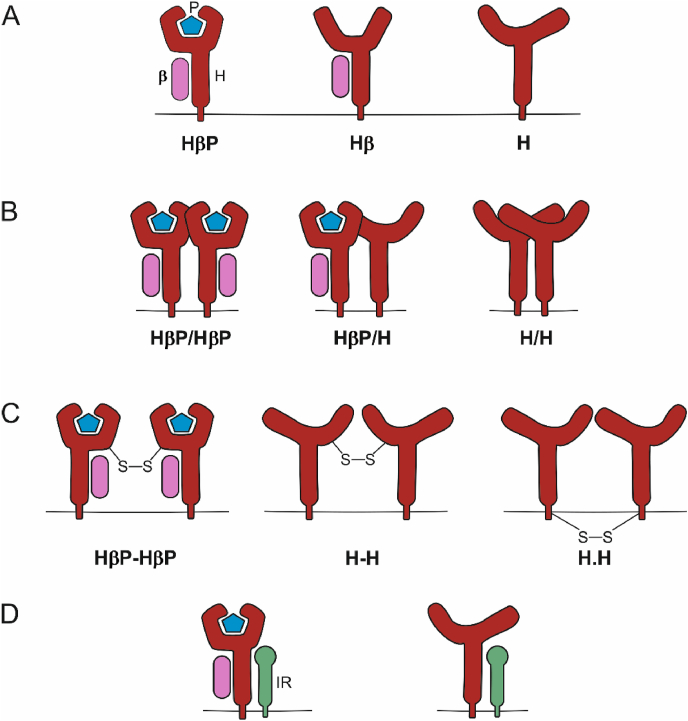
Through the presentation of peptide antigens to cytotoxic T lymphocytes, major histocompatibility complex (MHC) class I molecules mediate the adaptive immune response against tumors and viruses. Additional non-immunological functions include the heterotypic association of class I molecules with cell surface receptors, regulating their activities by unknown mechanisms. Also, homotypic associations resulting in class I dimers and oligomers - of unknown function - have been related to pathological outcomes. In this review, we provide an overview of the current knowledge about the occurrence, biochemical nature, and dynamics of homotypic and heterotypic associations of class I molecules at the cell surface with special focus on the molecular species that take part in the complexes and on the evidence that supports novel biological roles for class I molecules. We show that both heterotypic and homotypic class I associations reported in the literature describe not one but several kinds of oligomers with distinctive stoichiometry and biochemical properties.
通过将肽抗原呈递给细胞毒性T淋巴细胞,主要组织相容性复合体(MHC)I类分子介导针对肿瘤和病毒的适应性免疫反应。其他非免疫功能包括I类分子与细胞表面受体的异型缔合,通过未知机制调节其活性。此外,导致I类二聚体和寡聚体(功能未知)的同型缔合与病理结果有关。在这篇综述中,我们概述了目前关于I类分子在细胞表面同型和异型缔合的发生、生化性质和动力学的知识,特别关注参与复合物的分子种类以及支持I类分子新生物学作用的证据。我们表明,文献中报道的异型和同型I类缔合描述的不是一种而是几种具有独特化学计量和生化特性的寡聚体。