Department of Clinical and Molecular Medicine, Sant'Andrea Hospital, Sapienza University of Rome, Rome, Italy.
Department of Neurosciences, Mental Health & Sensory Organs (NESMOS), Sapienza University of Rome, Rome, Italy.
Andrology. 2022 Sep;10(6):1023-1029. doi: 10.1111/andr.13199. Epub 2022 Jun 8.
The effects of an mRNA COVID-19 vaccine on spermatozoa parameters are not known. The aim of this study was to evaluate the effect of the BNT162b2 mRNA COVID-19 vaccine on human semen, comparing spermatozoa parameters before and after vaccine inoculation.
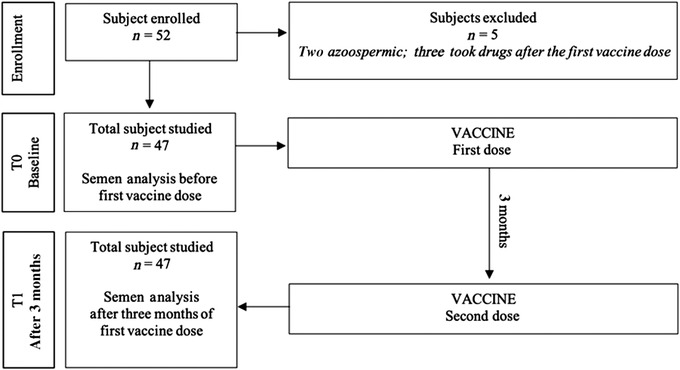
In this single-center prospective study, voluntary subjects who received mRNA vaccines from February to July 2021 were enrolled. The study population included male subjects aged between 18 and 45 years who completed the BNT162b2 mRNA COVID-19 vaccine cycle. All subjects were evaluated before the first dose of vaccine (T0) and after 3 months (T1) with semen analysis and further analysis of seminal plasma, including colorimetric determination of reactive oxygen metabolites (d-ROM test), electrolytes, and interleukin 6 (IL-6) assessment by enzyme-linked immunosorbent assay technology.
The experimental sample included 47 subjects (age: 29.3 ± 6.0 years, range 24-32; body mass index: 23.15 ± 2.5 kg/m , range 19.2-28.0). All the subjects reported no systemic side effects. No significant differences were observed in any spermatozoa parameter between T0 and T1. A subanalysis was performed in oligoazoospermic and asthenozoospermic subjects, confirming the same results. Electrolyte analysis also showed no significant differences before and after vaccine inoculation. Finally, no significant differences were observed in T0, compared to T1 for the d-ROM test and IL-6.
In this study, no significant differences in spermatozoa parameters before and after vaccine inoculations were found. Furthermore, oxidative stress analysis,, the activity of the cell membrane, and IL-6, as a marker of inflammation, was not affected by the mRNA COVID-19 vaccine. These results suggest that this vaccine is safe for male semen quality.
mRNA COVID-19 疫苗对精子参数的影响尚不清楚。本研究旨在评估 BNT162b2 mRNA COVID-19 疫苗对人类精液的影响,比较疫苗接种前后精子参数的变化。
在这项单中心前瞻性研究中,纳入了 2021 年 2 月至 7 月接种 mRNA 疫苗的志愿者。研究人群包括年龄在 18 至 45 岁之间、完成 BNT162b2 mRNA COVID-19 疫苗接种周期的男性受试者。所有受试者均在第一次疫苗接种前(T0)和 3 个月后(T1)进行精液分析,并进一步分析精液,包括比色法测定活性氧代谢物(d-ROM 试验)、电解质和白细胞介素 6(IL-6),采用酶联免疫吸附技术进行评估。
实验样本包括 47 名受试者(年龄:29.3±6.0 岁,范围 24-32;体重指数:23.15±2.5kg/m ,范围 19.2-28.0)。所有受试者均无全身副作用报告。T0 和 T1 之间的任何精子参数均无显著差异。在少精症和弱精症患者中进行了亚分析,结果相同。电解质分析也显示疫苗接种前后无显著差异。最后,与 T1 相比,T0 时 d-ROM 试验和 IL-6 也无显著差异。
在本研究中,疫苗接种前后精子参数无显著差异。此外,氧化应激分析、细胞膜活性和 IL-6(作为炎症标志物)不受 mRNA COVID-19 疫苗的影响。这些结果表明,该疫苗对男性精液质量是安全的。