Division of Basic and Clinical Immunology, Department of Medicine, University of California Irvine, Irvine, CA, 92697, USA.
Department of Radiation Oncology, University of California Irvine, Irvine, CA, 92697, USA.
Cell Mol Life Sci. 2022 Jun 1;79(6):331. doi: 10.1007/s00018-022-04347-6.
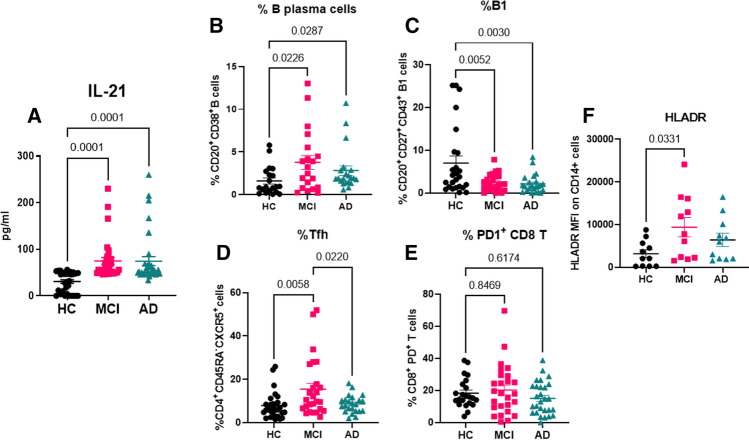
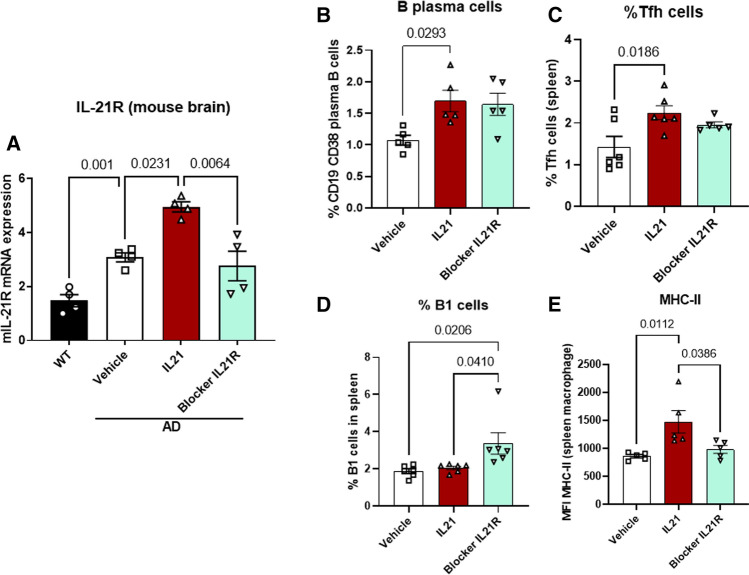
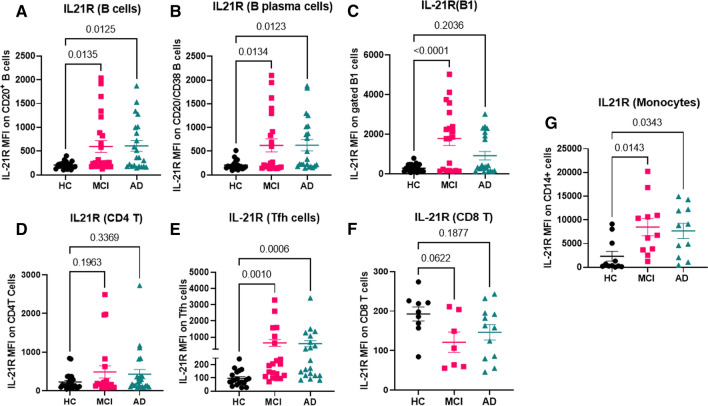
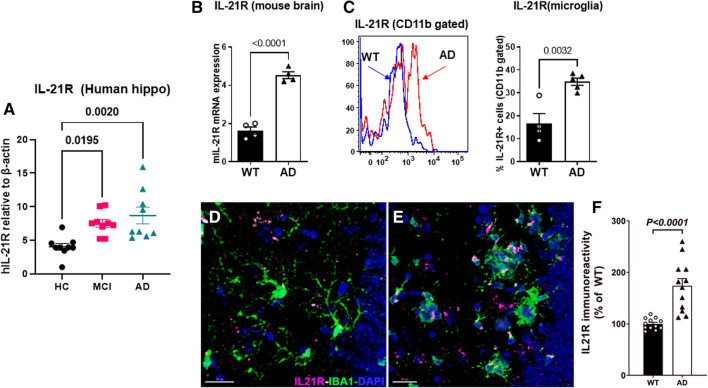
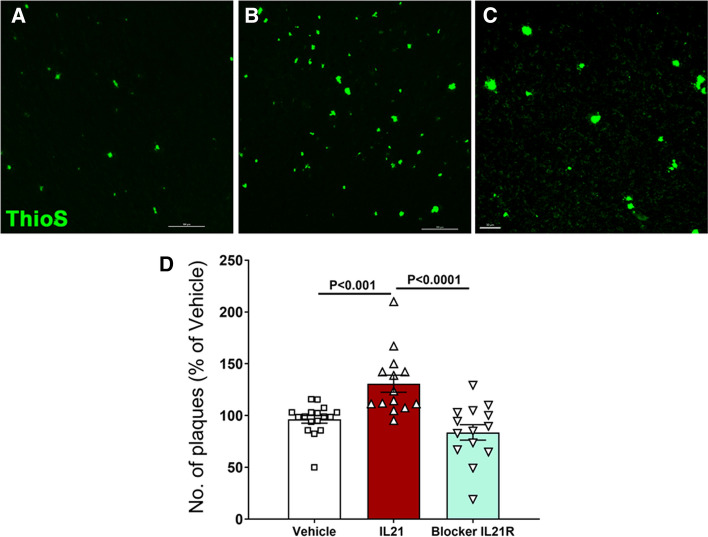
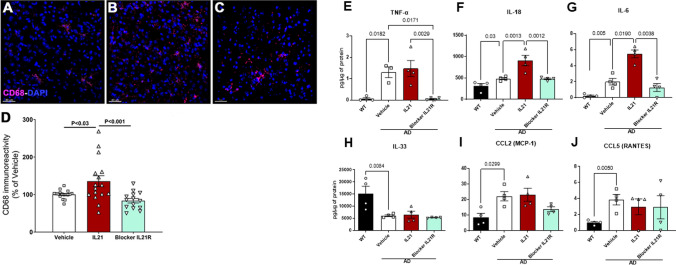
Alzheimer's disease (AD) is associated with dysregulated immune and inflammatory responses. Emerging evidence indicates that peripheral immune activation is linked to neuroinflammation and AD pathogenesis. The present study focuses on determining the role of IL-21 in the pathogenesis of AD using human samples and the 5xFAD mice model. We find that the levels of IL-21 are increased in the periphery of both humans and mice in AD. In addition, the proportions of IL-21 target cells, Tfh and B plasma cells as well as activation of monocytes is increased in PBMCs from AD and mild cognitively impaired (MCI) subjects as compared to age-matched controls, indicating immune activation. In contrast, the percentage of B1 cells that control inflammation is decreased. These changes are due to IL-21 as the expression of IL-21 receptor (IL-21R) is higher on all these cells in AD. Furthermore, treatment with recombinant IL-21 in AD mice also leads to similar alterations in Tfh, B, B1, and macrophages. The effect of IL-21 is not confined to the periphery since increased expression of IL-21R is also observed in both humans and mice hippocampus derived from the AD brains. In addition, mice injected with IL-21 display increased deposition of amyloid beta (Aβ) plaques in the brain which is reduced following anti-IL-21R antibody that blocks the IL-21 signaling. Moreover, activation of microglia was enhanced in IL-21-injected mice. In keeping with enhanced microglial activation, we also observed increased production of pro-inflammatory cytokines, IL-18 and IL-6 in IL-21-injected mice. The microglial activation and cytokines were both inhibited following IL-21R blockage. Altogether, IL-21 escalates AD pathology by enhancing peripheral and brain immune and inflammatory responses leading to increased Aβ plaque deposition. IL-21 impacts AD neuropathology by enhancing peripheral and neuronal immune activation, inflammation, and Aβ plaque deposition. Increased levels of IL-21 in the circulation of AD and MCI subjects enhances the proportions of Tfh and B plasma cells indicative of peripheral immune activation. On the other hand, the proportions of B1 cells that help reduce inflammation and clear Aβ are reduced. In addition to the periphery, IL-21 also acts on the brain via IL-21 receptor, IL-21R that displays increased expression in the hippocampi of AD and MCI subjects. IL-21 enhances the activation of microglia, induces the secretion of pro-inflammatory cytokines and deposition of Aβ plaques in the brain in AD.
阿尔茨海默病(AD)与失调的免疫和炎症反应有关。新出现的证据表明,外周免疫激活与神经炎症和 AD 发病机制有关。本研究旨在使用人类样本和 5xFAD 小鼠模型确定 IL-21 在 AD 发病机制中的作用。我们发现,AD 患者和小鼠的外周血中 IL-21 水平升高。此外,与年龄匹配的对照组相比,AD 和轻度认知障碍(MCI)患者的 PBMC 中 IL-21 靶细胞、滤泡辅助性 T 细胞(Tfh)和浆细胞以及单核细胞的激活比例增加,表明存在免疫激活。相反,控制炎症的 B1 细胞的比例减少。这些变化归因于 IL-21,因为 AD 患者的所有这些细胞上的 IL-21 受体(IL-21R)表达均升高。此外,在 AD 小鼠中用重组 IL-21 治疗也会导致 Tfh、B、B1 和巨噬细胞发生类似的改变。IL-21 的作用不仅局限于外周,因为从 AD 大脑来源的人和小鼠的海马体中也观察到 IL-21R 的表达增加。此外,注射 IL-21 的小鼠大脑中β淀粉样蛋白(Aβ)斑块的沉积增加,而阻断 IL-21 信号的抗 IL-21R 抗体可减少这种沉积。此外,在注射 IL-21 的小鼠中,小胶质细胞的激活增强。与增强的小胶质细胞激活一致,我们还观察到在注射 IL-21 的小鼠中促炎细胞因子 IL-18 和 IL-6 的产生增加。阻断 IL-21R 后,小胶质细胞的激活和细胞因子均受到抑制。总之,IL-21 通过增强外周和脑免疫和炎症反应,导致 Aβ 斑块沉积增加,从而加剧 AD 病理学。IL-21 通过增强外周和神经元免疫激活、炎症和 Aβ 斑块沉积来影响 AD 神经病理学。AD 和 MCI 患者循环中 IL-21 水平升高,增加了 Tfh 和浆细胞的比例,表明外周免疫激活。另一方面,有助于减少炎症和清除 Aβ 的 B1 细胞的比例减少。除了外周组织,IL-21 还通过 IL-21 受体(IL-21R)在 AD 和 MCI 患者的海马体中发挥作用,IL-21R 的表达增加。IL-21 增强小胶质细胞的激活,诱导促炎细胞因子的分泌,并在 AD 中导致大脑中 Aβ 斑块的沉积。