School of Pharmacy, University of Eastern Finland, Kuopio, Finland.
Aalto University, Helsinki, Finland.
PLoS One. 2022 Jun 1;17(6):e0269245. doi: 10.1371/journal.pone.0269245. eCollection 2022.
Treatments should be customized to patients to improve patients' health outcomes and maximize the treatment benefits. We aimed to identify meaningful data-driven trajectories of incident type 2 diabetes patients with similarities in glycated haemoglobin (HbA1c) patterns since diagnosis and to examine their clinical and economic relevance.
A cohort of 1540 patients diagnosed in 2011-2012 was retrieved from electronic health records covering primary and specialized healthcare in the North Karelia region, Finland. EHRs data were compiled with medication purchase data. Average HbA1c levels, use of medications, and incidence of micro- and macrovascular complications and deaths were measured annually for seven years since T2D diagnosis. Trajectories were identified applying latent class growth models. Differences in 4-year cumulative healthcare costs with 95% confidence intervals (CIs) were estimated with non-parametric bootstrapping.
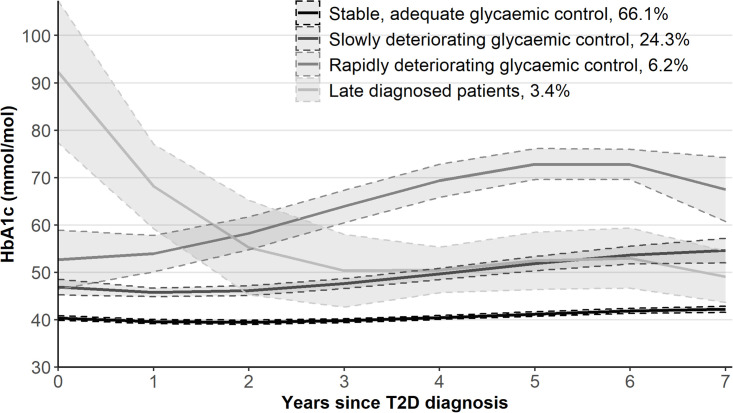
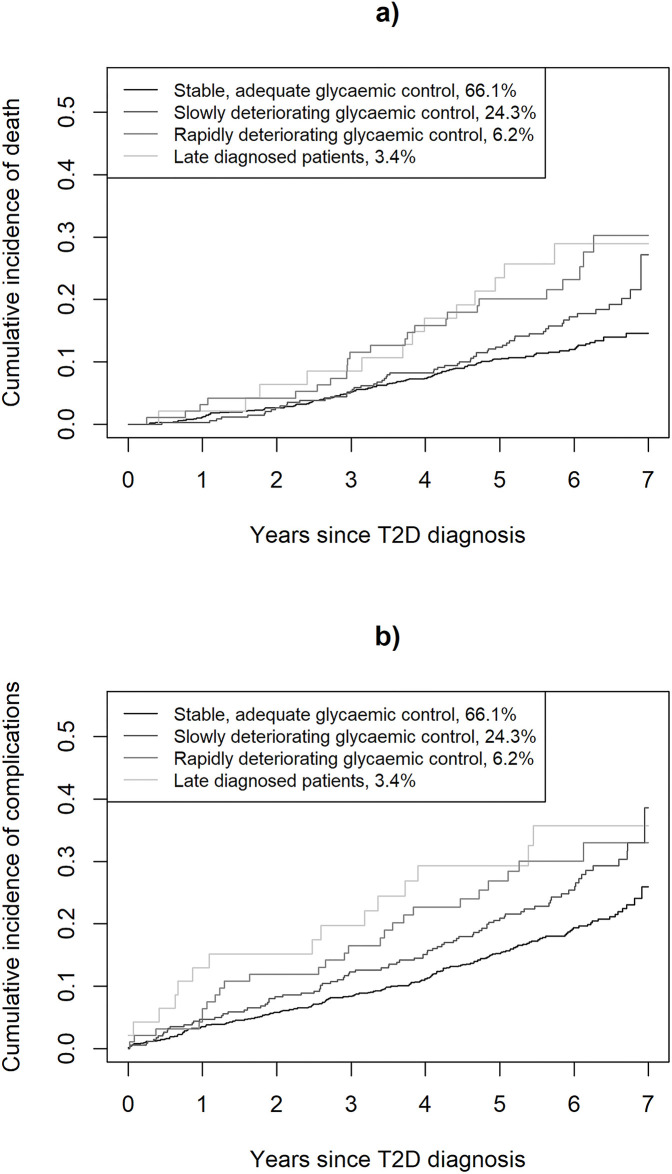
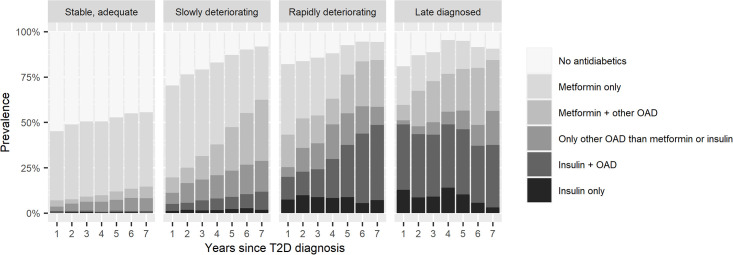
Four distinct trajectories of HbA1c development during 7 years after T2D diagnosis were extracted: patients with "Stable, adequate" (66.1%), "Slowly deteriorating" (24.3%), and "Rapidly deteriorating" glycaemic control (6.2%) as well as "Late diagnosed" patients (3.4%). During the same period, 2.2 (95% CI 1.9-2.6) deaths per 100 person-years occurred in the "Stable, adequate" trajectory increasing to 3.2 (2.4-4.0) in the "Slowly deteriorating", 4.7 (3.1-6.9) in the "Rapidly deteriorating" and 5.2 (2.9-8.7) in the "Late diagnosed" trajectory. Similarly, 3.5 (95% CI 3.0-4.0) micro- and macrovascular complications per 100 person-years occurred in the "Stable, adequate" trajectory increasing to 5.1 (4.1-6.2) in the "Slowly deteriorating", 5.5 (3.6-8.1) in the "Rapidly deteriorating" and 7.3 (4.3-11.8) in the "Late diagnosed" trajectory. Patients in the "Stable, adequate" trajectory had lower accumulated 4-year medication costs than other patients.
Data-driven patient trajectories have clinical and economic relevance and could be utilized as a step towards personalized medicine instead of the common "one-fits-for-all" treatment practices.
为了改善患者的健康结果并使治疗效益最大化,应该根据患者的情况定制治疗方案。我们的目的是确定有相似糖化血红蛋白(HbA1c)模式的 2 型糖尿病患者的有意义的、数据驱动的发病轨迹,并检验其临床和经济相关性。
从芬兰北卡累利阿地区的初级和专科医疗保健电子健康记录中检索了 2011-2012 年诊断的 1540 名患者的队列。EHR 数据与药物购买数据一起进行了编译。在 2 型糖尿病诊断后的 7 年内,每年测量平均 HbA1c 水平、药物使用情况以及微血管和大血管并发症和死亡的发生率。应用潜在类别增长模型确定轨迹。使用非参数自举法估计 4 年累积医疗保健费用的差异(95%置信区间[CI])。
从 2 型糖尿病诊断后 7 年内提取了 4 种不同的 HbA1c 发展轨迹:血糖控制“稳定、充足”(66.1%)、“缓慢恶化”(24.3%)和“快速恶化”(6.2%)以及“晚期诊断”患者(3.4%)。在此期间,“稳定、充足”轨迹中每 100 人年发生 2.2(95%CI 1.9-2.6)例死亡,“缓慢恶化”轨迹中增加到 3.2(2.4-4.0),“快速恶化”轨迹中增加到 4.7(3.1-6.9),“晚期诊断”轨迹中增加到 5.2(2.9-8.7)。同样,“稳定、充足”轨迹中每 100 人年发生 3.5(95%CI 3.0-4.0)例微血管和大血管并发症,“缓慢恶化”轨迹中增加到 5.1(4.1-6.2),“快速恶化”轨迹中增加到 5.5(3.6-8.1),“晚期诊断”轨迹中增加到 7.3(4.3-11.8)。“稳定、充足”轨迹的患者累计 4 年药物费用低于其他患者。
数据驱动的患者轨迹具有临床和经济相关性,可以作为迈向个性化医疗的一步,而不是常见的“一刀切”治疗方法。