Nordby Emilie S, Gjestad Rolf, Kenter Robin M F, Guribye Frode, Mukhiya Suresh K, Lundervold Astri J, Nordgreen Tine
Division of Psychiatry, Haukeland University Hospital, Bergen, Norway.
Department of Biological and Medical Psychology, Faculty of Psychology, University of Bergen, Bergen, Norway.
Front Digit Health. 2022 May 16;4:821031. doi: 10.3389/fdgth.2022.821031. eCollection 2022.
Self-guided Internet-delivered interventions may serve as an accessible and flexible non-pharmacological treatment supplement for adults with ADHD. However, these interventions are challenged by low adherence.
To examine whether weekly SMS reminders improve adherence to a self-guided Internet-delivered intervention for adults with ADHD.
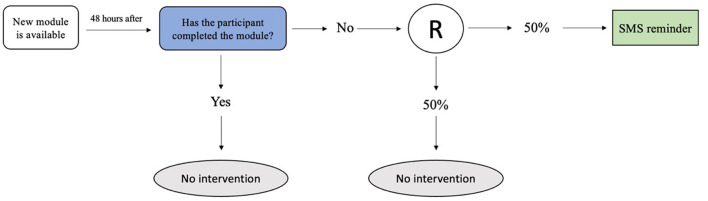
The study used a multiple randomized trial design where the participants who had not completed their weekly module within 2 days were randomized to either receive or not receive an SMS reminder. The primary outcome was adherence, defined as module completion, logins, time spent on intervention, and self-reported practice of coping strategies.
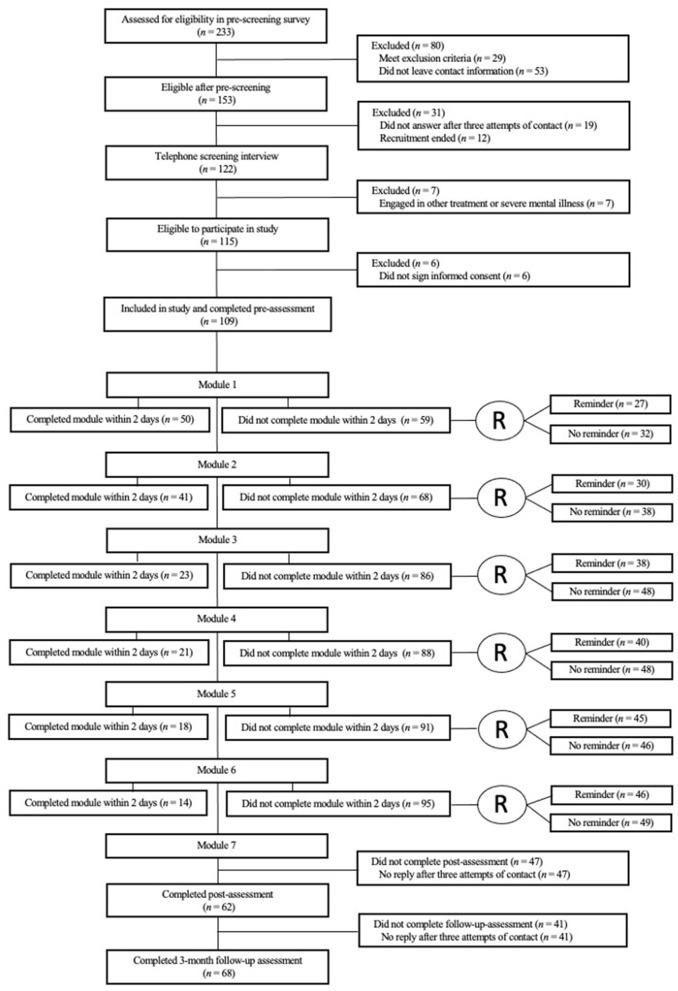
A total of 109 adults with a self-reported ADHD diagnosis were included in the study. The results showed that SMS reminders were associated with an increased likelihood of login within 48 h during the second module of the intervention, but not for the remaining modules. Moreover, receiving an SMS reminder was associated spending more time on the modules and faster login time in module three and five, specifically. However, the overall results did not show an effect of SMS reminders on module completion, number of logins or practice of coping strategies.
The results showed that SMS reminders do not improve number of logins, module completion rates or practice of coping strategies, but they may lead to faster login time and more time spent on the modules. To utilize the potential of self-guided Internet-delivered intervention in making non-pharmacological accessible for adults with ADHD, new methods to facilitate meaningful engagement should be developed and tested.
ClinicalTrials.gov NCT04511169.
自我引导的网络干预可能作为成人注意力缺陷多动障碍(ADHD)患者一种可及且灵活的非药物治疗补充方式。然而,这些干预措施面临着依从性低的挑战。
探讨每周短信提醒是否能提高成人ADHD患者对自我引导网络干预的依从性。
本研究采用多重随机试验设计,将在2天内未完成每周模块的参与者随机分为接受或不接受短信提醒两组。主要结局指标为依从性,定义为模块完成情况、登录次数、干预时长以及自我报告的应对策略实践情况。
共有109名自我报告患有ADHD的成年人纳入本研究。结果显示,短信提醒与干预第二个模块期间48小时内登录可能性增加相关,但对其余模块无此影响。此外,接受短信提醒尤其与在第三和第五个模块上花费更多时间以及更快登录时间相关。然而,总体结果并未显示短信提醒对模块完成、登录次数或应对策略实践有影响。
结果表明,短信提醒并不能提高登录次数、模块完成率或应对策略实践情况,但可能会使登录时间更快,且在模块上花费更多时间。为了利用自我引导网络干预的潜力,使ADHD成人患者能够获得非药物治疗,应开发并测试促进有效参与的新方法。
ClinicalTrials.gov NCT04511169