Geiger Martin Andreas, Flumignan Ronald Luiz Gomes, Sobreira Marcone Lima, Avelar Wagner Mauad, Fingerhut Carla, Stein Sokrates, Guillaumon Ana Terezinha
Division of Vascular Surgery, Department of Surgery, Universidade Estadual de Campinas-UNICAMP, São Paulo, Brazil.
Division of Vascular and Endovascular Surgery, Department of Surgery, Universidade Federal de São Paulo, São Paulo, Brazil.
Front Cardiovasc Med. 2022 May 16;9:885483. doi: 10.3389/fcvm.2022.885483. eCollection 2022.
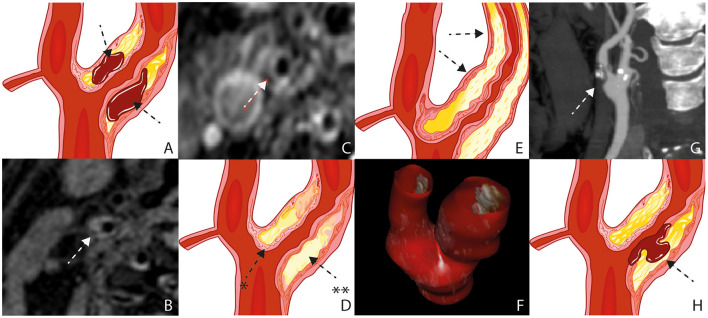
Luminal stenosis has been the standard feature for the current management strategies in patients with atherosclerotic carotid disease. Histological and imaging studies show considerable differences between plaques with identical degrees of stenosis. They indicate that specific plaque characteristics like Intraplaque hemorrhage, Lipid Rich Necrotic Core, Plaque Inflammation, Thickness and Ulceration are responsible for the increased risk of ischemic events. Intraplaque hemorrhage is defined by the accumulation of blood components within the plaque, Lipid Rich Necrotic Core is composed of macrophages loaded with lipid, Plaque Inflammation is defined as the process of atherosclerosis itself and Plaque thickness and Ulceration are defined as morphological features. Advances in imaging methods like Magnetic Resonance Imaging, Ultrasound, Computed Tomography and Positron Emission Tomography have enabled a more detailed characterization of the plaque, and its vulnerability is linked to these characteristics, changing the management of these patients based only on the degree of plaque stenosis. Studies like Rotterdam, ARIC, PARISK, CAPIAS and BIOVASC were essential to evaluate and prove the relevance of these characteristics with cerebrovascular symptoms. A better approach for the prevention of stroke is needed. This review summarizes the more frequent carotid plaque features and the available validation from recent studies with the latest evidence.
管腔狭窄一直是目前动脉粥样硬化性颈动脉疾病患者管理策略的标准特征。组织学和影像学研究表明,狭窄程度相同的斑块之间存在显著差异。这些研究表明,斑块内出血、富含脂质的坏死核心、斑块炎症、厚度和溃疡等特定斑块特征是缺血性事件风险增加的原因。斑块内出血定义为斑块内血液成分的积聚,富含脂质的坏死核心由充满脂质的巨噬细胞组成,斑块炎症定义为动脉粥样硬化本身的过程,斑块厚度和溃疡定义为形态学特征。磁共振成像、超声、计算机断层扫描和正电子发射断层扫描等成像方法的进展使得能够更详细地描述斑块特征,并且其易损性与这些特征相关联,这改变了仅基于斑块狭窄程度对这些患者的管理方式。鹿特丹研究、动脉粥样硬化风险社区研究、巴黎卒中风险研究、颈动脉斑块成像与卒中关联研究和生物血管研究等对于评估和证明这些特征与脑血管症状的相关性至关重要。需要一种更好的预防中风的方法。本综述总结了更常见的颈动脉斑块特征以及近期研究根据最新证据进行的有效验证。