College of Chemistry, State Key Laboratory of Elemento-Organic Chemistry, Nankai University, Tianjin, 300071, P. R. China.
Adv Sci (Weinh). 2022 Aug;9(22):e2201523. doi: 10.1002/advs.202201523. Epub 2022 Jun 2.
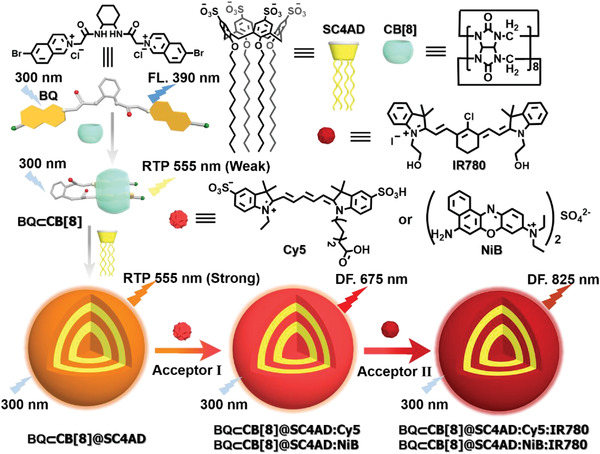
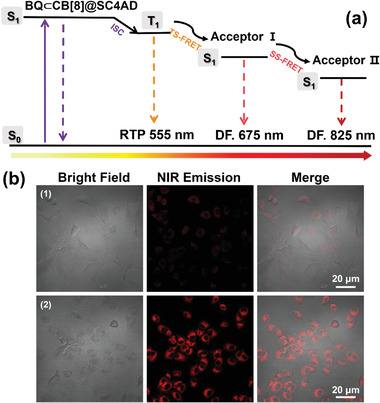
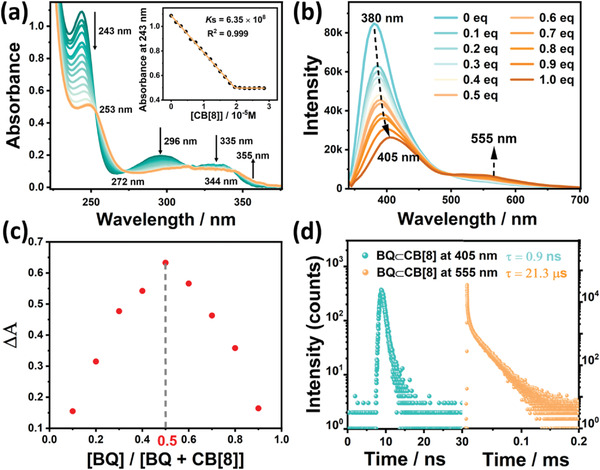
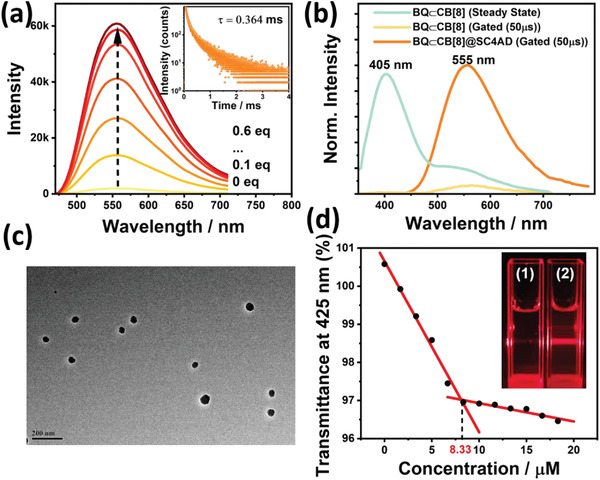
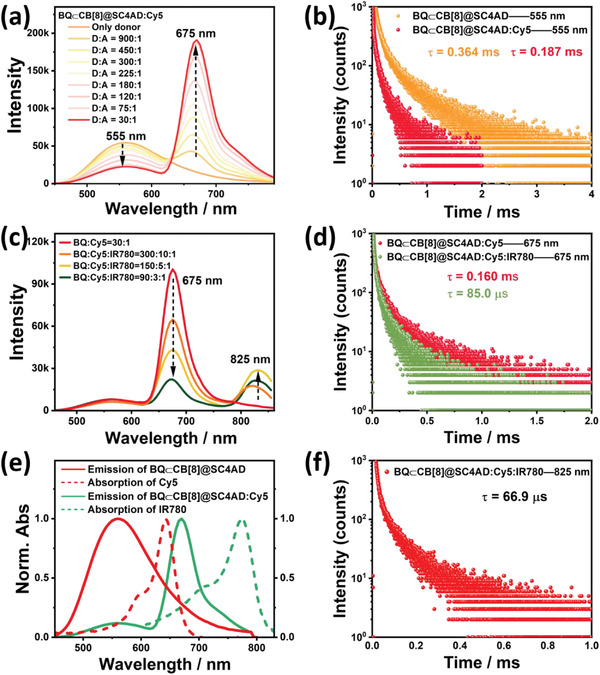
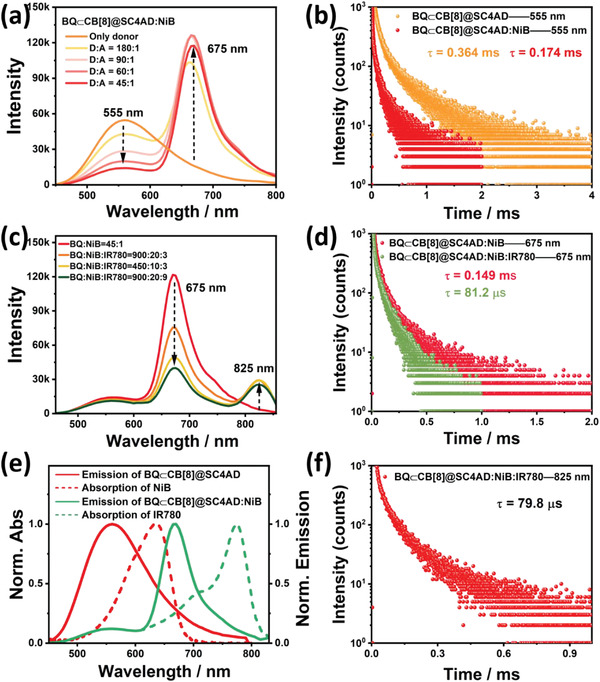
A two-step sequential phosphorescence harvesting system with ultralarge Stokes shift and near-infrared (NIR) emission at 825 nm is successfully constructed by racemic 1,2-diaminocyclohexan-derived 6-bromoisoquinoline (BQ), cucurbit[8]uril (CB[8]), and amphipathic sulfonatocalix[4]arene (SC4AD) via cascaded assembly strategy in aqueous solution. In virtue of the confinement effect of CB[8] with rigid cavity, BQ can generate an emerging phosphorescent emission at 555 nm. Subsequently, the binary BQ⊂CB[8] further assemblies with SC4AD to form close-packed spherical aggregate, which contributes to the dramatic enhancement of phosphorescence emission intensity ≈30 times with prolonged lifetime from 21.3 µs to 0.364 ms. Notably, the BQ⊂CB[8]@SC4AD assembly can serve as an energy donor to conduct stepwise phosphorescence harvesting process through successive introduction of primary acceptors, cyanine 5 (Cy5) or nile blue (NiB), and secondary acceptor, heptamethine cyanine (IR780). The final aggregate with remarkable ultralarge Stokes shift (≈525 nm) and long-lived NIR photoluminescence (PL) emission at 825 nm is further employed as imaging agent for NIR cell labeling.
通过手性 1,2-二氨基环己烷衍生的 6-溴异喹啉(BQ)、葫芦[8]脲(CB[8])和两亲性磺化杯[4]芳烃(SC4AD)的级联组装策略,在水溶液中成功构建了具有超大幅斯托克斯位移和近红外(NIR)发射(825nm)的两步顺序磷光收集系统。由于刚性空腔的 CB[8]的限制作用,BQ 可以在 555nm 处产生新兴的磷光发射。随后,二元 BQ⊂CB[8]进一步与 SC4AD 组装形成紧密堆积的球形聚集体,这有助于磷光发射强度的显著增强,寿命从 21.3µs 延长至 0.364ms,增强约 30 倍。值得注意的是,BQ⊂CB[8]@SC4AD 组装可以作为能量供体,通过连续引入初级受体、Cy5 或 Nile Blue(NiB)和二级受体、七甲川花菁(IR780),进行逐步磷光收集过程。具有显著超大幅斯托克斯位移(≈525nm)和长寿命 NIR 光致发光(PL)发射(825nm)的最终聚集体进一步用作 NIR 细胞标记的成像剂。