Zhang Xinyu, Li Dewang, Zhang Zhenhu, Liu Hongli, Wang Shirong
School of Chemical Engineering and Technology, Tianjin University, Tianjin, 300072, P. R. China.
Collaborative Innovation Center of Chemical Science and Engineering (Tianjin), Tianjin, 300072, P. R. China.
Adv Sci (Weinh). 2022 Aug;9(23):e2200450. doi: 10.1002/advs.202200450. Epub 2022 Jun 2.
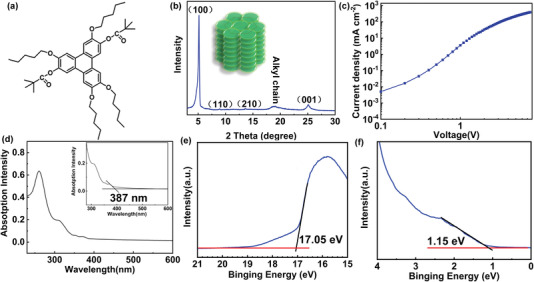
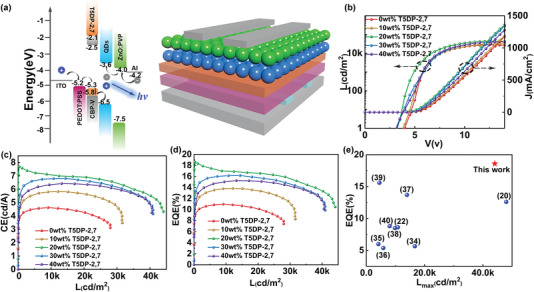
The inadequate hole injection limits the efficiency and lifetime of the blue quantum dot light-emitting diodes (QLEDs), which severely hampers their commercial applications. Here a new discotic molecule of 3,6,10,11-tetrakis(pentyloxy)triphenylene-2,7-diyl bis(2,2-dimethylpropanoate) (T5DP-2,7) is introduced, in which the hole transport channels with superior hole mobility (2.6 × 10 cm V s ) is formed by stacking. The composite hole transport material (HTM) is prepared by blending T5DP-2,7 with the cross-linked 4,4'- bis(3-vinyl-9H-carbazol-9-yl)-1,1'biphenyl (CBP-V) which shows the deep highest occupied molecular orbital energy level. The increased hole mobility of the target composite HTM from 10 to 10 cm V s as well as the stepwise energy levels facilitates the hole transport, which would be beneficial for more balanced carrier injection. This composite hole transport layer (HTL) has improved the deep-blue-emission performances of Commission International de I'Eclairage of (0.14, 0.04), luminance of 44080 cd m , and external quantum efficiency of 18.59%. Furthermore, when L is 100 cd m , the device lifetime T is extended from 139 to 502 h. The state-of-the-art performance shows the successful promotion of the high-efficiency for deep blue QLEDs, and indicates that the optimizing HTL by discotic molecule stacking can serve as an excellent alternative for the development of HTL in the future.
空穴注入不足限制了蓝色量子点发光二极管(QLED)的效率和寿命,这严重阻碍了它们的商业应用。本文引入了一种新型盘状分子3,6,10,11-四(戊氧基)三亚苯基-2,7-二基双(2,2-二甲基丙酸酯)(T5DP-2,7),其中通过堆叠形成了具有优异空穴迁移率(2.6×10 cm² V⁻¹ s⁻¹)的空穴传输通道。通过将T5DP-2,7与显示出深最高占据分子轨道能级的交联4,4'-双(3-乙烯基-9H-咔唑-9-基)-1,1'-联苯(CBP-V)混合制备复合空穴传输材料(HTM)。目标复合HTM的空穴迁移率从10⁻⁶提高到10⁻⁵ cm² V⁻¹ s⁻¹以及逐步的能级有助于空穴传输,这将有利于更平衡的载流子注入。这种复合空穴传输层(HTL)改善了国际照明委员会(CIE)坐标为(0.14, 0.04)的深蓝色发射性能、44080 cd m⁻²的亮度和18.59%的外量子效率。此外,当亮度L为100 cd m⁻²时,器件寿命T从139小时延长到502小时。这种先进的性能表明成功提升了深蓝色QLED的效率,并表明通过盘状分子堆叠优化HTL可成为未来HTL发展的优秀替代方案。