Sorbonne Université, INSERM, Institut Pierre Louis d'Épidémiologie et de Santé Publique, IPLESP, Department of Social Epidemiology, F75012, Paris, France.
Sorbonne Université, Faculty of Medicine Pierre et Marie Curie, Department of Education and Research in General Medicine, F75012, Paris, France.
J Urban Health. 2022 Dec;99(6):1170-1182. doi: 10.1007/s11524-022-00648-0. Epub 2022 Jun 2.
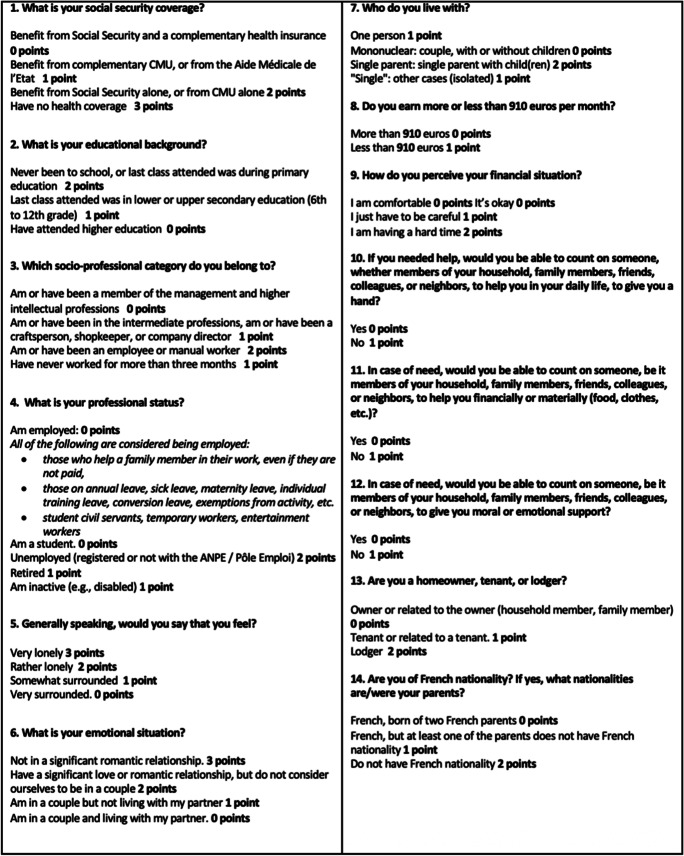
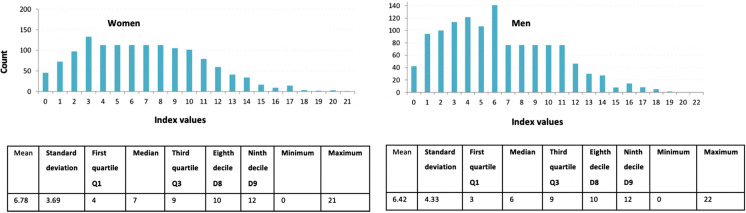
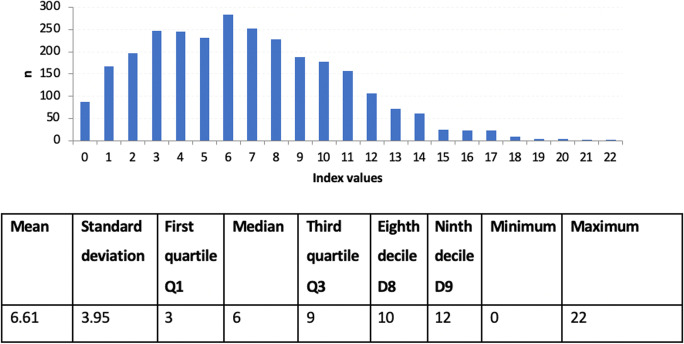
The association between health status and deprivation is well established. However, it is difficult to measure deprivation at an individual level and already-existing indices in France are not validated or do not meet the needs of health practitioners. The aim of this work was to establish a validated, easy-to-use, multidimensional, relevant index that was representative of the population in the Paris metropolitan area. From the SIRS 2010 cohort study, 14 socio-economic characteristics were selected: health insurance, educational background, socio-professional category, professional status, feelings of loneliness, emotional situation, household type, income, perceived financial situation, social support (support in daily life, financial and emotional), housing situation, and migration origin. In addition, a total of 12 health status, healthcare use, and nutrition-related variables were also selected. Content validity and internal validity of the index were explored. The 14 socio-economic indicators were associated to varying degrees with poorer health status, less use of healthcare, and poorer nutrition and were distributed across the 14 multiple-choice questions of the index. Each answer was rated from 0 to 2. The index value of 10 that isolates 20% of the most deprived individuals was used as threshold. "Being deprived," as defined with this value, was significantly associated with 9 of the 12 studied health variables. This index could be a relevant instrument in the assessment of deprivation and social inequalities of health.
健康状况与贫困之间存在关联,这一点已得到充分证实。然而,在个体层面上衡量贫困程度较为困难,法国现有的指数既未经验证,也无法满足卫生从业者的需求。本研究旨在建立一个经过验证、易于使用、多维、具有代表性的指数,以反映巴黎大都市区的人群状况。从 SIRS 2010 队列研究中,选择了 14 项社会经济特征:健康保险、教育背景、社会职业类别、职业状况、孤独感、情绪状况、家庭类型、收入、对财务状况的感知、社会支持(日常生活、经济和情感方面的支持)、住房状况和移民来源。此外,还选择了总共 12 项与健康状况、医疗保健使用和营养相关的变量。该指数的内容效度和内部效度得到了探索。这 14 项社会经济指标与较差的健康状况、较少使用医疗保健以及较差的营养状况均存在不同程度的关联,并分布在指数的 14 个多项选择题中。每个答案的评分范围为 0 到 2。将隔离 20%最贫困人群的指数值 10 作为阈值。使用该值定义的“贫困”与 12 项研究的健康变量中的 9 项显著相关。该指数可作为评估贫困程度和健康社会不平等的一个有效工具。