Medicine Service, Veterans Affairs Eastern Colorado Health Care System, Aurora, Colorado, United States of America.
Department of Medicine, University of Colorado Anschutz Medical Campus, Aurora, Colorado, United States of America.
PLoS Genet. 2022 Jun 2;18(6):e1010193. doi: 10.1371/journal.pgen.1010193. eCollection 2022 Jun.
Height has been associated with many clinical traits but whether such associations are causal versus secondary to confounding remains unclear in many cases. To systematically examine this question, we performed a Mendelian Randomization-Phenome-wide association study (MR-PheWAS) using clinical and genetic data from a national healthcare system biobank.
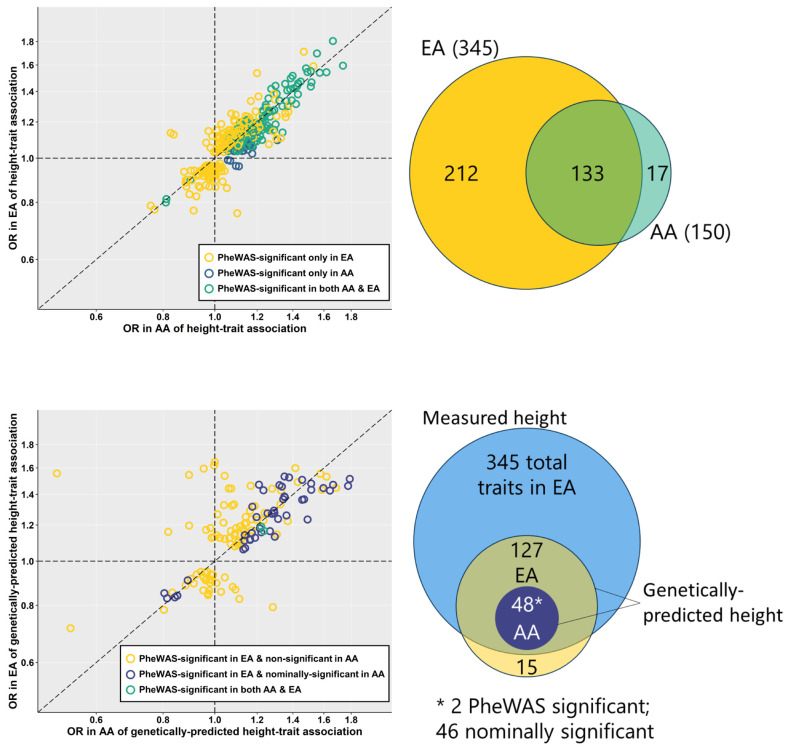
Analyses were performed using data from the US Veterans Affairs (VA) Million Veteran Program in non-Hispanic White (EA, n = 222,300) and non-Hispanic Black (AA, n = 58,151) adults in the US. We estimated height genetic risk based on 3290 height-associated variants from a recent European-ancestry genome-wide meta-analysis. We compared associations of measured and genetically-predicted height with phenome-wide traits derived from the VA electronic health record, adjusting for age, sex, and genetic principal components. We found 345 clinical traits associated with measured height in EA and an additional 17 in AA. Of these, 127 were associated with genetically-predicted height at phenome-wide significance in EA and 2 in AA. These associations were largely independent from body mass index. We confirmed several previously described MR associations between height and cardiovascular disease traits such as hypertension, hyperlipidemia, coronary heart disease (CHD), and atrial fibrillation, and further uncovered MR associations with venous circulatory disorders and peripheral neuropathy in the presence and absence of diabetes. As a number of traits associated with genetically-predicted height frequently co-occur with CHD, we evaluated effect modification by CHD status of genetically-predicted height associations with risk factors for and complications of CHD. We found modification of effects of MR associations by CHD status for atrial fibrillation/flutter but not for hypertension, hyperlipidemia, or venous circulatory disorders.
We conclude that height may be an unrecognized but biologically plausible risk factor for several common conditions in adults. However, more studies are needed to reliably exclude horizontal pleiotropy as a driving force behind at least some of the MR associations observed in this study.
身高与许多临床特征有关,但在许多情况下,这些关联是因果关系还是混杂因素的结果仍不清楚。为了系统地研究这个问题,我们使用来自国家医疗保健系统生物库的临床和遗传数据进行了孟德尔随机化-表型全基因组关联研究(MR-PheWAS)。
使用来自美国退伍军人事务部(VA)百万退伍军人计划的非西班牙裔白种人(EA,n=222300)和非西班牙裔黑人(AA,n=58151)成年人的数据进行了分析。我们根据最近一项欧洲血统全基因组荟萃分析中的 3290 个与身高相关的变异来估计身高遗传风险。我们比较了测量身高和遗传预测身高与来自 VA 电子健康记录的表型全基因组特征之间的关联,同时调整了年龄、性别和遗传主成分。我们发现 EA 中 345 种临床特征与测量身高相关,AA 中另外 17 种与测量身高相关。其中,在 EA 中,有 127 种表型全基因组显著相关,AA 中有 2 种与遗传预测身高显著相关。这些关联在很大程度上独立于体重指数。我们证实了之前描述的一些 MR 关联,即身高与心血管疾病特征(如高血压、高血脂、冠心病和心房颤动)之间的关联,并且在存在和不存在糖尿病的情况下,进一步发现了与静脉循环障碍和周围神经病变相关的 MR 关联。由于与遗传预测身高相关的许多特征经常与冠心病共同发生,我们评估了冠心病状态对遗传预测身高与冠心病危险因素和并发症之间关联的影响修饰作用。我们发现冠心病状态对 MR 关联的影响有修饰作用,如心房颤动/扑动,但对高血压、高血脂或静脉循环障碍没有修饰作用。
我们的结论是,身高可能是成年人中几种常见疾病的未被认识但具有生物学合理性的危险因素。然而,需要更多的研究来可靠地排除水平遗传异质性,这是该研究中观察到的至少一些 MR 关联的驱动力。