Department of Cognitive Neuroscience, Institute for Cognitive Science Studies, Tehran, Iran.
Department of Cognitive Rehabilitation, Institute for Cognitive Science Studies, Tehran, Iran.
Biomed Res Int. 2022 Apr 22;2022:8588272. doi: 10.1155/2022/8588272. eCollection 2022.
Binaural beats (BBs) are phantom sound illusions perceived when two sounds of slightly different frequencies are separately transmitted to the ears. It is suggested that some BB frequencies might entrain the brain and enhance certain cognitive functions such as working memory or attention. Nevertheless, studies in this regard are very scarce, quite controversial, and merely covering a very small portion of this vast field of research (e.g., testing only a few BB frequencies), not to mention adopting some limited methodologies (e.g., no assessment of the loudness of the BB sound, adopting only between-subject analyses, and testing only one perceptual modality). Hence, we aimed to assess the potential effects of alpha, beta, and gamma BBs on cognitive-behavioral parameters of working memory and attention examined simultaneously in two different modalities (visuospatial and auditory-verbal).
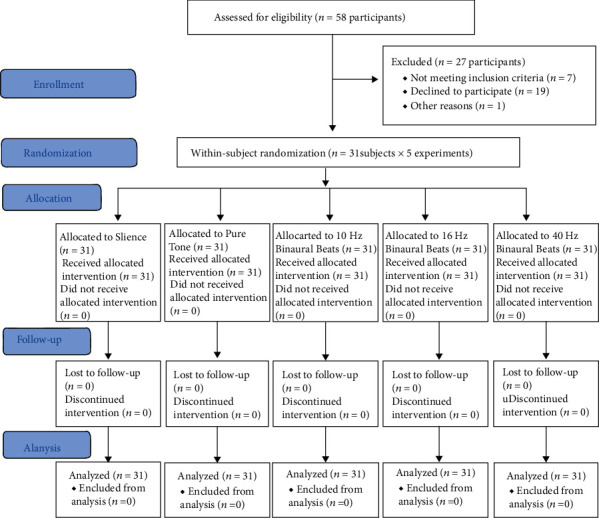
This within-subject five-arm randomized placebo-controlled clinical trial included 155 trials in 31 healthy right-handed subjects (17 women, 14 men, 30.84 ± 6.16 years old). Each subject listened to 8-minute sessions of 10 Hz, 16 Hz, and 40 Hz binaural beats versus 240 Hz pure tone and silence (in random orders). In each 8-minute block, they played a dual 2-back task with feedback enabled. Their cognitive-behavioral parameters (working memory capacities, signal detection measures (hit rate, false alarm rate, sensitivity, and response bias), and reaction speed measures (response time and intrasubject response time variability)) were calculated. The effects of the sound interventions and short-term training on these working memory and attention measures were assessed statistically using mixed-model linear regressions, repeated-measures ANOVAs and ANCOVAs, Bonferroni tests, and one-sample -tests ( = 0.05).
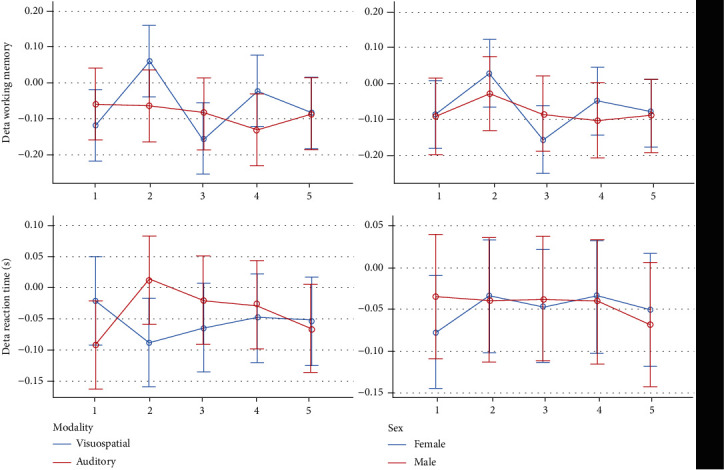
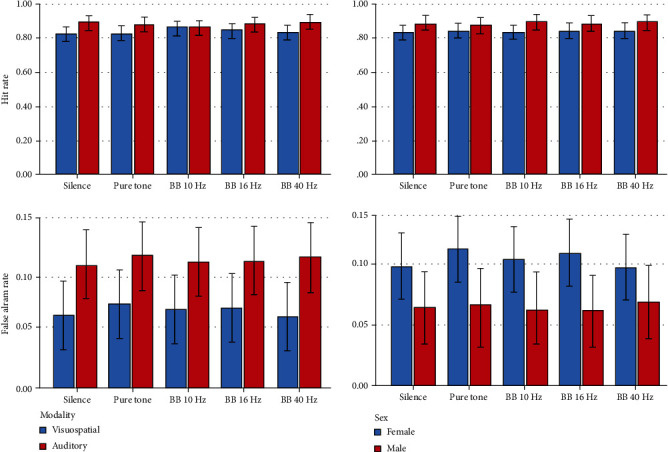
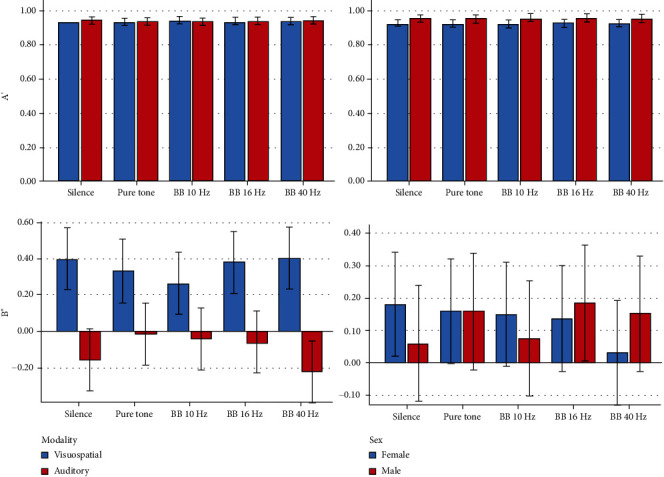
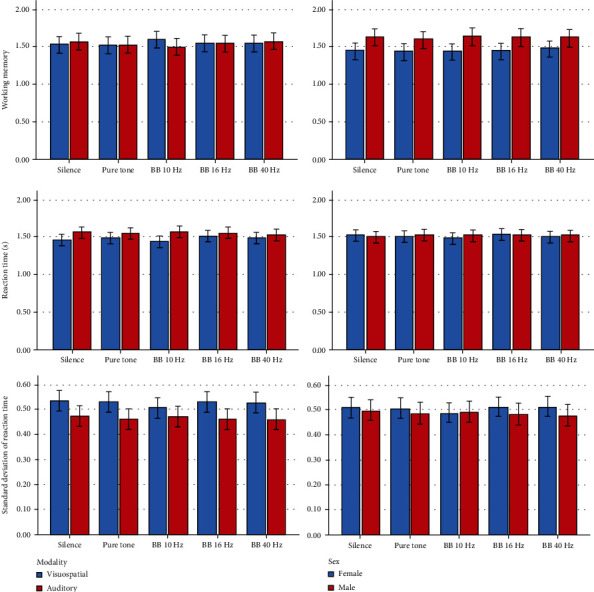
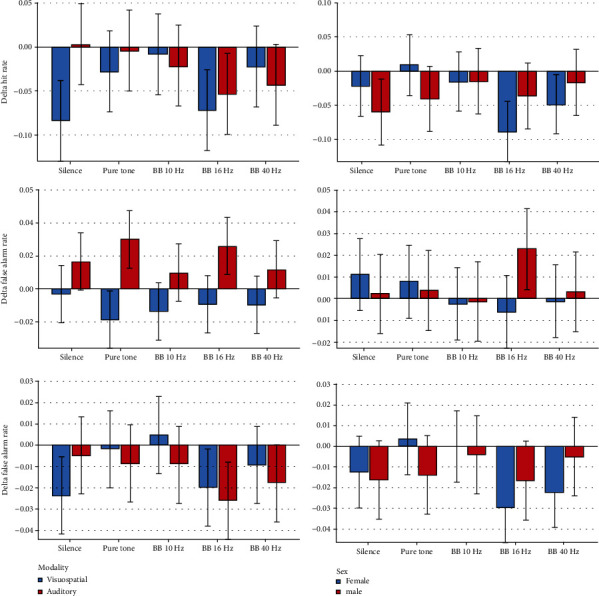
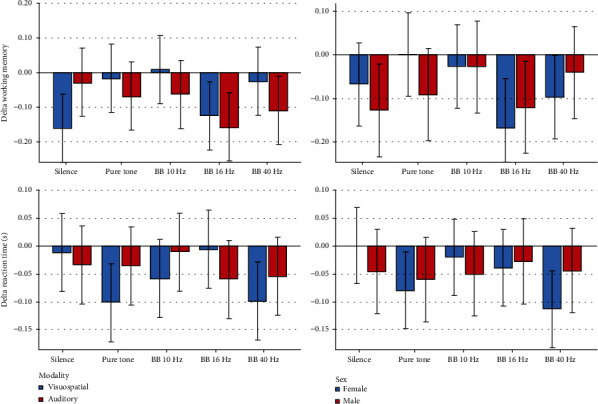
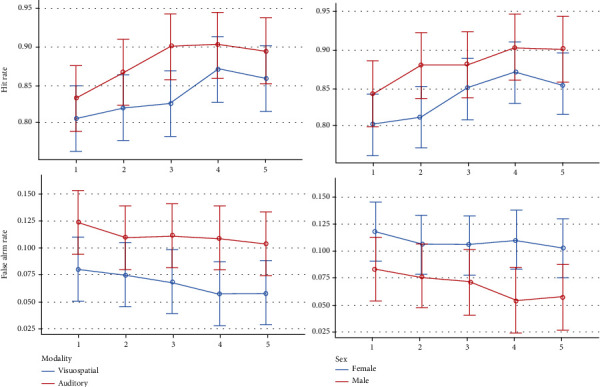
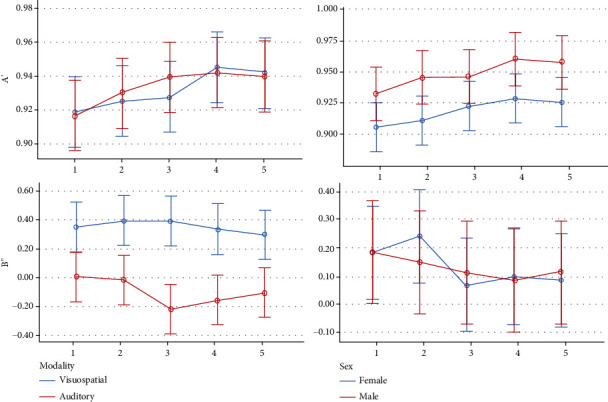
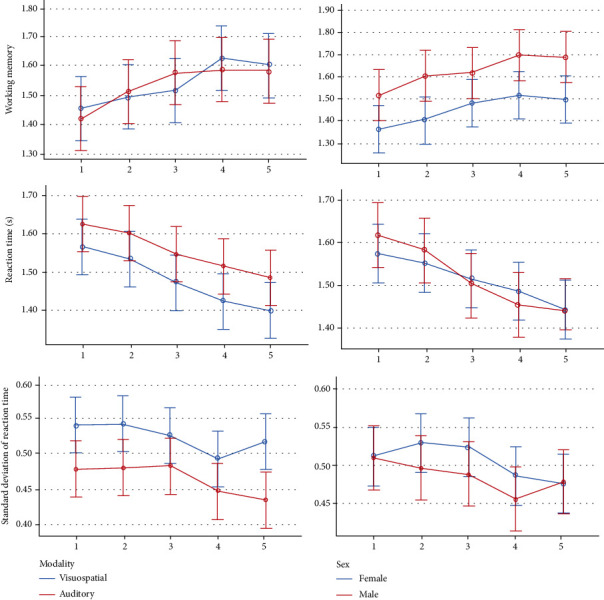
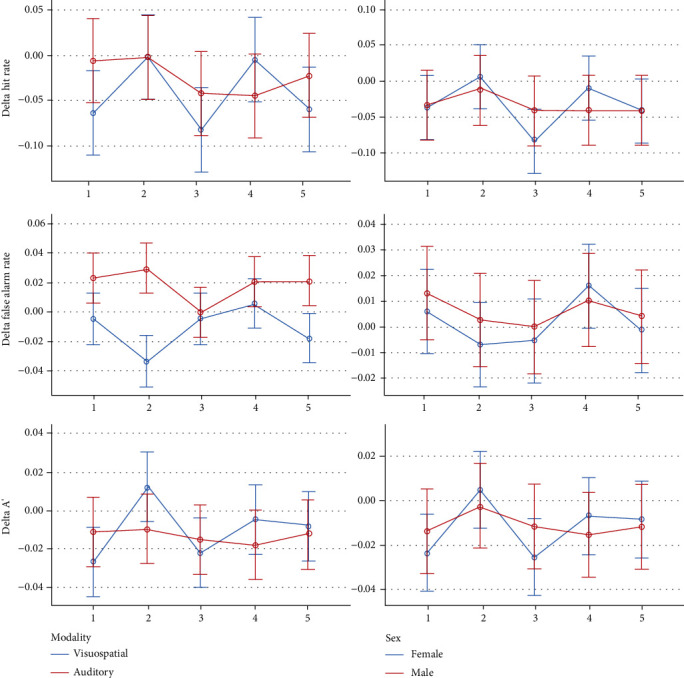
The following are some major statistically significant findings ( ≤ 0.05): In the visuospatial modality, the 10 Hz BB reduced the response time and intrasubject response time variability and reduced the extent of decline over time in the case of visuospatial working memory, sensitivity, and hit rate. In the auditory-verbal modality, the 10 Hz intervention reduced the hit rate, false alarm rate, and sensitivity. The 10 Hz intervention also caused the lowest intermodality discrepancies in hit rates and false alarm rates, the highest response time discrepancies, and negative discrepancies in working memories and sensitivities (indicating the superiority of the visuospatial modality). The response biases tended to be liberal-to-neutral in the verbal modality and rather conservative in the visuospatial modality. Reactions were faster in the visuospatial modality than the auditory-verbal one, while the intrasubject variability of reaction times was smaller in the auditory-verbal modality. Short-term training can increase the hit rate, working memory, and sensitivity and can decrease the false alarm rate and response time. Aging and reduced sound intervention volume may slow down responses and increase the intrasubject variability of response time. Faster reactions might be correlated with greater hit rates, working memories, and sensitivities and also with lower false alarm rates.
The 8-minute alpha-band binaural beat entrainment may have a few, slight enhancing effects within the visuospatial modality, but not in both modalities combined. Short-term training can improve working memory and some cognitive parameters of attention. Some BB interventions can affect the intermodality discrepancies. There may be differences between the two modalities in terms of the response speeds and intrasubject response time variabilities. Aging can slow down the response, while increasing the volume of audio interventions may accelerate it.
双耳节拍(BBs)是当两个略有不同频率的声音分别传入耳朵时产生的幻音错觉。有人认为,一些 BB 频率可能会使大脑同步,并增强某些认知功能,如工作记忆或注意力。然而,这方面的研究非常有限,颇具争议,而且只涵盖了这个广阔研究领域的一小部分(例如,仅测试了几个 BB 频率),更不用说采用了一些有限的方法(例如,不评估 BB 声音的响度,仅采用组间分析,并且仅测试一种感知模式)。因此,我们旨在评估 alpha、beta 和 gamma BBs 对工作记忆和注意力的认知行为参数的潜在影响,这些参数同时在两种不同的模式(视觉空间和听觉言语)中进行检查。
这项在个体内的五臂随机安慰剂对照临床试验包括 31 名健康右利手受试者(17 名女性,14 名男性,30.84 ± 6.16 岁)的 155 次试验。每个受试者都听了 8 分钟的 10 Hz、16 Hz 和 40 Hz 双耳节拍与 240 Hz 纯音和静音(随机顺序)。在每 8 分钟的时间段内,他们进行了带有反馈的双 2 背任务。他们的认知行为参数(工作记忆能力、信号检测指标(击中率、虚报率、灵敏度和反应偏差)和反应速度指标(反应时间和个体内反应时间变异性))都被计算出来。使用混合模型线性回归、重复测量方差分析和协方差分析、Bonferroni 检验和单样本 t 检验( = 0.05)来统计评估声音干预和短期训练对这些工作记忆和注意力测量的影响。
以下是一些主要的具有统计学意义的发现( ≤ 0.05):在视觉空间模式下,10 Hz BB 降低了反应时间和个体内反应时间变异性,并降低了视觉空间工作记忆、灵敏度和击中率随时间的下降程度。在听觉言语模式下,10 Hz 干预降低了击中率、虚报率和灵敏度。10 Hz 干预还导致击中率和虚报率的模态间差异最小,反应时间的差异最大,工作记忆和灵敏度的差异为负(表明视觉空间模式具有优势)。反应偏差在言语模态中倾向于宽松到中性,而在视觉空间模态中则倾向于保守。反应在视觉空间模式下比听觉言语模式更快,而听觉言语模式下的反应时间个体内变异性更小。短期训练可以提高击中率、工作记忆和灵敏度,降低虚报率和反应时间。年龄增长和声音干预音量降低可能会使反应速度变慢,增加反应时间的个体内变异性。更快的反应可能与更高的击中率、工作记忆和灵敏度以及更低的虚报率相关。
8 分钟的 alpha 波段双耳节拍可能会在视觉空间模式中产生一些轻微的增强作用,但不会在两种模式的组合中产生。短期训练可以提高工作记忆和注意力的一些认知参数。一些 BB 干预可以影响模态间的差异。两种模式在反应速度和个体内反应时间变异性方面可能存在差异。年龄增长会使反应速度变慢,而增加音频干预的音量可能会加快反应速度。