Université de Paris, INCC UMR 8002, 75006, Paris, France.
CNRS, INCC UMR 8002, Paris, France.
Nat Commun. 2021 Feb 19;12(1):1149. doi: 10.1038/s41467-021-21393-z.
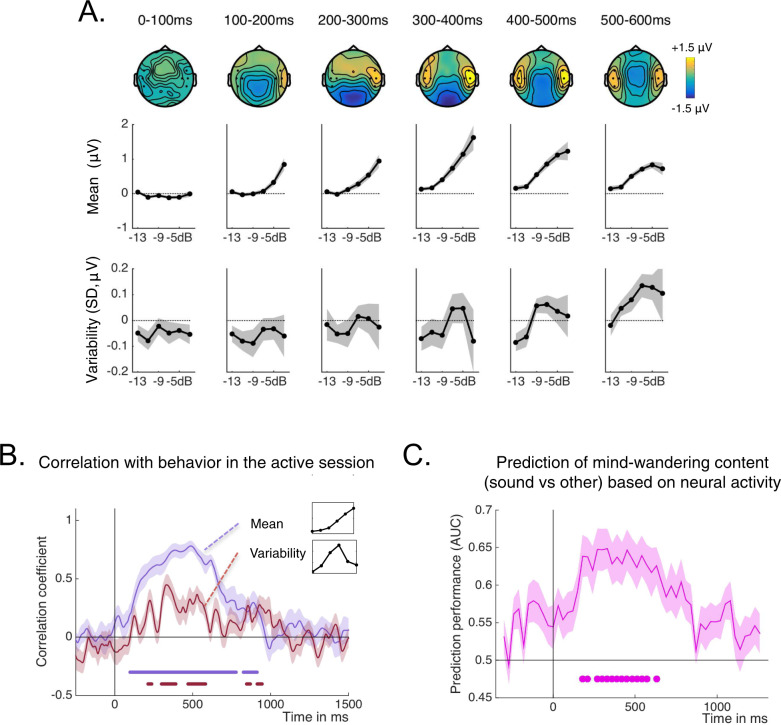
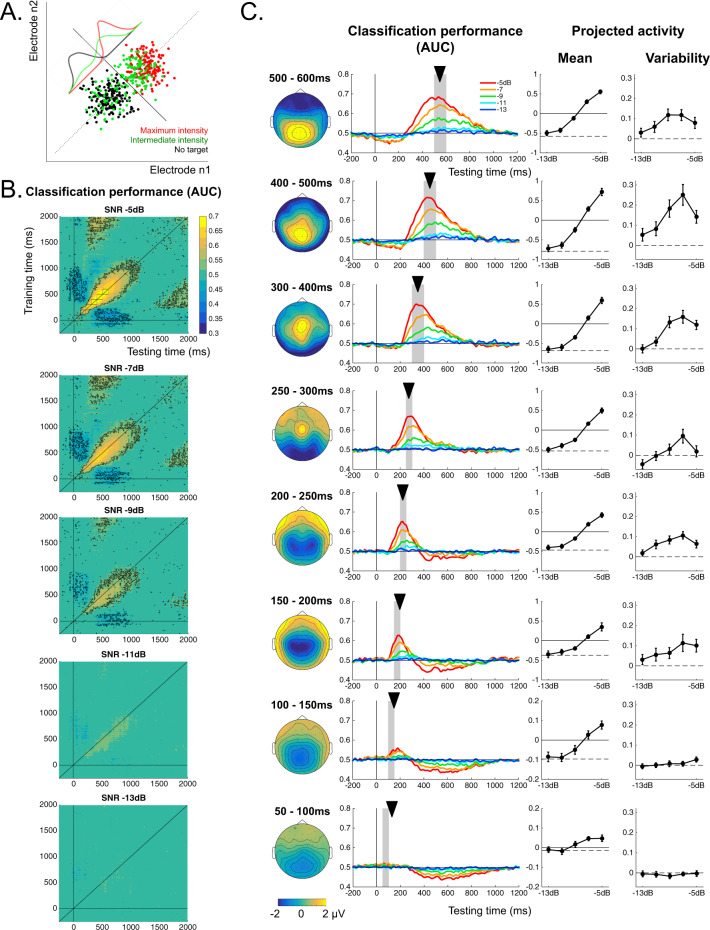
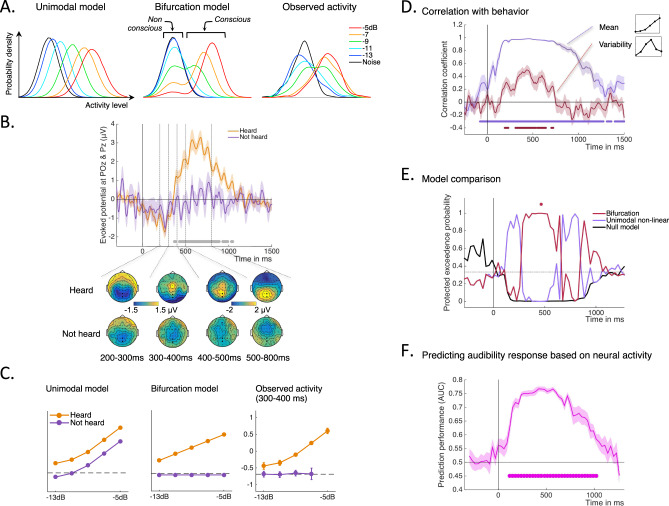
An outstanding challenge for consciousness research is to characterize the neural signature of conscious access independently of any decisional processes. Here we present a model-based approach that uses inter-trial variability to identify the brain dynamics associated with stimulus processing. We demonstrate that, even in the absence of any task or behavior, the electroencephalographic response to auditory stimuli shows bifurcation dynamics around 250-300 milliseconds post-stimulus. Namely, the same stimulus gives rise to late sustained activity on some trials, and not on others. This late neural activity is predictive of task-related reports, and also of reports of conscious contents that are randomly sampled during task-free listening. Source localization further suggests that task-free conscious access recruits the same neural networks as those associated with explicit report, except for frontal executive components. Studying brain dynamics through variability could thus play a key role for identifying the core signatures of conscious access, independent of report.
意识研究面临的一个突出挑战是,在不依赖任何决策过程的情况下,描述意识获取的神经特征。在这里,我们提出了一种基于模型的方法,该方法使用试验间变异性来识别与刺激处理相关的大脑动力学。我们证明,即使在没有任何任务或行为的情况下,听觉刺激的脑电图反应在刺激后 250-300 毫秒左右也会出现分岔动力学。也就是说,相同的刺激在某些试验中会引起延迟持续活动,而在其他试验中则不会。这种晚期神经活动可预测与任务相关的报告,也可预测在无任务聆听期间随机采样的意识内容报告。源定位进一步表明,无任务的意识获取会招募与明确报告相关的相同神经网络,除了额叶执行成分。因此,通过变异性研究大脑动力学可能在识别独立于报告的意识获取的核心特征方面发挥关键作用。