Hakimizadeh Elham, Kaeidi Ayat, Rahmani Mohammadreza, Allahtavakoli Mohammad, Hassanshahi Jalal
Physiology-Pharmacology Research Center, Research Institute of Basic Medical Sciences, Rafsanjan University of Medical Sciences, Rafsanjan, Iran.
Department of Physiology and Pharmacology, School of Medicine, Rafsanjan University of Medical Sciences, Rafsanjan, Iran.
Iran J Basic Med Sci. 2022 Feb;25(2):148-154. doi: 10.22038/IJBMS.2022.61499.13606.
Calcium dobesilate (CaD) has anti-oxidant, anti-inflammatory, and anti-apoptotic effects. In this study, the protective effects of CaD against hepatorenal damage induced by carbon tetrachloride (CCl) in mice were evaluated.
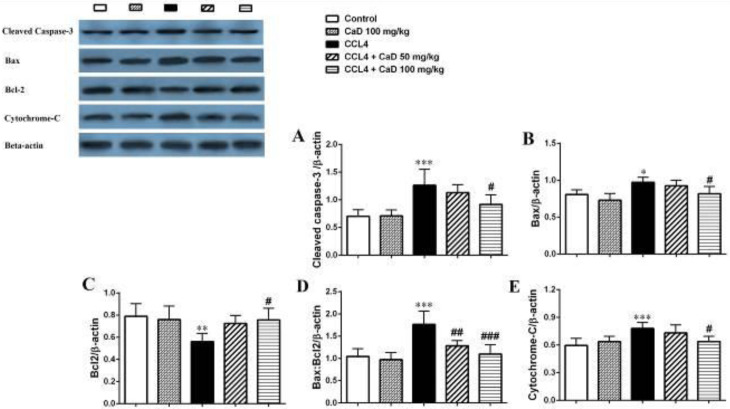
Thirty male mice were randomly divided into five groups: Control, CaD 100 mg/kg, CCl, CCl+CaD 50 mg/kg, and CCl+CaD 100 mg/kg. CaD (50 and 100 mg/kg) was administered orally once a day for 4 weeks. The liver and kidney indices (serum creatinine, blood urine nitrogen, alanine aminotransferase, and aspartate aminotransferase levels) were determined. Also, liver and kidney tissue oxidant/anti-oxidant markers (glutathione peroxidase, malondialdehyde, total anti-oxidant capacity, and superoxide dismutase) were measured. Cleaved caspase-3, Bax, cytochrome-c, and Bcl-2 protein levels were measured by immunoblotting method in the liver and kidney tissues. The liver and kidney histopathological changes were evaluated by the Hematoxylin and Eosin (H&E) staining method.
CCl induced significant oxidative stress and apoptosis in kidney and liver tissues that was concomitant with histopathological abnormalities in these organs in the CCl group versus the control (<0.05). However, CaD (100 mg/kg) could significantly improve the histopathological change in the liver and kidney tissues of CCl+CaD 100 mg/kg mice versus the CCl group (<0.05). In addition, CaD (100 mg/kg) attenuated the pro and anti-apoptotic markers in the liver and kidney tissues of CCl+CaD 100 mg/kg mice versus the CCl group (<0.05).
CaD (100 mg/kg) has a protective effect against hepatorenal injury induced by CCl at least via its anti-apoptotic and anti-oxidant properties.
羟苯磺酸钙(CaD)具有抗氧化、抗炎和抗凋亡作用。在本研究中,评估了CaD对四氯化碳(CCl)诱导的小鼠肝肾损伤的保护作用。
30只雄性小鼠随机分为五组:对照组、CaD 100 mg/kg组、CCl组、CCl+CaD 50 mg/kg组和CCl+CaD 100 mg/kg组。CaD(50和100 mg/kg)每天口服一次,持续4周。测定肝肾功能指标(血清肌酐、血尿素氮、丙氨酸转氨酶和天冬氨酸转氨酶水平)。此外,检测肝和肾组织中的氧化/抗氧化标志物(谷胱甘肽过氧化物酶、丙二醛、总抗氧化能力和超氧化物歧化酶)。采用免疫印迹法检测肝和肾组织中裂解的半胱天冬酶-3、Bax、细胞色素-c和Bcl-2蛋白水平。采用苏木精和伊红(H&E)染色法评估肝和肾组织的组织病理学变化。
与对照组相比,CCl组中CCl诱导肾和肝组织发生显著氧化应激和凋亡,并伴有这些器官的组织病理学异常(P<0.05)。然而,与CCl组相比,CaD(100 mg/kg)可显著改善CCl+CaD 100 mg/kg小鼠肝和肾组织的组织病理学变化(P<0.05)。此外,与CCl组相比,CaD(100 mg/kg)可减轻CCl+CaD 100 mg/kg小鼠肝和肾组织中的促凋亡和抗凋亡标志物(P<0.05)。
CaD(100 mg/kg)至少通过其抗凋亡和抗氧化特性对CCl诱导的肝肾损伤具有保护作用。