Campos-Martinez Ana M, Expósito-Herrera J, Gonzalez-Bolívar M, Fernández-Marin E, Uberos Jose
Neonatal Intensive Care Unit, San Cecilio Clinical Hospital, Granada, Spain.
Pediatrics Department, Medicine Faculty, Granada, Spain.
Front Pediatr. 2022 May 17;10:874976. doi: 10.3389/fped.2022.874976. eCollection 2022.
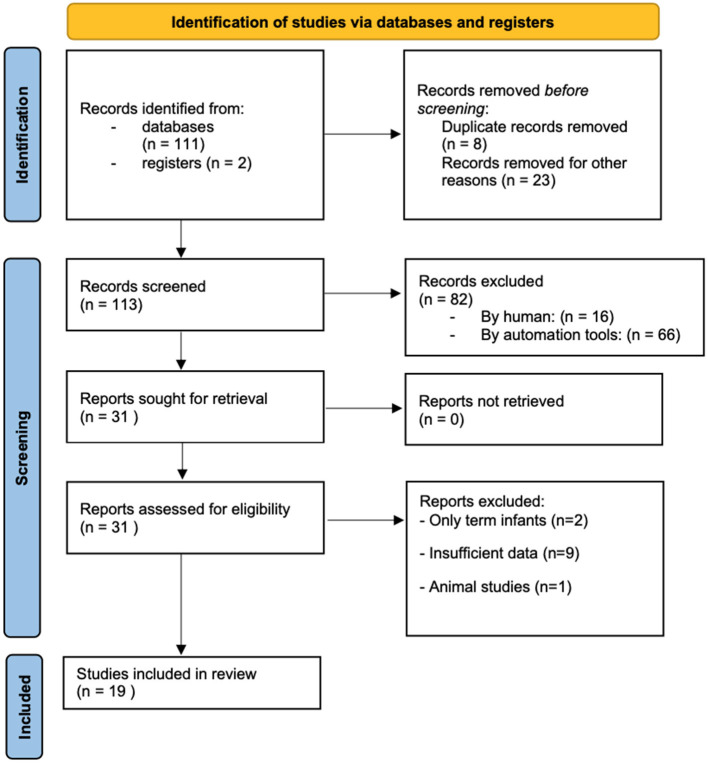
Necrotizing enterocolitis (NEC) is a serious condition related to prematurity and the initiation of enteral feeding. In this article, we review the evidence published in recent years on necrotizing enterocolitis risk factors (prematurity, feeding with low-weight formula, existence of intestinal dysbiosis) and protective factors (human milk or donated milk supply, supplementation of human milk with oligosaccharides, probiotics administration, and the determination of disease predictive biomarkers). A systematic review was conducted of preventive, risk and predictive factors for necrotizing enterocolitis in neonates prior to 37 weeks' gestational age, based on a literature search for clinical trials, meta-analyses, randomized controlled trials and systematic reviews published between January 2018 and October 2021. For this purpose, the PubMed, MEDLINE, and Cochrane Library databases were consulted. The literature search obtained 113 articles, of which 19 were selected for further analysis after applying the inclusion and exclusion criteria. The conclusions drawn from this analysis were that adequate knowledge of risk factors that can be prevented or modified (such as alteration of the intestinal microbiota, oxidative stress, metabolic dysfunction at birth, or alteration of the immunity modulation) can reduce the incidence of NEC in premature infants. These factors include the supplementation of enteral nutrition with human milk oligosaccharides (with prebiotic and immunomodulatory effects), the combined administration of probiotics (especially the spp and spp combination, which inhibits bacterial adhesion effects, improves the intestinal mucosa barrier function, strengthens the innate and adaptive immune system and increases the secretion of bioactive metabolites), the supplementation of human milk with lactoferrin and the use of donated milk fortified in accordance with the characteristics of the premature newborn. The determination of factors that can predict the existence of NEC, such as fecal calprotectin, increased TLR4 activity, and IL6 receptor, can lead to an early diagnosis of NEC. Although further studies should be conducted to determine the values of predictive biomarkers of NEC, and/or the recommended doses and strains of probiotics, lactoferrin or oligosaccharides, the knowledge acquired in recent years is encouraging.
坏死性小肠结肠炎(NEC)是一种与早产及肠内喂养起始相关的严重病症。在本文中,我们回顾了近年来发表的关于坏死性小肠结肠炎风险因素(早产、使用低体重配方奶喂养、肠道菌群失调的存在)及保护因素(母乳或捐赠母乳供应、用低聚糖补充母乳、给予益生菌以及疾病预测生物标志物的测定)的证据。基于对2018年1月至2021年10月期间发表的临床试验、荟萃分析、随机对照试验及系统评价的文献检索,对孕周小于37周的新生儿坏死性小肠结肠炎的预防、风险及预测因素进行了系统评价。为此,查阅了PubMed、MEDLINE和Cochrane图书馆数据库。文献检索获得113篇文章,应用纳入和排除标准后,选择其中19篇进行进一步分析。该分析得出的结论是,充分了解可预防或改变的风险因素(如肠道微生物群改变、氧化应激、出生时的代谢功能障碍或免疫调节改变)可降低早产儿坏死性小肠结肠炎的发病率。这些因素包括用具有益生元和免疫调节作用的母乳低聚糖补充肠内营养、联合给予益生菌(尤其是 spp和 spp组合,其可抑制细菌黏附作用、改善肠黏膜屏障功能、增强先天和适应性免疫系统并增加生物活性代谢产物的分泌)、用乳铁蛋白补充母乳以及根据早产新生儿的特点使用强化捐赠母乳。确定可预测坏死性小肠结肠炎存在的因素,如粪便钙卫蛋白、TLR4活性增加和IL6受体,可实现坏死性小肠结肠炎的早期诊断。尽管应开展进一步研究以确定坏死性小肠结肠炎预测生物标志物的值,和/或益生菌、乳铁蛋白或低聚糖的推荐剂量及菌株,但近年来获得的知识令人鼓舞。