Department of Emergency Medicine National Taiwan University Hospital Taipei Taiwan.
Departments of Pediatrics and Emergency Medicine University of Calgary Alberta Canada.
J Am Heart Assoc. 2022 Jun 7;11(11):e025661. doi: 10.1161/JAHA.122.025661. Epub 2022 Jun 3.
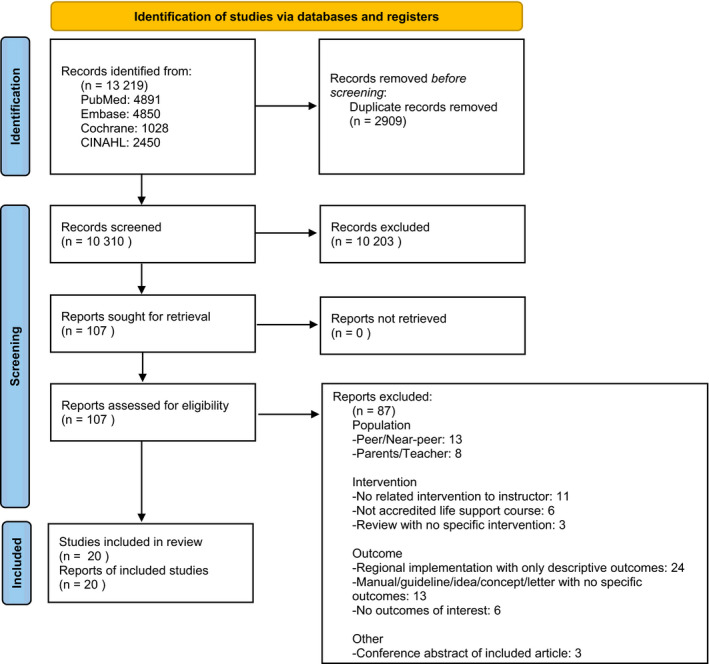
The aim of this scoping review initiated by the Education, Implementation and Teams Task Force of the International Liaison Committee on Resuscitation was to identify faculty development approaches to improve instructional competence in accredited life support courses. We searched PubMed, Ovid Embase, Cumulative Index to Nursing and Allied Health Literature, and the Cochrane Central Register of Controlled Trials to identify studies published from January 1, 1966 to December 31, 2021 on approaches to improve faculty development for life support courses. Data on participant characteristics, interventions, design, and outcomes of included studies were extracted. Of the initially identified 10 310 studies, we included 20 studies (5 conference abstracts, 1 short communication, 14 full-length articles). Among them, 12 studies aimed to improve instructors/candidates' teaching ability in basic life support courses. A wide variety of interventions were identified. The interventions were categorized into 4 themes: instructor qualification/training (n=9), assessment tools (n=3), teaching skills enhancement (n=3), and additional courses for instructors (n=5). Most studies showed that these interventions improved specific teaching ability or confidence of the instructors and learning outcomes in different kinds of life support courses. However, no studies addressed clinical outcomes of patients. In conclusion, the faculty development approaches for instructors are generally associated with improved learning outcomes for participants, and also improved teaching ability and self-confidence of the instructors. It is encouraged that local organizations implement faculty development programs for their teaching staff of their accredited resuscitation courses. Further studies should explore the best ways to strengthen and maintain instructor competency, and define the cost-effectiveness of various different faculty development strategies.
本研究由复苏国际联络委员会教育、实施和团队工作组发起,旨在确定提高认可的生命支持课程教学能力的教师发展方法。我们检索了 PubMed、Ovid Embase、护理学和联合健康文献累积索引以及 Cochrane 对照试验中心注册库,以确定自 1966 年 1 月 1 日至 2021 年 12 月 31 日发表的关于改善生命支持课程教师发展方法的研究。提取纳入研究的参与者特征、干预措施、设计和结果的数据。在最初确定的 10310 项研究中,我们纳入了 20 项研究(5 项会议摘要、1 项短通讯、14 篇全文文章)。其中,12 项研究旨在提高指导员/学员在基础生命支持课程中的教学能力。确定了各种各样的干预措施。这些干预措施分为 4 个主题:指导员资格/培训(n=9)、评估工具(n=3)、教学技能增强(n=3)和指导员额外课程(n=5)。大多数研究表明,这些干预措施提高了指导员在不同类型的生命支持课程中的特定教学能力或信心以及学习成果。然而,没有研究涉及患者的临床结果。总之,教师发展方法通常与参与者学习成果的提高有关,也与指导员的教学能力和自信心的提高有关。鼓励地方组织为其认可的复苏课程的教学人员实施教师发展计划。进一步的研究应探索加强和维持指导员能力的最佳方法,并确定各种不同教师发展策略的成本效益。