• 文献检索
  • 文档翻译
  • 深度研究
  • 学术资讯
  • Suppr Zotero 插件Zotero 插件
  • 邀请有礼
  • 套餐&价格
  • 历史记录
应用&插件
Suppr Zotero 插件Zotero 插件浏览器插件Mac 客户端Windows 客户端微信小程序
定价
高级版会员购买积分包购买API积分包
服务
文献检索文档翻译深度研究API 文档MCP 服务
关于我们
关于 Suppr公司介绍联系我们用户协议隐私条款
关注我们

Suppr 超能文献

核心技术专利:CN118964589B侵权必究
粤ICP备2023148730 号-1Suppr @ 2026

文献检索

告别复杂PubMed语法,用中文像聊天一样搜索,搜遍4000万医学文献。AI智能推荐,让科研检索更轻松。

立即免费搜索

文件翻译

保留排版,准确专业,支持PDF/Word/PPT等文件格式,支持 12+语言互译。

免费翻译文档

深度研究

AI帮你快速写综述,25分钟生成高质量综述,智能提取关键信息,辅助科研写作。

立即免费体验

人工智能在线引擎在偏头痛诊断中的准确性:一项多中心研究。

Diagnostic accuracy of an artificial intelligence online engine in migraine: A multi-center study.

机构信息

Division of Headache and Facial Pain, Department of Neurology and Neurological Sciences, Stanford University School of Medicine, Stanford, California, USA.

Neurology, University of California, Los Angeles, California, USA.

出版信息

Headache. 2022 Jul;62(7):870-882. doi: 10.1111/head.14324. Epub 2022 Jun 3.

DOI:10.1111/head.14324
PMID:35657603
原文链接:https://pmc.ncbi.nlm.nih.gov/articles/PMC9378575/
Abstract

OBJECTIVE

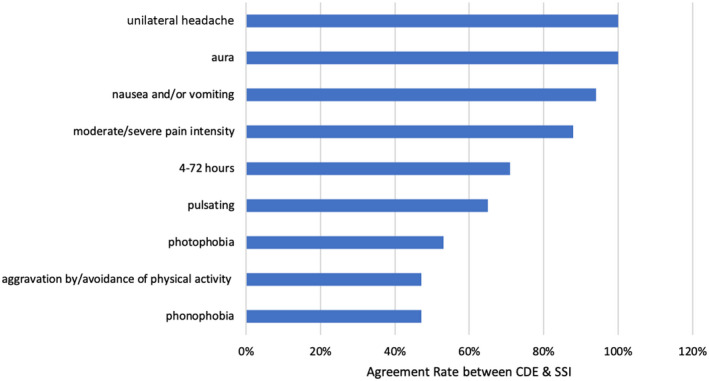
This study assesses the concordance in migraine diagnosis between an online, self-administered, Computer-based, Diagnostic Engine (CDE) and semi-structured interview (SSI) by a headache specialist, both using International Classification of Headache Disorders, 3rd edition (ICHD-3) criteria.

BACKGROUND

Delay in accurate diagnosis is a major barrier to headache care. Accurate computer-based algorithms may help reduce the need for SSI-based encounters to arrive at correct ICHD-3 diagnosis.

METHODS

Between March 2018 and August 2019, adult participants were recruited from three academic headache centers and the community via advertising to our cross-sectional study. Participants completed two evaluations: phone interview conducted by headache specialists using the SSI and a web-based expert questionnaire and analytics, CDE. Participants were randomly assigned to either the SSI followed by the web-based questionnaire or the web-based questionnaire followed by the SSI. Participants completed protocols a few minutes apart. The concordance in migraine/probable migraine (M/PM) diagnosis between SSI and CDE was measured using Cohen's kappa statistics. The diagnostic accuracy of CDE was assessed using the SSI as reference standard.

RESULTS

Of the 276 participants consented, 212 completed both SSI and CDE (study completion rate = 77%; median age = 32 years [interquartile range: 28-40], female:male ratio = 3:1). Concordance in M/PM diagnosis between SSI and CDE was: κ = 0.83 (95% confidence interval [CI]: 0.75-0.91). CDE diagnostic accuracy: sensitivity = 90.1% (118/131), 95% CI: 83.6%-94.6%; specificity = 95.8% (68/71), 95% CI: 88.1%-99.1%. Positive and negative predictive values = 97.0% (95% CI: 91.3%-99.0%) and 86.6% (95% CI: 79.3%-91.5%), respectively, using identified migraine prevalence of 60%. Assuming a general migraine population prevalence of 10%, positive and negative predictive values were 70.3% (95% CI: 43.9%-87.8%) and 98.9% (95% CI: 98.1%-99.3%), respectively.

CONCLUSION

The SSI and CDE have excellent concordance in diagnosing M/PM. Positive CDE helps rule in M/PM, through high specificity and positive likelihood ratio. A negative CDE helps rule out M/PM through high sensitivity and low negative likelihood ratio. CDE that mimics SSI logic is a valid tool for migraine diagnosis.

摘要

目的

本研究通过使用国际头痛疾病分类第 3 版(ICHD-3)标准的在线、自我管理的基于计算机的诊断引擎(CDE)和头痛专家的半结构化访谈(SSI),评估偏头痛诊断在两者之间的一致性。

背景

准确诊断的延迟是头痛护理的主要障碍。准确的基于计算机的算法可能有助于减少基于 SSI 的就诊次数,以得出正确的 ICHD-3 诊断。

方法

2018 年 3 月至 2019 年 8 月,通过在我们的横断面研究中向三个学术头痛中心和社区发布广告,从三个学术头痛中心和社区招募成年参与者。参与者完成了两项评估:由头痛专家通过 SSI 进行的电话访谈和基于网络的专家问卷和分析,CDE。参与者被随机分配到 SSI 后进行基于网络的问卷或基于网络的问卷后进行 SSI。参与者在几分钟内完成方案。通过 Cohen's kappa 统计量测量 SSI 和 CDE 之间偏头痛/可能偏头痛(M/PM)诊断的一致性。使用 SSI 作为参考标准评估 CDE 的诊断准确性。

结果

在 276 名同意的参与者中,有 212 名完成了 SSI 和 CDE(研究完成率为 77%;中位数年龄为 32 岁[四分位距:28-40],男女比例为 3:1)。SSI 和 CDE 之间 M/PM 诊断的一致性为:κ=0.83(95%置信区间[CI]:0.75-0.91)。CDE 的诊断准确性:敏感性为 90.1%(118/131),95%CI:83.6%-94.6%;特异性为 95.8%(68/71),95%CI:88.1%-99.1%。阳性和阴性预测值分别为 97.0%(95%CI:91.3%-99.0%)和 86.6%(95%CI:79.3%-91.5%),分别使用确定的偏头痛患病率为 60%。假设一般偏头痛人群患病率为 10%,阳性和阴性预测值分别为 70.3%(95%CI:43.9%-87.8%)和 98.9%(95%CI:98.1%-99.3%)。

结论

SSI 和 CDE 在诊断 M/PM 方面具有极好的一致性。阳性 CDE 通过高特异性和阳性似然比有助于诊断 M/PM。阴性 CDE 通过高灵敏度和低阴性似然比有助于排除 M/PM。模仿 SSI 逻辑的 CDE 是偏头痛诊断的有效工具。

https://cdn.ncbi.nlm.nih.gov/pmc/blobs/2289/9546323/6035f2bf5f54/HEAD-62-870-g002.jpg
https://cdn.ncbi.nlm.nih.gov/pmc/blobs/2289/9546323/053dacdbc616/HEAD-62-870-g003.jpg
https://cdn.ncbi.nlm.nih.gov/pmc/blobs/2289/9546323/6da101de7f6d/HEAD-62-870-g001.jpg
https://cdn.ncbi.nlm.nih.gov/pmc/blobs/2289/9546323/6035f2bf5f54/HEAD-62-870-g002.jpg
https://cdn.ncbi.nlm.nih.gov/pmc/blobs/2289/9546323/053dacdbc616/HEAD-62-870-g003.jpg
https://cdn.ncbi.nlm.nih.gov/pmc/blobs/2289/9546323/6da101de7f6d/HEAD-62-870-g001.jpg
https://cdn.ncbi.nlm.nih.gov/pmc/blobs/2289/9546323/6035f2bf5f54/HEAD-62-870-g002.jpg

相似文献

1
Diagnostic accuracy of an artificial intelligence online engine in migraine: A multi-center study.人工智能在线引擎在偏头痛诊断中的准确性:一项多中心研究。
Headache. 2022 Jul;62(7):870-882. doi: 10.1111/head.14324. Epub 2022 Jun 3.
2
Development and validation of a web-based headache diagnosis questionnaire.基于网络的头痛诊断问卷的开发和验证。
Sci Rep. 2022 Apr 29;12(1):7032. doi: 10.1038/s41598-022-11008-y.
3
Clinical decision support system using hierarchical fuzzy diagnosis model for migraine and tension-type headache based on International Classification of Headache Disorders, 3rd edition.基于《国际头痛疾病分类》第三版,使用分层模糊诊断模型的偏头痛和紧张型头痛临床决策支持系统
Front Neurol. 2024 Sep 10;15:1444197. doi: 10.3389/fneur.2024.1444197. eCollection 2024.
4
The HUNT4 study: the validity of questionnaire-based diagnoses.HUNT4 研究:基于问卷的诊断的有效性。
J Headache Pain. 2019 Jun 13;20(1):70. doi: 10.1186/s10194-019-1021-0.
5
Accuracy of family history reports of migraine in a community-based family study of migraine.在一项基于社区的偏头痛家庭研究中偏头痛家族史报告的准确性。
Headache. 2015 Mar;55(3):407-12. doi: 10.1111/head.12501. Epub 2015 Feb 13.
6
Validity of self-reported migraine in adolescents and children.青少年和儿童自我报告偏头痛的有效性。
Headache. 2023 May;63(5):634-641. doi: 10.1111/head.14498. Epub 2023 May 4.
7
Description and validation of an Italian ICHD-II-based questionnaire for use in epidemiological research.描述并验证了一个基于 ICHD-II 的意大利问卷,用于流行病学研究。
Headache. 2012 Sep;52(8):1262-82. doi: 10.1111/j.1526-4610.2011.02057.x. Epub 2011 Dec 28.
8
KAMST - Simple method for patients with migraine screening.KAMST-偏头痛患者的简易筛查方法。
Med Hypotheses. 2019 Jul;128:21-24. doi: 10.1016/j.mehy.2019.04.018. Epub 2019 May 4.
9
The burden of headache in China: validation of diagnostic questionnaire for a population-based survey.中国头痛负担:基于人群调查的诊断问卷验证。
J Headache Pain. 2011 Apr;12(2):141-6. doi: 10.1007/s10194-011-0336-2. Epub 2011 Mar 31.
10
Use of the ICHD-II criteria in the diagnosis of pediatric migraine.国际头痛疾病分类第二版(ICHD-II)标准在儿童偏头痛诊断中的应用。
Headache. 2005 Nov-Dec;45(10):1288-97. doi: 10.1111/j.1526-4610.2005.00260.x.

引用本文的文献

1
Artificial intelligence in headache medicine: between automation and the doctor-patient relationship. A systematic review.头痛医学中的人工智能:在自动化与医患关系之间。一项系统综述。
J Headache Pain. 2025 Sep 2;26(1):192. doi: 10.1186/s10194-025-02143-8.
2
Artificial Intelligence and Predictive Modeling in the Management and Treatment of Episodic Migraine.人工智能与发作性偏头痛管理及治疗中的预测建模
Curr Pain Headache Rep. 2025 Feb 26;29(1):56. doi: 10.1007/s11916-025-01364-5.
3
Artificial intelligence terminology, methodology, and critical appraisal: A primer for headache clinicians and researchers.

本文引用的文献

1
Tele-healthcare in migraine medicine: from diagnosis to monitoring treatment outcomes.偏头痛医学中的远程医疗:从诊断到监测治疗效果
Expert Rev Neurother. 2022 Mar;22(3):237-243. doi: 10.1080/14737175.2022.2045954. Epub 2022 Feb 28.
2
Computerized migraine diagnostic tools: a systematic review.计算机化偏头痛诊断工具:一项系统评价。
Ther Adv Chronic Dis. 2022 Jan 24;13:20406223211065235. doi: 10.1177/20406223211065235. eCollection 2022.
3
Primer on the In-home Teleneurologic Examination: A COVID-19 Pandemic Imperative.居家远程神经学检查入门:COVID-19大流行的必要举措。
人工智能术语、方法及批判性评价:头痛临床医生和研究人员入门指南
Headache. 2025 Jan;65(1):180-190. doi: 10.1111/head.14880. Epub 2024 Dec 10.
4
Enhancing neuro-oncology care through equity-driven applications of artificial intelligence.通过人工智能推动的公平应用来增强神经肿瘤学护理。
Neuro Oncol. 2024 Nov 4;26(11):1951-1963. doi: 10.1093/neuonc/noae127.
5
Application of Artificial Intelligence in the Headache Field.人工智能在头痛领域的应用。
Curr Pain Headache Rep. 2024 Oct;28(10):1049-1057. doi: 10.1007/s11916-024-01297-5. Epub 2024 Jul 8.
6
Preliminary External Validation Results of the Artificial Intelligence-Based Headache Diagnostic Model: A Multicenter Prospective Observational Study.基于人工智能的头痛诊断模型的初步外部验证结果:一项多中心前瞻性观察性研究。
Life (Basel). 2024 Jun 11;14(6):744. doi: 10.3390/life14060744.
7
Benchmarking State-of-the-Art Large Language Models for Migraine Patient Education: Performance Comparison of Responses to Common Queries.针对偏头痛患者教育的最先进大型语言模型基准测试:对常见查询的响应性能比较。
J Med Internet Res. 2024 Jul 23;26:e55927. doi: 10.2196/55927.
8
Preliminary Evidence of the Use of Generative AI in Health Care Clinical Services: Systematic Narrative Review.生成式人工智能在医疗保健临床服务中应用的初步证据:系统叙述性综述
JMIR Med Inform. 2024 Mar 20;12:e52073. doi: 10.2196/52073.
9
The Clinical Relevance of Artificial Intelligence in Migraine.人工智能在偏头痛中的临床相关性
Brain Sci. 2024 Jan 16;14(1):85. doi: 10.3390/brainsci14010085.
10
Developing an Artificial Intelligence-Based Pediatric and Adolescent Migraine Diagnostic Model.开发基于人工智能的儿童和青少年偏头痛诊断模型。
Cureus. 2023 Aug 30;15(8):e44415. doi: 10.7759/cureus.44415. eCollection 2023 Aug.
Neurol Clin Pract. 2021 Apr;11(2):e157-e164. doi: 10.1212/CPJ.0000000000000876.
4
Barriers to care in episodic and chronic migraine: Results from the Chronic Migraine Epidemiology and Outcomes Study.发作性和慢性偏头痛患者就诊的障碍:来自慢性偏头痛流行病学和结局研究的结果。
Headache. 2021 Apr;61(4):628-641. doi: 10.1111/head.14103. Epub 2021 Apr 1.
5
Screening accuracy of a 14-day smartphone ambulatory assessment of depression symptoms and mood dynamics in a general population sample: Comparison with the PHQ-9 depression screening.智能手机连续 14 天监测一般人群抑郁症状和情绪动态的筛查准确性:与 PHQ-9 抑郁筛查的比较。
PLoS One. 2021 Jan 6;16(1):e0244955. doi: 10.1371/journal.pone.0244955. eCollection 2021.
6
Digital tools as promoters for person-centered care practices in chronic care? Healthcare professionals' experiences from rheumatology care.数字工具能否促进慢性病护理中以患者为中心的护理实践?来自风湿病护理领域医疗专业人员的经验。
BMC Health Serv Res. 2020 Dec 1;20(1):1108. doi: 10.1186/s12913-020-05945-5.
7
Global burden of 369 diseases and injuries in 204 countries and territories, 1990-2019: a systematic analysis for the Global Burden of Disease Study 2019.204 个国家和地区 1990-2019 年 369 种疾病和伤害导致的全球负担:2019 年全球疾病负担研究的系统分析。
Lancet. 2020 Oct 17;396(10258):1204-1222. doi: 10.1016/S0140-6736(20)30925-9.
8
Improving the accuracy of medical diagnosis with causal machine learning.利用因果机器学习提高医学诊断的准确性。
Nat Commun. 2020 Aug 11;11(1):3923. doi: 10.1038/s41467-020-17419-7.
9
Validation of an algorithm for automated classification of migraine and tension-type headache attacks in an electronic headache diary.验证一种用于电子头痛日记中偏头痛和紧张型头痛发作自动分类的算法。
J Headache Pain. 2020 Jun 12;21(1):75. doi: 10.1186/s10194-020-01139-w.
10
Teleneurology during the COVID-19 pandemic: A step forward in modernizing medical care.新冠疫情期间的远程神经学:医疗现代化的重要一步。
J Neurol Sci. 2020 Jul 15;414:116930. doi: 10.1016/j.jns.2020.116930. Epub 2020 May 21.