Tufts University School of Medicine, Boston, MA, United States of America.
University of Pittsburgh, School of Medicine, Pittsburgh, PA, United States of America.
Health Res Policy Syst. 2022 Jun 3;20(1):60. doi: 10.1186/s12961-022-00837-y.
The relationship between burden of disease and research funding has been examined cross-sectionally, but temporal patterns have not been investigated. It is logical to assume that temporal improvements in disability-adjusted life-years (DALYs) reflect benefits from research funding; such assumptions are tempered by an unknown lag time for emergence of benefits from research.
We studied National Institutes of Health (NIH) research fund allocations and United States DALY estimates for overlapping disease categories (matched disease categories, MDC, N = 38). Using a general linear model, we separately analysed DALYs for MDCs in 2017 in relation to NIH research allocations in 2017 and 2007. We also examined how changes in DALYs were related to cumulative NIH research funding (2006-2017). After regressing DALY change on summed funding, we obtained model residuals as estimates of the discrepancy for each MDC between observed and expected change in burden, given funding.
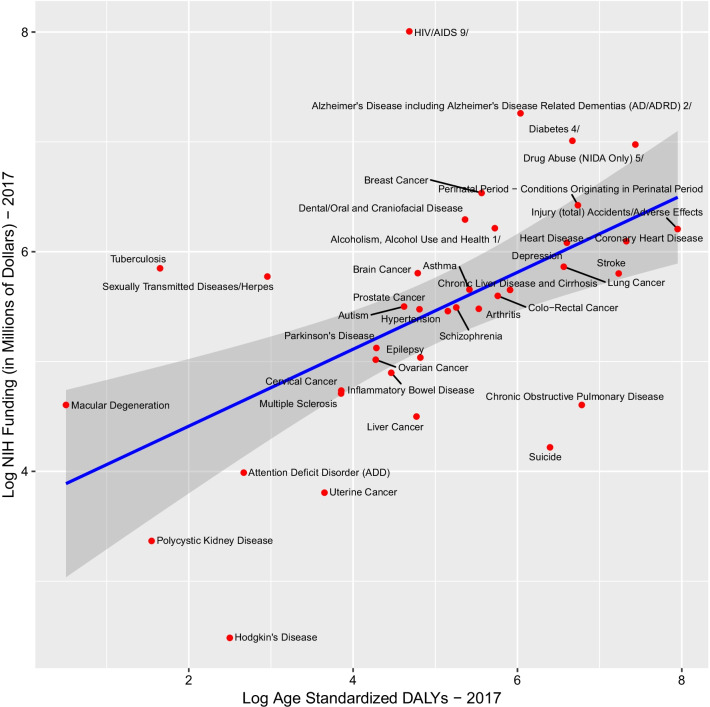
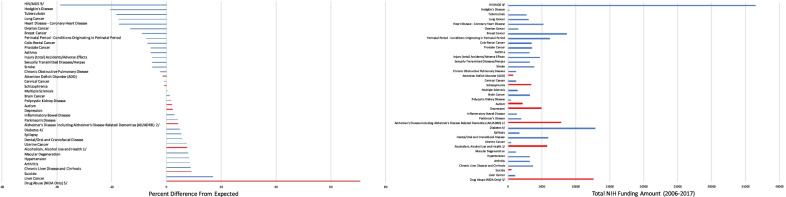
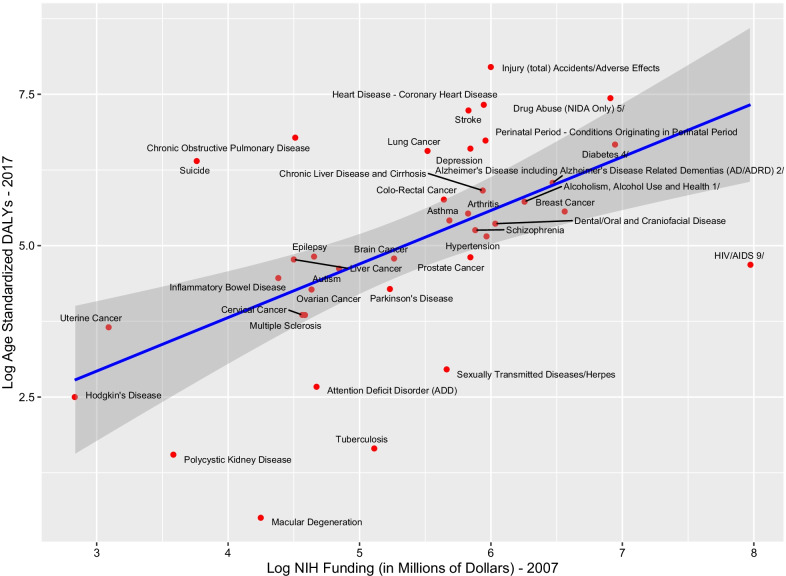
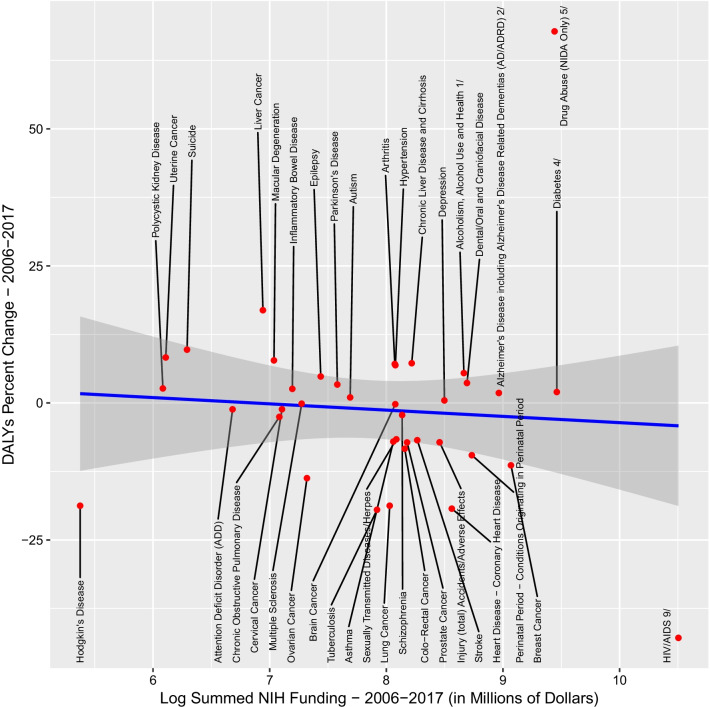
In 2017, there was a positive association between NIH research fund allocations and DALYs for the same year (F = 16.087, p = 0.0002921; slope = 0.35020; model R = 0.3088), suggesting proportionate allocation. There was a positive association between 2017 DALYs and 2007 NIH research allocation, implying a beneficial impact of research (F = 15.754, p = 0.0003; slope = 0.8845; model R = 0.3044). In contrast, there was a nonsignificant association between summed NIH funding and percent change in DALYs over 2006-2017 (F = 0.199; p = 0.65; beta coefficient = -1.144). When MDCs were ordered based on residuals, HIV/AIDS ranked first. Mental, neurologic or substance abuse (MNS) disorders comprised most residuals in the lower half.
NIH fund allocation is proportional to DALYs for MDCs. Temporal changes in DALYs vary by MDCs, but they are not significantly related to cumulative research outlays. Further analysis of temporal changes in DALYs could help to inform research outlays for MDCs and to study the impact of research.
疾病负担与研究资金之间的关系已经进行了横断面研究,但尚未研究其时间模式。从逻辑上讲,残疾调整生命年(DALY)的时间改善反映了研究资金的收益;但是,从研究中获得收益的未知滞后时间对此种假设进行了限制。
我们研究了美国国立卫生研究院(NIH)的研究资金分配和美国 DALY 估计值,这些数据涉及重叠的疾病类别(匹配疾病类别,MDC,N=38)。我们使用一般线性模型,分别分析了 2017 年 MDC 的 DALY 与 2017 年和 2007 年 NIH 研究分配之间的关系。我们还研究了 DALY 的变化如何与 NIH 研究资金的累积(2006-2017 年)有关。在将 DALY 变化回归到总和资金之后,我们获得了模型残差,这些残差估计了给定资金的每个 MDC 在负担变化方面观察到的和预期的变化之间的差异。
2017 年,NIH 研究资金分配与当年的 DALY 之间存在正相关关系(F=16.087,p=0.0002921;斜率=0.35020;模型 R=0.3088),表明分配比例合理。2017 年 DALY 与 2007 年 NIH 研究分配之间存在正相关关系,表明研究具有有益影响(F=15.754,p=0.0003;斜率=0.8845;模型 R=0.3044)。相比之下,2006-2017 年 NIH 资金总和与 DALY 变化百分比之间的相关性没有统计学意义(F=0.199;p=0.65;β系数=-1.144)。当根据残差对 MDC 进行排序时,艾滋病毒/艾滋病排名第一。精神、神经或物质滥用(MNS)障碍占下半部分中大多数残差。
NIH 资金分配与 MDC 的 DALY 成正比。DALY 的时间变化因 MDC 而异,但与累积研究支出没有明显关系。对 DALY 的时间变化进行进一步分析可以帮助确定 MDC 的研究支出,并研究研究的影响。