Department of Pharmacology, Institute of Basic Medical Sciences, Chinese Academy of Medical Sciences & School of Basic Medicine, Peking Union Medical College, Beijing, 100005, China.
State Key Laboratory of Natural and Biomimetic Drugs, School of Pharmaceutical Sciences, Peking University, Beijing, 100191, China.
J Hematol Oncol. 2022 Jun 3;15(1):73. doi: 10.1186/s13045-022-01274-8.
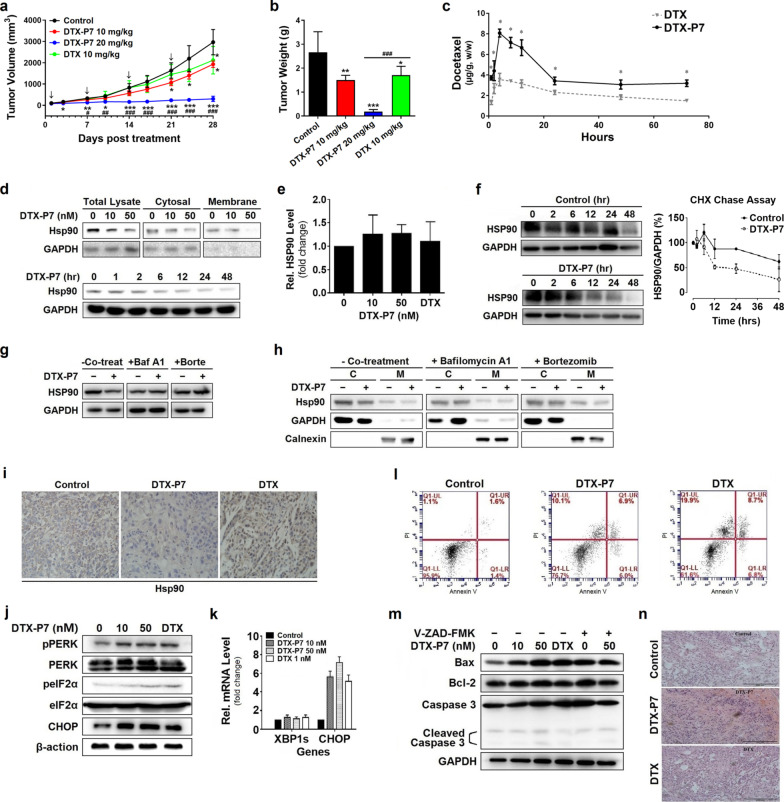
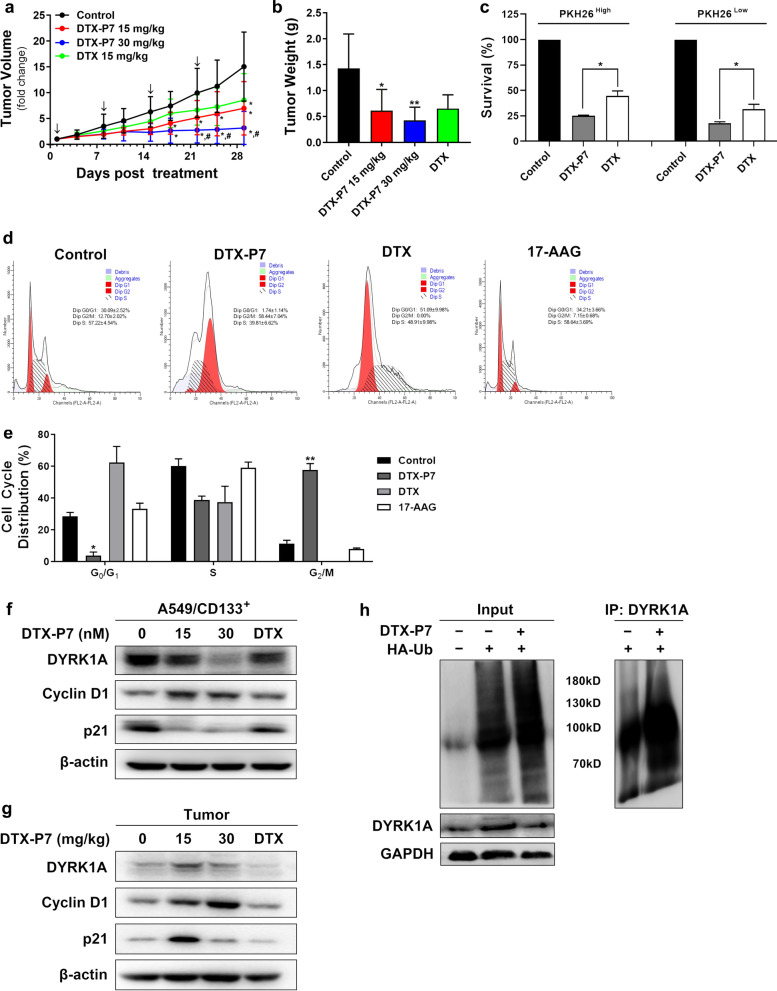
Despite tremendous success of molecular targeted therapy together with immunotherapy, only a small subset of patients can benefit from them. Chemotherapy remains the mainstay treatment for most of tumors including non-small cell lung cancer (NSCLC); however, non-selective adverse effects on healthy tissues and secondary resistance are the main obstacles. Meanwhile, the quiescent or dormant cancer stem-like cells (CSLCs) are resistant to antimitotic chemoradiotherapy. Complete remission can only be realized when both proliferative cancer cells and quiescent cancer stem cells are targeted. In the present research, we constructed a cooperatively combating conjugate (DTX-P7) composed of docetaxel (DTX) and a heptapeptide (P7), which specifically binds to cell surface Hsp90, and assessed the anti-tumor effects of DTX-P7 on non-small cell lung cancer. DTX-P7 preferentially suppressed tumor growth compared with DTX in vivo with a favorable distribution to tumor tissues and long circulation half-life. Furthermore, we revealed a distinctive mechanism whereby DTX-P7 induced unfolded protein response and eventually promoted apoptosis. More importantly, we found that DTX-P7 promoted cell cycle reentry of slow-proliferating CSLCs and subsequently killed them, exhibiting a "proliferate to kill" pattern. Collecitvely, by force of active targeting delivery of DTX via membrane-bound Hsp90, DTX-P7 induces unfolded protein response and subsequent apoptosis by degrading Hsp90, meanwhile awakens and kills the dormant cancer stem cells. Thus, DTX-P7 deserves further development as a promising anticancer therapeutic for treatment of various membrane-harboring Hsp90 cancer types.
尽管分子靶向治疗和免疫疗法取得了巨大成功,但只有一小部分患者从中受益。化疗仍然是大多数肿瘤的主要治疗方法,包括非小细胞肺癌(NSCLC);然而,对健康组织的非选择性不良反应和继发性耐药性是主要障碍。同时,静止或休眠的癌症干细胞样细胞(CSLCs)对抗有丝分裂的化疗和放疗具有抗性。只有当增殖性癌细胞和静止的癌症干细胞都被靶向时,才能实现完全缓解。在本研究中,我们构建了一种协同对抗的缀合物(DTX-P7),由多西紫杉醇(DTX)和一个七肽(P7)组成,它特异性地结合细胞表面的 HSP90,并评估了 DTX-P7 对非小细胞肺癌的抗肿瘤作用。与体内的 DTX 相比,DTX-P7 优先抑制肿瘤生长,具有良好的肿瘤组织分布和长循环半衰期。此外,我们揭示了一种独特的机制,即 DTX-P7 诱导未折叠蛋白反应,最终促进细胞凋亡。更重要的是,我们发现 DTX-P7 促进了缓慢增殖的 CSLC 的细胞周期再进入,随后杀死它们,表现出“增殖杀死”的模式。总之,通过膜结合 HSP90 主动靶向递送 DTX,DTX-P7 通过降解 HSP90 诱导未折叠蛋白反应和随后的细胞凋亡,同时唤醒并杀死休眠的癌症干细胞。因此,DTX-P7 值得进一步开发,作为一种有前途的治疗各种膜结合 HSP90 癌症类型的抗癌治疗药物。