Sainsbury Wellcome Centre for Neural Circuits and Behaviour, University College London, 25 Howland Street, London W1T 4JG, UK.
Sainsbury Wellcome Centre for Neural Circuits and Behaviour, University College London, 25 Howland Street, London W1T 4JG, UK.
Curr Biol. 2022 Jul 11;32(13):2972-2979.e3. doi: 10.1016/j.cub.2022.05.022. Epub 2022 Jun 2.
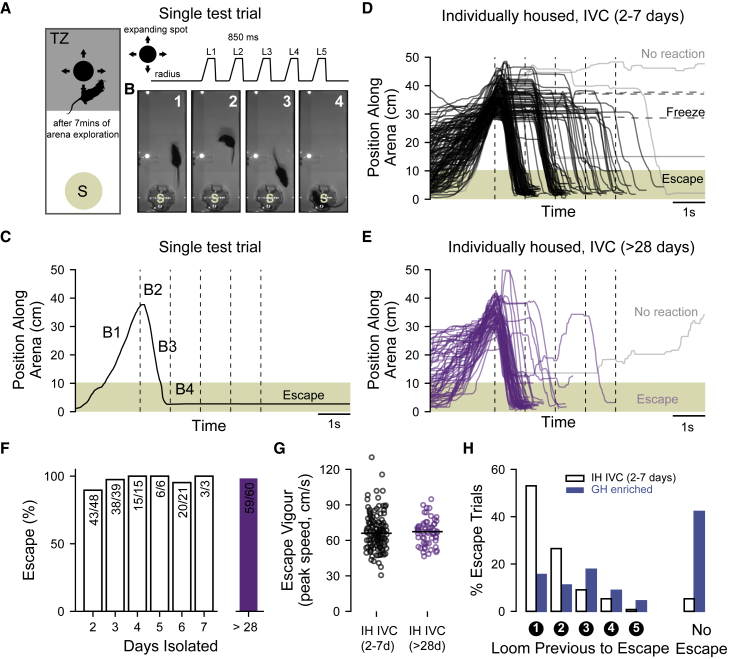
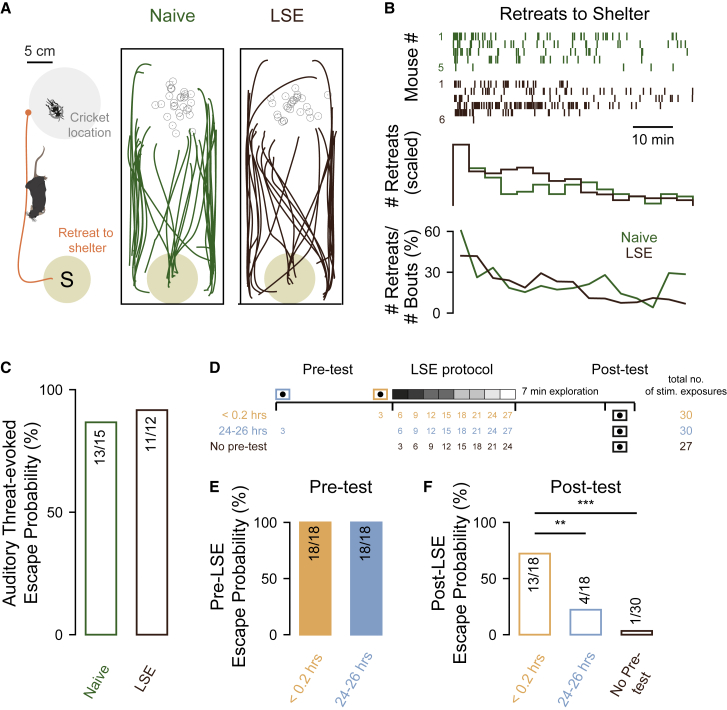
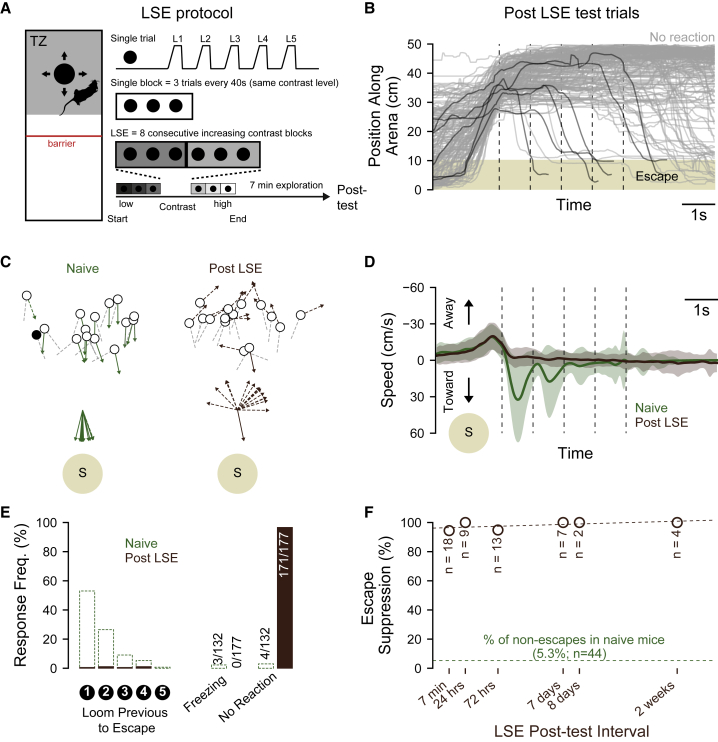
In many instances, external sensory-evoked neuronal activity is used by the brain to select the most appropriate behavioral response. Predator-avoidance behaviors such as freezing and escape are of particular interest since these stimulus-evoked responses are behavioral manifestations of a decision-making process that is fundamental to survival. Over the lifespan of an individual, however, the threat value of agents in the environment is believed to undergo constant revision, and in some cases, repeated avoidance of certain stimuli may no longer be an optimal behavioral strategy. To begin to study this type of adaptive control of decision-making, we devised an experimental paradigm to probe the properties of threat escape in the laboratory mouse Mus musculus. First, we found that while robust escape to visual looming stimuli can be observed after 2 days of social isolation, mice can also rapidly learn that such stimuli are non-threatening. This learned suppression of escape (LSE) is extremely robust and can persist for weeks and is not a generalized adaptation, since flight responses to novel live prey and auditory threat stimuli in the same environmental context were maintained. We also show that LSE cannot be explained by trial number or a simple form of stimulus desensitization since it is dependent on threat-escape history. We propose that the action selection process mediating escape behavior is constantly updated by recent threat history and that LSE can be used as a robust model system to understand the neurophysiological mechanisms underlying experience-dependent decision-making.
在许多情况下,大脑利用外部感觉诱发的神经元活动来选择最合适的行为反应。回避捕食者的行为,如冻结和逃跑,特别有趣,因为这些刺激诱发的反应是决策过程的行为表现,而决策过程是生存的基础。然而,在个体的一生中,环境中刺激物的威胁价值被认为会不断发生变化,在某些情况下,对某些刺激物的重复回避可能不再是最优的行为策略。为了开始研究这种类型的决策自适应控制,我们设计了一个实验范式来探测实验室小鼠 Mus musculus 中威胁逃避的特性。首先,我们发现,虽然在社交隔离 2 天后可以观察到对视觉逼近刺激的强烈逃避反应,但小鼠也可以迅速学习到这些刺激是没有威胁的。这种习得的逃避抑制(LSE)非常强大,可以持续数周,而且不是一种普遍的适应,因为在相同的环境背景下,对新的活体猎物和听觉威胁刺激的飞行反应仍然存在。我们还表明,LSE 不能用试验次数或简单的刺激脱敏形式来解释,因为它依赖于威胁逃避的历史。我们提出,介导逃避行为的动作选择过程会不断被最近的威胁历史所更新,而 LSE 可以作为一个强大的模型系统,用于理解经验依赖决策的神经生理机制。