Clinical, Educational and Health Psychology, University College London, Gower Street, London, WC1E 6BT, UK.
Institute of Psychiatry, Psychology and Neuroscience, King's College London, 16 De Crespigny Park, London, SE5 8AF, UK.
Sci Rep. 2022 Jun 3;12(1):9281. doi: 10.1038/s41598-022-12173-w.
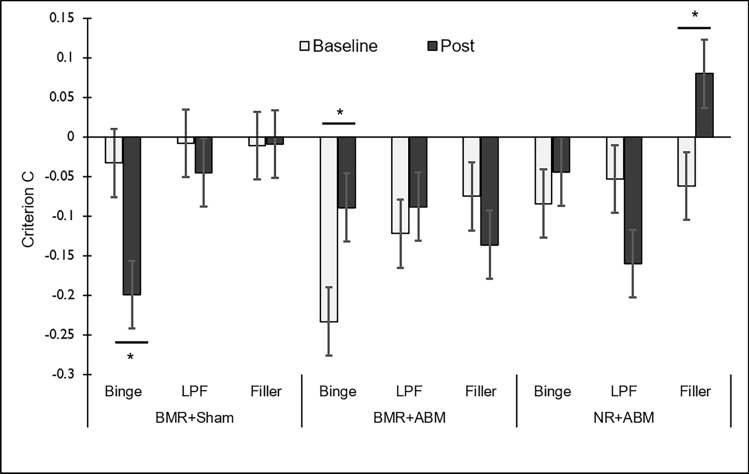
Binge eating is increasingly prevalent among adolescents and young adults and can have a lasting harmful impact on mental and physical health. Mechanistic insights suggest that aberrant reward-learning and biased cognitive processing may be involved in the aetiology of binge eating. We therefore investigated whether recently developed approaches to catalyse brief interventions by putatively updating maladaptive memory could also boost the effects of cognitive bias modification training on binge eating behaviour. A non-treatment-seeking sample of 90 binge eating young adults were evenly randomised to undergo either selective food response inhibition training, or sham training following binge memory reactivation. A third group received training without binge memory reactivation. Laboratory measures of reactivity and biased responses to food cues were assessed pre-post intervention and bingeing behaviour and disordered eating assessed up to 9 months post-intervention. The protocol was pre-registered at https://osf.io/82c4r/ . We found limited evidence of premorbid biased processing in lab-assessed measures of cognitive biases to self-selected images of typical binge foods. Accordingly, there was little evidence of CBM reducing these biases and this was not boosted by prior 'reactivation' of binge food reward memories. No group differences were observed on long-term bingeing behaviour, caloric consumption or disordered eating symptomatology. These findings align with recent studies showing limited impact of selective inhibition training on binge eating and do not permit conclusions regarding the utility of retrieval-dependent memory 'update' mechanisms as a treatment catalyst for response inhibition training.
暴饮暴食在青少年和年轻人中越来越普遍,会对身心健康产生持久的有害影响。机制研究表明,异常的奖励学习和有偏差的认知加工可能与暴饮暴食的病因有关。因此,我们研究了最近开发的通过假设更新适应不良的记忆来促进简短干预的方法是否也可以增强认知偏差修正训练对暴饮暴食行为的影响。我们将 90 名非治疗性的暴饮暴食的年轻成年人随机分为选择性食物反应抑制训练组或在暴饮暴食记忆再激活后进行假训练组,第三组在没有暴饮暴食记忆再激活的情况下接受训练。在干预前后评估实验室对食物线索的反应性和偏差反应,在干预后 9 个月评估暴饮暴食行为和饮食失调。该方案已在 https://osf.io/82c4r/ 上预先注册。我们发现,在实验室评估对自我选择的典型暴饮暴食食物图像的认知偏差的测量中,有证据表明存在与发病前的偏差处理。因此,认知偏差修正训练减少这些偏差的证据有限,而之前对暴食食物奖励记忆的“再激活”并没有增强这种效果。在长期暴饮暴食行为、卡路里摄入量或饮食失调症状方面,各组之间没有差异。这些发现与最近的研究一致,这些研究表明选择性抑制训练对暴饮暴食的影响有限,并且不能得出关于基于检索的记忆“更新”机制作为反应抑制训练治疗催化剂的效用的结论。