Tian Fan, Shen Qing, Hu Yihan, Ye Weimin, Valdimarsdóttir Unnur A, Song Huan, Fang Fang
Institute of Environmental Medicine, Karolinska Institute, Stockholm, Sweden.
West China School of Public Health and West China Fourth Hospital, Sichuan University, Chengdu, China.
Lancet Reg Health Eur. 2022 May 28;18:100402. doi: 10.1016/j.lanepe.2022.100402. eCollection 2022 Jul.
Prior research provides suggestive evidence on an association between stress-related disorders and mortality. No previous study has however addressed the role of familial confounding on such association.
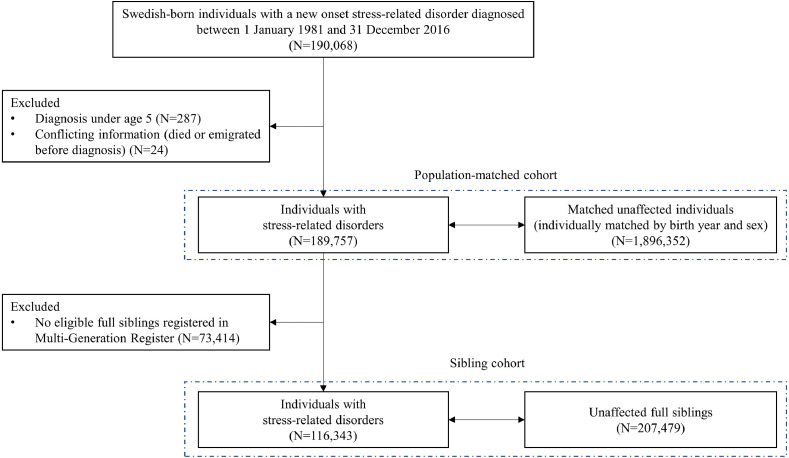
We conducted a nationwide cohort study of 189,757 individuals with a first-onset stress-related disorder between January 1, 1981 and December 31, 2016 in Sweden (i.e., exposed patients), 1,896,352 matched unexposed individuals, and 207,479 unaffected full siblings of the exposed patients. Cox proportional hazards models were used to estimate the hazard ratios (HRs) and 95% confidence intervals (CIs) of all-cause and cause-specific mortality.
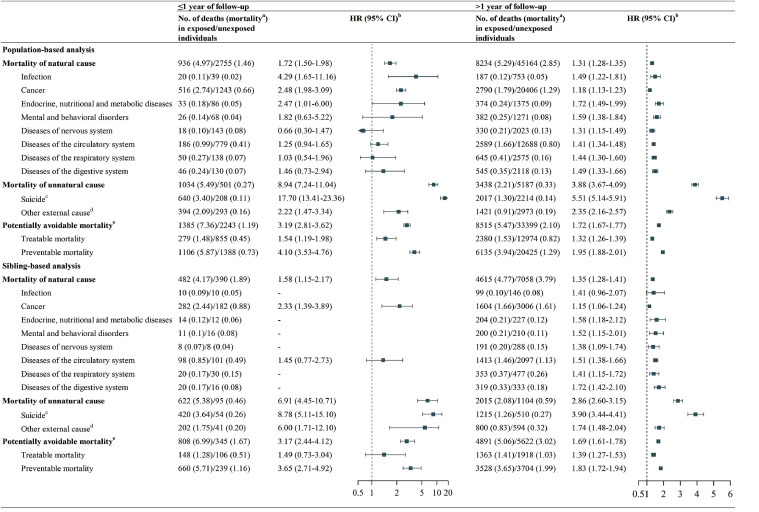
During a mean follow-up of 9.42 years, an elevated risk of all-cause mortality was observed during the entire follow-up among patients with stress-related disorders, compared with either unexposed individuals or their unaffected full siblings. Such excess risk was most pronounced within the first year after diagnosis of stress-related disorders (HR, 3.19 [95% CI, 2.87-3.54] in population-based comparison; HR, 3.21 [95% CI, 2.56-4.02] in sibling-based comparison). The excess risk decreased but remained statistically significant thereafter (HR, 1.64 [95% CI, 1.60-1.67] in population-based comparison; HR, 1.61 [95% CI, 1.54-1.68] in sibling-based comparison). An increased risk was observed for almost all cause-specific mortality, with greater risk increase for deaths from unnatural causes, especially suicide, and potentially avoidable causes.
Stress-related disorders were associated with an increased risk of all-cause mortality and multiple cause-specific mortality, and the risk elevation was independent of familial confounding. The excess mortality attributable to unnatural causes and potentially avoidable causes highlights the importance of clinical surveillance of major health hazards among patients with stress-related disorders.
EU Horizon 2020 Research and Innovation Action Grant, 1.3.5 Project for Disciplines of Excellence at West China Hospital of Sichuan University, National Natural Science Foundation of China, Icelandic Research Fund (Grant of Excellence), ERC Consolidator Grant, and Swedish Research Council.
先前的研究提供了有关应激相关障碍与死亡率之间关联的提示性证据。然而,此前尚无研究探讨家族混杂因素在此类关联中的作用。
我们在瑞典开展了一项全国性队列研究,纳入了1981年1月1日至2016年12月31日期间首次发作应激相关障碍的189,757名个体(即暴露患者)、1,896,352名匹配的未暴露个体以及207,479名暴露患者的未受影响的同胞手足。采用Cox比例风险模型估计全因死亡率和特定病因死亡率的风险比(HRs)及95%置信区间(CIs)。
在平均9.42年的随访期间,与未暴露个体或其未受影响的同胞手足相比,应激相关障碍患者在整个随访期间全因死亡率风险升高。这种额外风险在应激相关障碍诊断后的第一年内最为明显(基于人群比较的HR为3.19 [95% CI,2.87 - 3.54];基于同胞手足比较的HR为3.21 [95% CI,2.56 - 4.02])。此后额外风险虽有所下降,但仍具有统计学意义(基于人群比较的HR为1.64 [95% CI,1.60 - 1.67];基于同胞手足比较的HR为1.61 [95% CI,1.54 - 1.68])。几乎所有特定病因死亡率的风险均有所增加,非自然原因导致的死亡,尤其是自杀以及潜在可避免原因导致的死亡风险增加更为显著。
应激相关障碍与全因死亡率及多种特定病因死亡率风险增加相关,且风险升高独立于家族混杂因素。非自然原因和潜在可避免原因导致的额外死亡率凸显了对应激相关障碍患者主要健康危害进行临床监测的重要性。
欧盟“地平线2020”研究与创新行动资助、四川大学华西医院卓越学科1.3.5项目、中国国家自然科学基金、冰岛研究基金(卓越资助)、欧洲研究委员会巩固资助以及瑞典研究理事会。