West China Biomedical Big Data Center, West China Hospital, Sichuan University, China.
Med-X Center for Informatics, Sichuan University, Chengdu, China.
Int J Epidemiol. 2023 Apr 19;52(2):600-610. doi: 10.1093/ije/dyac145.
Although the death of a child, sibling or spouse has been associated with elevated risk of mortality, less is known about the survival of twin siblings exposed to a co-twin loss.
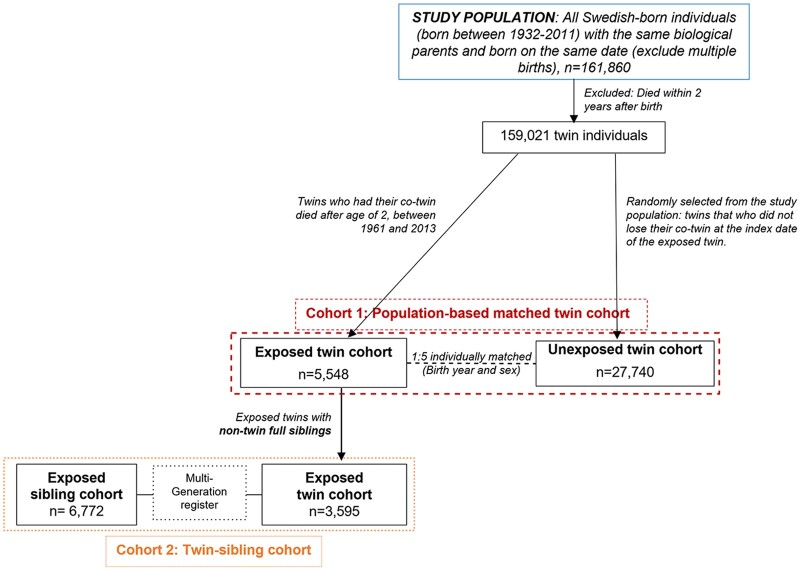
In a Swedish population-based sibling-matched cohort, we compared the mortality of 5548 twin individuals who lost their co-twin between 1932 and 2011 with that of 27 740 age-matched and sex-matched twin individuals without such a loss and 6772 full siblings of these exposed twin individuals. Cox regression models were used to estimate the hazard ratios (HRs) of all-cause and cause-specific mortality.
We found increased risk of all-cause mortality among twin individuals exposed to a co-twin loss compared with matched unexposed twin individuals (HR = 1.30, 95% CI: 1.18-1.43) and their full siblings (HR = 1.10, 95% CI: 0.96-1.27) after adjusting for multiple covariates. The all-cause mortality risk was greater for loss of a co-twin due to unnatural deaths (HR = 1.54, 95% CI: 1.17-2.03) than natural deaths (HR = 1.26, 95% CI: 1.14-1.40). For cause-specific mortality, co-twin loss was associated with a higher risk of unnatural deaths both among twin individuals who lost their co-twin due to unnatural deaths (HR = 1.98, 95% CI: 1.27-3.10) and those whose loss was due to natural deaths (HR = 1.48, 95% CI: 1.07-2.06). The risk elevations were generally stronger for loss of a monozygotic co-twin than loss of a dizygotic co-twin.
Loss of a co-twin, especially a monozygotic co-twin, was associated with increased mortality, particularly of unnatural causes, among the surviving twin individuals. The excess mortality is likely attributable to both shared disease susceptibility within the twin pair and the adverse health sequelae of bereavement.
尽管儿童、兄弟姐妹或配偶的死亡与死亡率升高有关,但对于双胞胎兄弟姐妹在失去同胞后存活的情况,人们了解较少。
在一项基于瑞典人群的同胞匹配队列研究中,我们比较了 1932 年至 2011 年间 5548 名失去同胞的双胞胎个体与 27740 名年龄和性别匹配的无此类丧失的双胞胎个体以及这些暴露于同胞丧失的双胞胎个体的 6772 名全同胞的死亡率。使用 Cox 回归模型估计全因和特定原因死亡率的风险比(HR)。
与匹配的未暴露的双胞胎个体(HR=1.30,95%CI:1.18-1.43)和他们的全同胞(HR=1.10,95%CI:0.96-1.27)相比,暴露于同胞丧失的双胞胎个体的全因死亡率风险增加。在调整了多个协变量后,由于非自然死亡导致的同胞丧失(HR=1.54,95%CI:1.17-2.03)的全因死亡率风险大于自然死亡(HR=1.26,95%CI:1.14-1.40)。对于特定原因的死亡率,同胞丧失与非自然死亡导致的同胞丧失的双胞胎个体(HR=1.98,95%CI:1.27-3.10)和因自然死亡导致的同胞丧失的双胞胎个体(HR=1.48,95%CI:1.07-2.06)的非自然死亡风险更高相关。这种风险升高在单卵双胞胎丧失时比在双卵双胞胎丧失时更为明显。
同胞丧失,特别是单卵双胞胎的丧失,与存活的双胞胎个体的死亡率升高有关,尤其是非自然原因导致的死亡率升高。这种额外的死亡率可能归因于双胞胎个体之间共同的疾病易感性和丧亲带来的不良健康后果。