Gasser Benedikt, Frei Annika, Niederseer David, Catuogno Silvio, Frey Walter O, Flück Martin
Departement für Bewegung und Sport, Universität Basel, Basel, Switzerland.
Laboratory for Muscle Plasticity, University of Zurich, Zurich, Switzerland.
Front Sports Act Living. 2022 May 19;4:814974. doi: 10.3389/fspor.2022.814974. eCollection 2022.
The efficiency of aerobic energy provision to working skeletal muscle is affected by aerobic fitness and a prominent insertion/deletion polymorphism in the angiotensin-converting enzyme (ACE-I/D) gene for the major modulator of tissue perfusion. We assessed whether variability in the fitness state is dependent on the contribution of multiple aspects of oxygen transport to the development of muscle power, and the respective control coefficients, are associated with the ACE-I/D genotype.
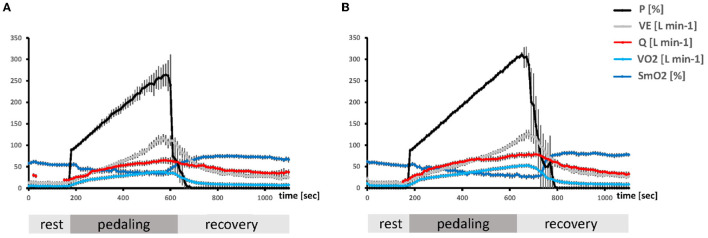
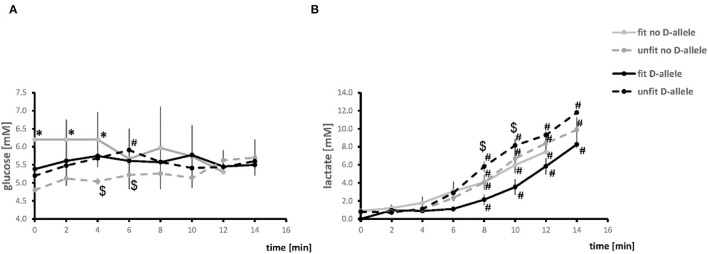
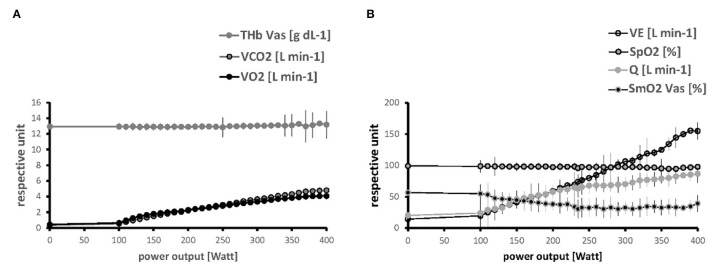
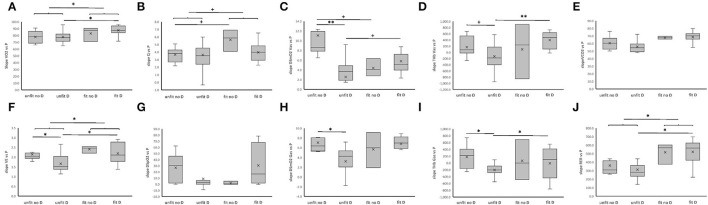
Twenty-five women and 19 men completed a ramp test of cycling exercise to exhaustion during which serial steps of oxygen transport [oxygen uptake (L O min) (VO), minute ventilation in (L min) (VE), cardiac output in equivalents of L min (Q), arterial oxygen saturation (SpO), muscle oxygen saturation (SmO), and total hemoglobin concentration (g dL) (THb) in and , respiration exchange ratio (RER)], blood lactate and glucose concentration, were continuously monitored. The contribution/reliance of power output (PO) on the parameters of oxygen transport was estimated based on the slopes in Pearson's moment correlations (|| > 0.65, < 0.05) vs. power values over the work phase of the ramp test, and for respective fractional changes per time (defining control coefficients) over the rest, work, and recovery phase of the ramp test. Associations of variability in slopes and control coefficients with the genotype and aerobic fitness were evaluated with ANOVA.
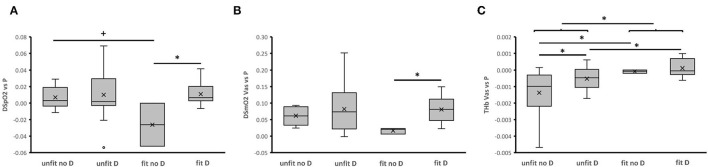
All parameters characterizing aspects of the pathway of oxygen, except THb, presented strong linear relationships [(|| > 0.70) to PO]. Metabolic efficiency was 30% higher in the aerobically fit subjects [peak oxygen uptake (mL O min) (VOpeak) ≥ 50 ml min kg], and energy expenditure at rest was associated with the fitness state × ACE-I/D genotype, being highest in the fit non-carriers of the ACE D-allele. For VO, VE, and RER the power-related slopes of linear relationships during work demonstrated an association with aerobic fitness, being 30-40% steeper in the aerobically fit than unfit subjects. For VE the power-related slope also demonstrated an association with the ACE-I/D genotype. For increasing deficit in muscle oxygen saturation (DSmO) in (DSmO Vas), the power-related slope was associated with the interaction between aerobic fitness × ACE-I/D genotype.
Local and systemic aspects of aerobic energy provision stand under influence of the fitness state and ACE-I/D genotype. This especially concerns the association with the index of the muscle's mitochondrial respiration (SmO) which compares to the genetic influences of endurance training.
向工作中的骨骼肌提供有氧能量的效率受有氧适能以及血管紧张素转换酶(ACE-I/D)基因中一个显著的插入/缺失多态性的影响,该基因是组织灌注的主要调节因子。我们评估了适能状态的变异性是否取决于氧运输多个方面对肌肉力量发展的贡献,以及各自的控制系数是否与ACE-I/D基因型相关。
25名女性和19名男性完成了一项渐增负荷的自行车运动测试,直至力竭,在此期间连续监测氧运输的一系列指标[摄氧量(L·min)(VO₂)、分钟通气量(L·min)(VE)、心输出量(L·min当量)(Q)、动脉血氧饱和度(SpO₂)、肌肉血氧饱和度(SmO₂)以及总血红蛋白浓度(g·dL)(THb)]、呼吸交换率(RER)、血乳酸和血糖浓度。基于皮尔逊积矩相关性中的斜率(|r|>0.65,P<0.05)与渐增负荷测试工作阶段的功率值之间的关系,以及渐增负荷测试休息、工作和恢复阶段各自每单位时间的分数变化(定义控制系数),估算功率输出(PO)对氧运输参数的贡献/依赖程度。通过方差分析评估斜率和控制系数的变异性与基因型及有氧适能之间的关联。
除THb外,所有表征氧运输途径各方面的参数与PO均呈现强线性关系(|r|>0.70)。有氧适能良好的受试者[峰值摄氧量(mL·O₂·min)(VO₂peak)≥50 ml·min⁻¹·kg⁻¹]的代谢效率高30%,静息能量消耗与适能状态×ACE-I/D基因型相关,在有氧适能良好且不携带ACE D等位基因的个体中最高。对于VO₂、VE和RER,工作期间线性关系的功率相关斜率与有氧适能相关,有氧适能良好的受试者比不适能的受试者陡30 - 40%。对于VE,功率相关斜率也与ACE-I/D基因型相关。对于肌肉血氧饱和度(ΔSmO₂)在[ΔSmO₂/ΔV̇O₂]中的增加不足,功率相关斜率与有氧适能×ACE-I/D基因型之间的相互作用相关。
有氧能量供应的局部和全身方面受适能状态和ACE-I/D基因型的影响。这尤其涉及与肌肉线粒体呼吸指标(SmO₂)的关联,该指标可与耐力训练的遗传影响相比较。