Jabbour Georges, Majed Lina
Sport Science Program, College of Arts and Sciences, Qatar University, Doha, Qatar.
Front Physiol. 2019 Mar 15;10:265. doi: 10.3389/fphys.2019.00265. eCollection 2019.
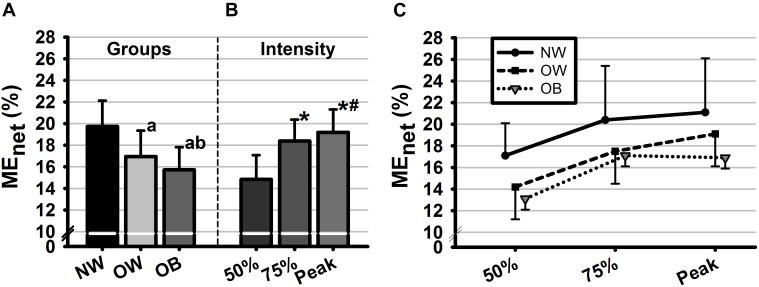
This study investigated the mechanical efficiency (ME) and associated factors in obese, overweight, and normal-weight adolescent boys during incremental cycle exercise test to exhaustion. Forty-five sedentary adolescent boys (13-14 years old) were separated in three groups according to the percentage of fat mass as follows: 15 normal-weight (NW) (body fat: 16.0 ± 1.9%), 15 overweight (OW) (body fat: 24.0 ± 1.6%), and 15 obese (OB) (body fat: 31.0 ± 3.0%). All groups completed an incremental cycle exercise to exhaustion in which energy consumption (E, W), ME (%), lipid oxidation rate (LO, %), plasma epinephrine and norepinephrine concentrations were determined consecutively at rest and at three intensity levels corresponding to 50 and 75% of each participant's maximal heart rate (50%HRmax and 75%HRmax) and peak oxygen consumption ( O). During the incremental cycle exercise test, plasma epinephrine, and norepinephrine responses as well as ME determined at 50%HRmax, 75%HRmax, and at VO stages were significantly lower in OB compared to NW and OW individuals ( < 0.01). Multiple linear regressions showed that body weight (ß = -0.64, < 0.001), energy consumption (ß = -0.24, < 0.05) and lipid oxidation (ß = 0.69, < 0.01) were significant predictors of ME at 50%HRmax. However, at 75%HRmax and O, significant predictors of ME were epinephrine (ß = 0.34, ß = 0.49, respectively, = 0.01), norepinephrine (ß = 0.26, ß = 0.60, respectively, < 0.05) and power output (ß = 0.62, ß = 0.71, respectively, < 0.01). These findings suggest that excess in body weight exerts a negative effect on ME at a low intensity by increasing energy consumption for obese and overweight adolescent boys, while at higher intensities (75%HRmax and VO) the lower ME could be better explained by the lower power output and catecholamine responses that were attenuated among obese and overweight adolescent boys.
本研究调查了肥胖、超重和正常体重的青春期男孩在递增式自行车运动至疲劳测试中的机械效率(ME)及相关因素。45名久坐不动的青春期男孩(13 - 14岁)根据体脂百分比分为三组:15名正常体重(NW)(体脂:16.0±1.9%),15名超重(OW)(体脂:24.0±1.6%),以及15名肥胖(OB)(体脂:31.0±3.0%)。所有组均完成递增式自行车运动至疲劳,在此过程中,连续测定静息状态以及对应于每位参与者最大心率(50%HRmax和75%HRmax)及峰值耗氧量( O)的三个强度水平下的能量消耗(E,瓦)、ME(%)、脂质氧化率(LO,%)、血浆肾上腺素和去甲肾上腺素浓度。在递增式自行车运动测试期间,与NW和OW个体相比,OB个体在50%HRmax、75%HRmax及VO阶段测定的血浆肾上腺素和去甲肾上腺素反应以及ME显著更低( < 0.01)。多元线性回归显示,体重(ß = -0.64, < 0.001)、能量消耗(ß = -0.24, < 0.05)和脂质氧化(ß = 0.69, < 0.01)是50%HRmax时ME的显著预测因素。然而,在75%HRmax和 O时,ME的显著预测因素是肾上腺素(分别为ß = 0.34,ß = 0.49, = 0.01)、去甲肾上腺素(分别为ß = 0.26,ß = 0.60, < 0.05)和功率输出(分别为ß = 0.62,ß = 0.71, < 0.01)。这些发现表明,体重超标通过增加肥胖和超重青春期男孩的能量消耗,在低强度时对ME产生负面影响,而在较高强度(75%HRmax和VO)时,较低的ME可以更好地由肥胖和超重青春期男孩中较低的功率输出以及减弱的儿茶酚胺反应来解释。