Burkova Valentina N, Butovskaya Marina L, Randall Ashley K, Fedenok Julija N, Ahmadi Khodabakhsh, Alghraibeh Ahmad M, Allami Fathil Bakir Mutsher, Alpaslan Fadime Suata, Al-Zu'bi Mohammad Ahmad Abdelaziz, Al-Mseidin Kholoud Imhammad Meqbel, Biçer Derya Fatma, Cetinkaya Hakan, David Oana Alexandra, Donato Silvia, Dural Seda, Erickson Paige, Ermakov Alexey M, Ertuğrul Berna, Fayankinnu Emmanuel Abiodun, Fisher Maryanne L, Al Gharaibeh Fakir, Hocker Lauren, Hromatko Ivana, Kasparova Elena, Kavina Alexander, Khatatbeh Yahya M, Khun-Inkeeree Hareesol, Kline Kai M, Koç Fırat, Kolodkin Vladimir, MacEacheron Melanie, Maruf Irma Rachmawati, Meskó Norbert, Mkrtchyan Ruzan, Nurisnaeny Poppy Setiawati, Ojedokun Oluyinka, Adebayo Damilola, Omar-Fauzee Mohd S B, Özener Barıs, Ponciano Edna Lúcia Tinoco, Rizwan Muhammad, Sabiniewicz Agnieszka, Spodina Victoriya I, Stoyanova Stanislava, Tripathi Nachiketa, Upadhyay Satwik, Weisfeld Carol, Yaakob Mohd Faiz Mohd, Yusof Mat Rahimi, Zinurova Raushaniia I
Center of Cross-Cultural Psychology and Human Ethology, Institute of Ethnology and Anthropology, Russian Academy of Sciences, Moscow, Russia.
International Centre of Anthropology, National Research University Higher School of Economics, Moscow, Russia.
Front Psychol. 2022 May 19;13:805586. doi: 10.3389/fpsyg.2022.805586. eCollection 2022.
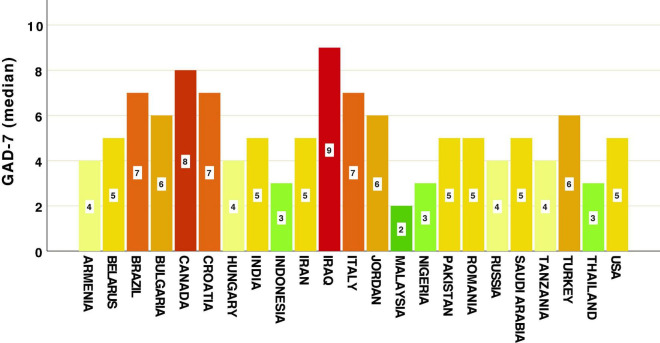
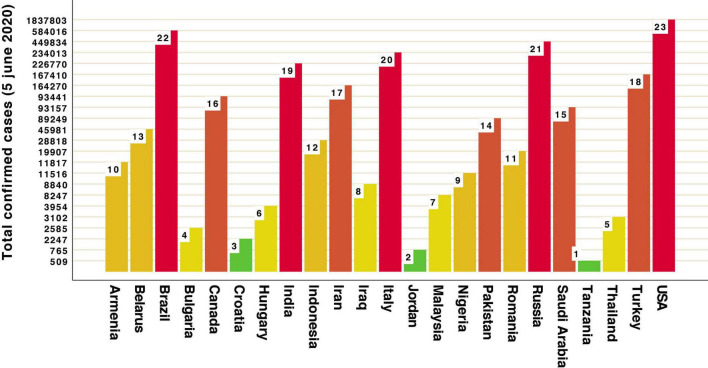
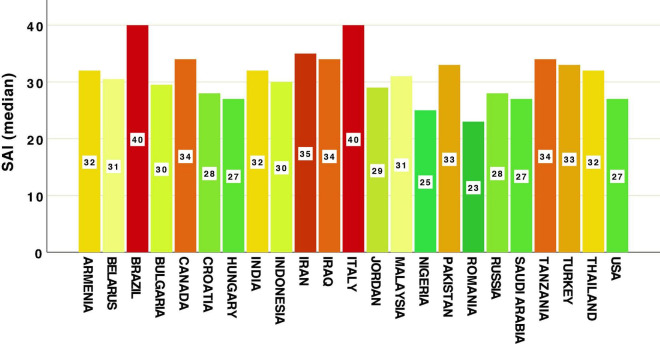
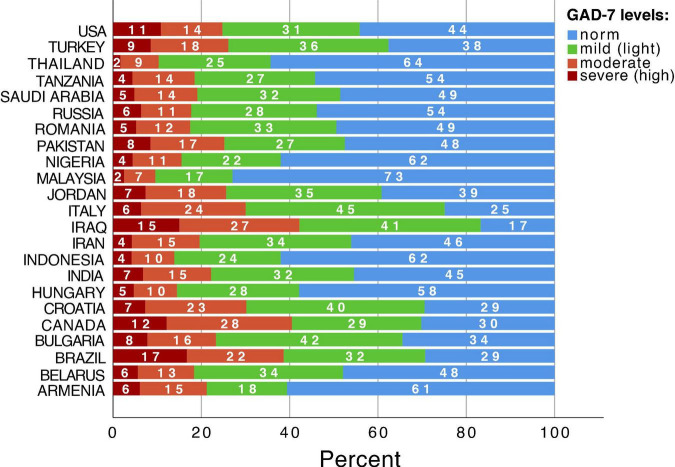
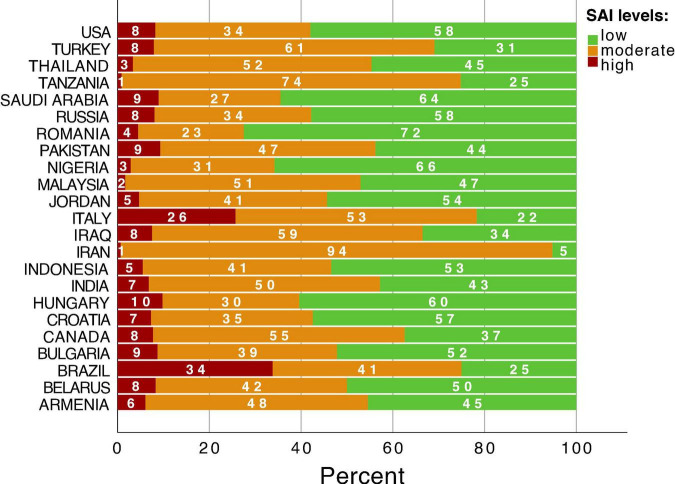
The COVID-19 restrictions have impacted people's lifestyles in all spheres (social, psychological, political, economic, and others). This study explored which factors affected the level of anxiety during the time of the first wave of COVID-19 and subsequent quarantine in a substantial proportion of 23 countries, included in this study. The data was collected from May to August 2020 (5 June 2020). The sample included 15,375 participants from 23 countries: (seven from Europe: Belarus, Bulgaria, Croatia, Hungary, Italy, Romania, Russia; 11 from West, South and Southeast Asia: Armenia, India, Indonesia, Iran, Iraq, Jordan, Malaysia, Pakistan, Saudi Arabia, Thailand, Turkey; two African: Nigeria and Tanzania; and three from North, South, and Central America: Brazil, Canada, United States). Level of anxiety was measured by means of the 7-item Generalized Anxiety Disorder Scale (GAD-7) and the 20-item first part of The State-Trait Anxiety Inventory (STAI)-State Anxiety Inventory (SAI). Respondents were also asked about their personal experiences with COVID-19, attitudes toward measures introduced by governments, changes in attitudes toward migrants during a pandemic, family income, isolation conditions, etc. The factor analysis revealed that four factors explained 45.08% of variance in increase of anxiety, and these components were interpreted as follows: (1) personal awareness of the threat of COVID-19, (2) personal reaction toward officially undertaken measures and attitudes to foreigners, (3) personal trust in official sources, (4) personal experience with COVID-19. Three out of four factors demonstrated strong associations with both scales of anxiety: high level of anxiety was significantly correlated with high level of personal awareness of the threat of COVID-19, low level of personal reaction toward officially undertaken measures and attitudes to foreigners, and high level of presence of personal experience with COVID-19. Our study revealed significant main effects of sex, country, and all four factors on the level of anxiety. It was demonstrated that countries with higher levels of anxiety assessed the real danger of a pandemic as higher, and had more personal experience with COVID-19. Respondents who trusted the government demonstrated lower levels of anxiety. Finally, foreigners were perceived as the cause of epidemic spread.
新冠疫情防控措施在各个领域(社会、心理、政治、经济等)都对人们的生活方式产生了影响。本研究探讨了在23个国家的相当一部分人群中,哪些因素在新冠疫情第一波及随后的隔离期间影响了焦虑水平,这23个国家均纳入了本研究。数据收集于2020年5月至8月(2020年6月5日)。样本包括来自23个国家的15375名参与者:(欧洲7个国家:白俄罗斯、保加利亚、克罗地亚、匈牙利、意大利、罗马尼亚、俄罗斯;西亚、南亚和东南亚11个国家:亚美尼亚、印度、印度尼西亚、伊朗、伊拉克、约旦、马来西亚、巴基斯坦、沙特阿拉伯、泰国、土耳其;非洲2个国家:尼日利亚和坦桑尼亚;北美洲、南美洲和中美洲3个国家:巴西、加拿大、美国)。焦虑水平通过7项广泛性焦虑障碍量表(GAD - 7)和状态 - 特质焦虑问卷(STAI)的20项第一部分——状态焦虑量表(SAI)进行测量。还询问了受访者关于他们感染新冠病毒的个人经历、对政府采取措施的态度、疫情期间对移民态度的变化、家庭收入、隔离条件等。因素分析表明,四个因素解释了焦虑增加变异的45.08%,这些因素被解释如下:(1)对新冠病毒威胁的个人认知,(2)对官方采取措施的个人反应以及对外国人的态度,(3)对官方消息来源的个人信任,(4)感染新冠病毒的个人经历。四个因素中的三个与两种焦虑量表都显示出强烈关联:高焦虑水平与对新冠病毒威胁的高个人认知、对官方采取措施的低个人反应以及对外国人的态度以及感染新冠病毒的高个人经历显著相关。我们的研究揭示了性别、国家以及所有四个因素对焦虑水平的显著主效应。结果表明,焦虑水平较高的国家认为疫情的实际危险更高,且感染新冠病毒的个人经历更多。信任政府的受访者焦虑水平较低。最后,外国人被视为疫情传播的原因。