Liu Qian, Hu Pingzhao
Department of Biochemistry and Medical Genetics, University of Manitoba, Winnipeg, Manitoba R3E 0W3, Canada.
Department of Computer Science, University of Manitoba, Winnipeg, Manitoba R3E 0W3, Canada.
Comput Struct Biotechnol J. 2022 May 18;20:2484-2494. doi: 10.1016/j.csbj.2022.05.031. eCollection 2022.
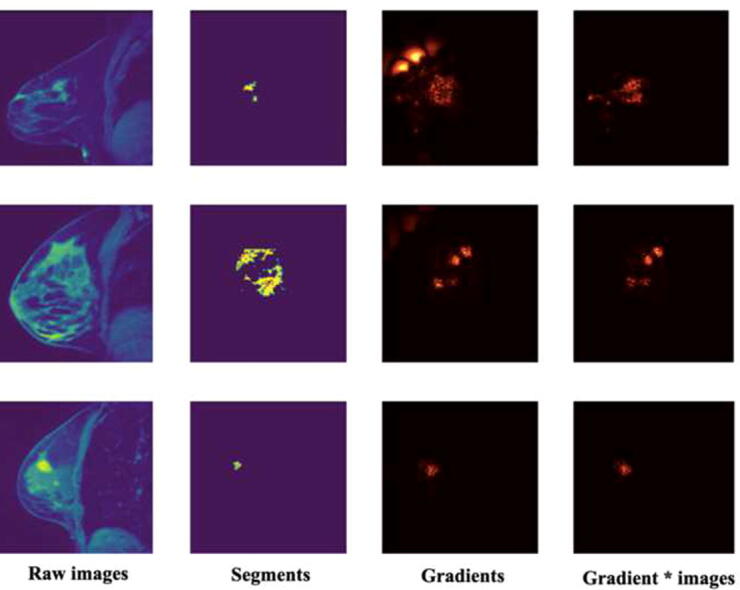
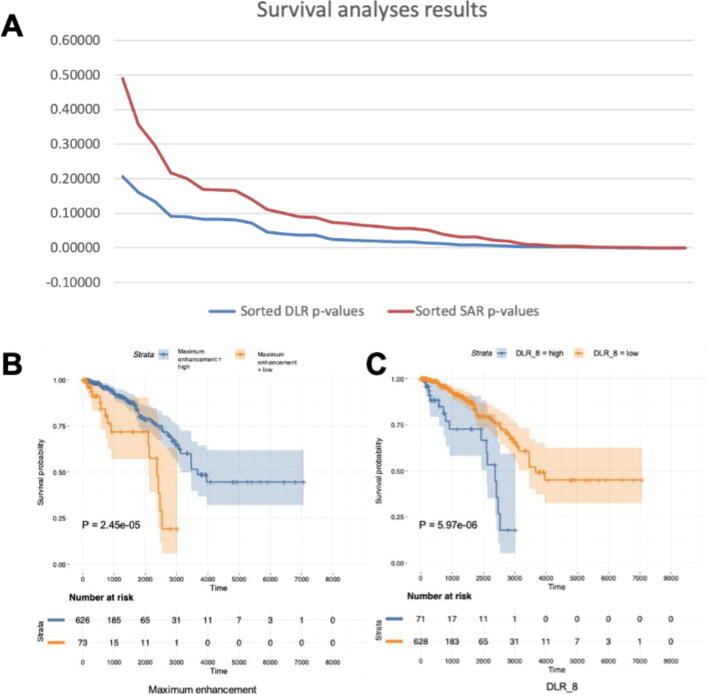
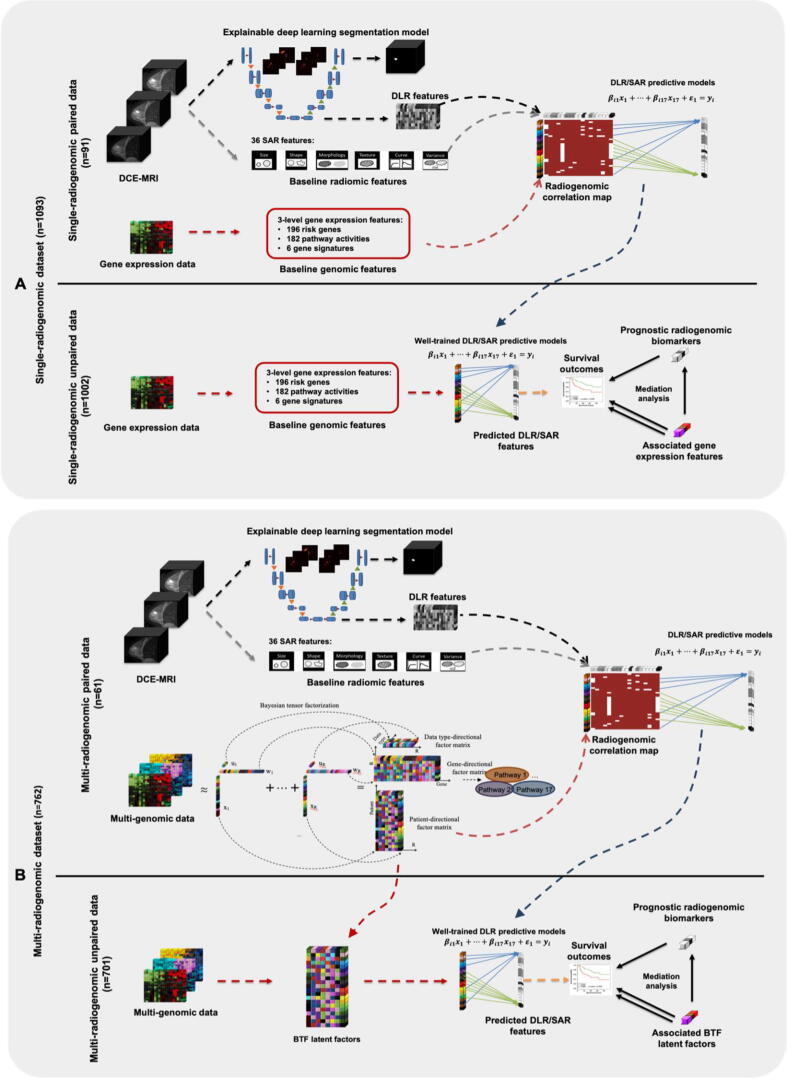
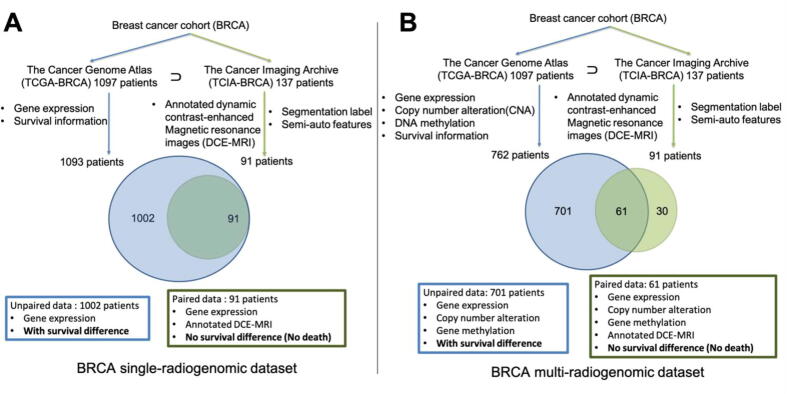
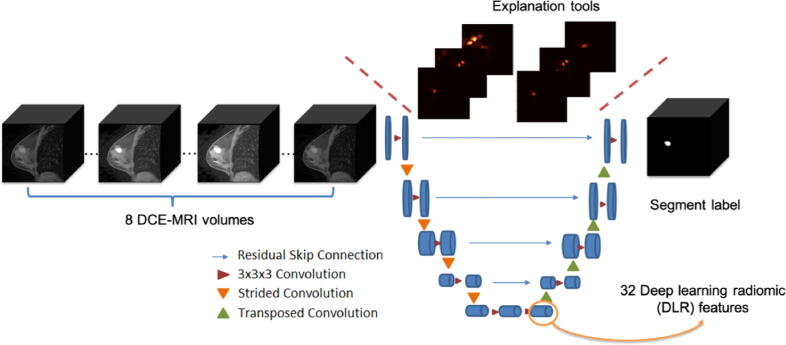
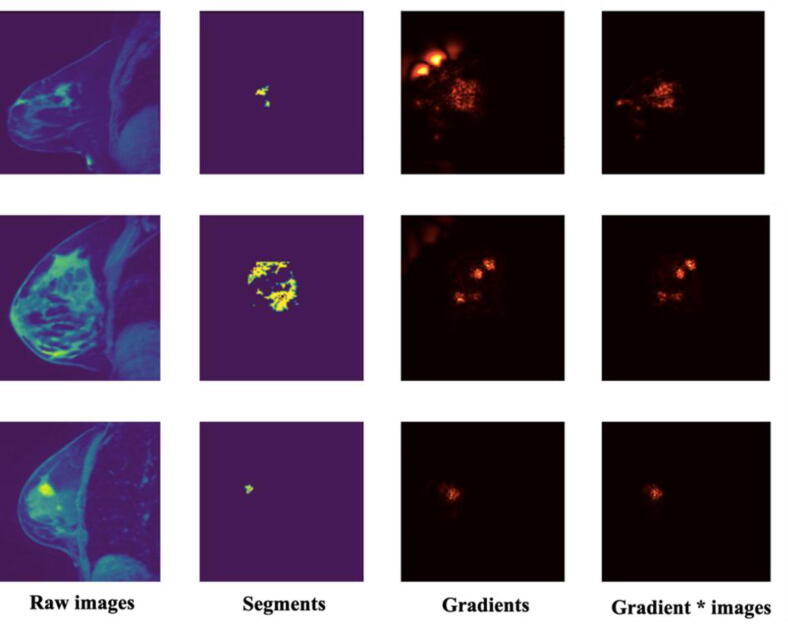
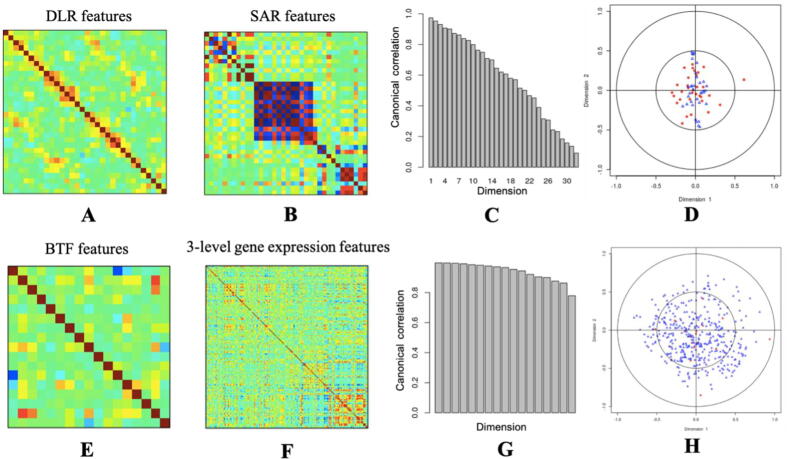
In precise medicine, it is with great value to develop computational frameworks for identifying prognostic biomarkers which can capture both multi-genomic and phenotypic heterogeneity of breast cancer (BC). Radiogenomics is a field where medical images and genomic measurements are integrated and mined to solve challenging clinical problems. Previous radiogenomic studies suffered from data incompleteness, feature subjectivity and low interpretability. For example, the majority of the radiogenomic studies miss one or two of medical imaging data, genomic data, and clinical outcome data, which results in the data incomplete issue. Feature subjectivity issue comes from the extraction of imaging features with significant human involvement. Thus, there is an urgent need to address above-mentioned limitations so that fully automatic and transparent radiogenomic prognostic biomarkers could be identified for BC. We proposed a novel framework for BC prognostic radiogenomic biomarker identification. This framework involves an explainable DL model for image feature extraction, a Bayesian tensor factorization (BTF) processing for multi-genomic feature extraction, a leverage strategy to utilize unpaired imaging, genomic, and survival outcome data, and a mediation analysis to provide further interpretation for identified biomarkers. This work provided a new perspective for conducting a comprehensive radiogenomic study when only limited resources are given. Compared with baseline traditional radiogenomic biomarkers, the 23 biomarkers identified by the proposed framework performed better in indicating patients' survival outcome. And their interpretability is guaranteed by different levels of build-in and follow-up analyses.
在精准医学中,开发用于识别预后生物标志物的计算框架具有重要价值,这些生物标志物能够捕捉乳腺癌(BC)的多基因组和表型异质性。放射基因组学是一个整合和挖掘医学图像与基因组测量数据以解决具有挑战性的临床问题的领域。以往的放射基因组学研究存在数据不完整、特征主观性和低可解释性等问题。例如,大多数放射基因组学研究缺少医学成像数据、基因组数据和临床结果数据中的一两项,这导致了数据不完整的问题。特征主观性问题源于在很大程度上依赖人工参与的成像特征提取。因此,迫切需要解决上述局限性,以便能够为BC识别出全自动且透明的放射基因组预后生物标志物。我们提出了一种用于BC预后放射基因组生物标志物识别的新型框架。该框架包括一个用于图像特征提取的可解释深度学习模型、一个用于多基因组特征提取贝叶斯张量分解(BTF)处理、一种利用未配对成像、基因组和生存结果数据的杠杆策略,以及一种用于为已识别生物标志物提供进一步解释的中介分析。这项工作为在资源有限的情况下进行全面的放射基因组学研究提供了一个新视角。与基线传统放射基因组生物标志物相比,所提出框架识别出的23种生物标志物在指示患者生存结果方面表现更佳。并且它们的可解释性通过不同层次的内置分析和后续分析得到保证。