Department Public Health, Institute of Nursing Science, University of Basel, Basel, Switzerland.
Center Clinical Nursing Science, University Hospital Zurich, Zurich, Switzerland.
Transpl Int. 2022 May 18;35:10255. doi: 10.3389/ti.2022.10255. eCollection 2022.
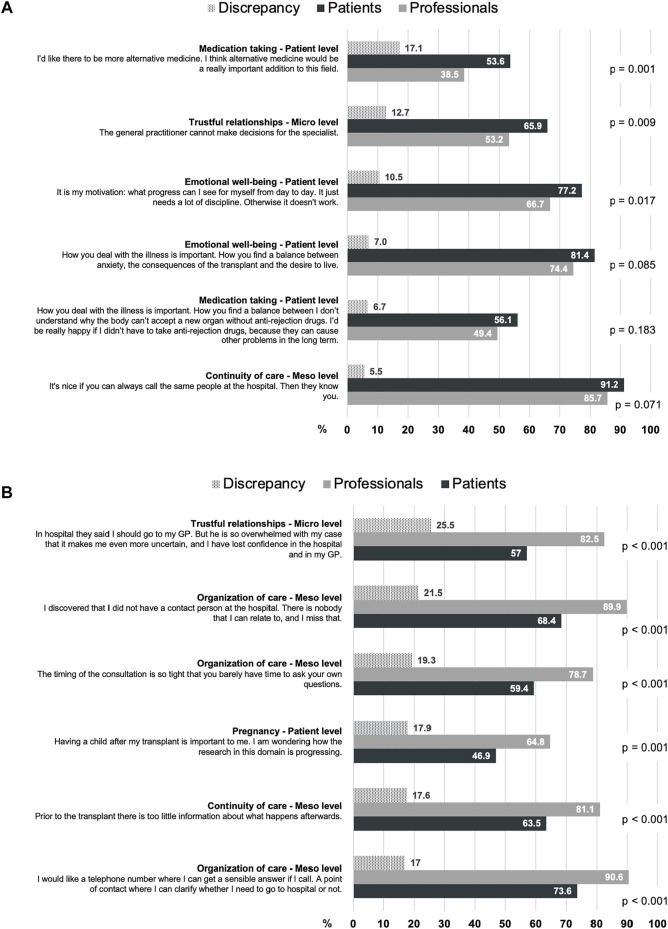
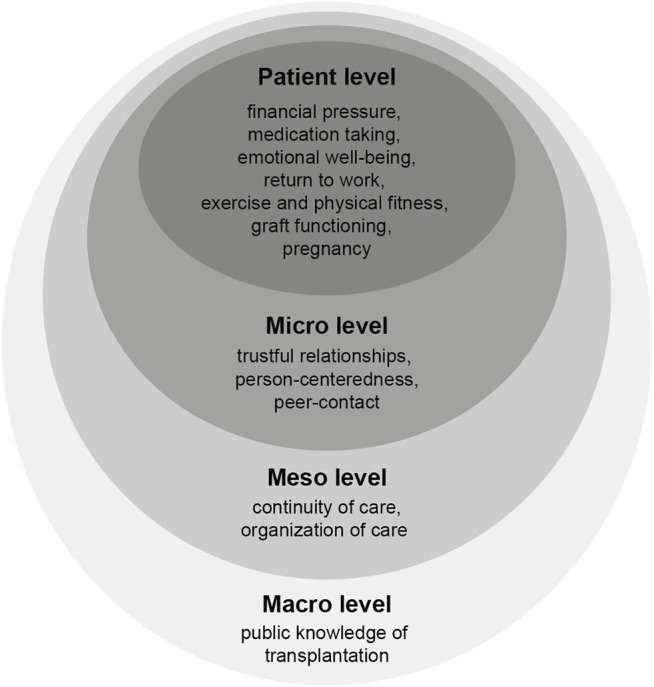
We aimed to identify, assess, compare and map research priorities of patients and professionals in the Swiss Transplant Cohort Study. The project followed 3 steps. 1) Focus group interviews identified patients' ( = 22) research priorities. 2) A nationwide survey assessed and compared the priorities in 292 patients and 175 professionals. 3) Priorities were mapped to the 4 levels of Bronfenbrenner's ecological framework. The 13 research priorities (financial pressure, medication taking, continuity of care, emotional well-being, return to work, trustful relationships, person-centredness, organization of care, exercise and physical fitness, graft functioning, pregnancy, peer contact and public knowledge of transplantation), addressed all framework levels: patient ( = 7), micro ( = 3), meso ( = 2), and macro ( = 1). Comparing each group's top 10 priorities revealed that continuity of care received highest importance rating from both (92.2% patients, 92.5% professionals), with 3 more agreements between the groups. Otherwise, perspectives were more diverse than congruent: Patients emphasized patient level priorities (emotional well-being, graft functioning, return to work), professionals those on the meso level (continuity of care, organization of care). Patients' research priorities highlighted a need to expand research to the micro, meso and macro level. Discrepancies should be recognized to avoid understudying topics that are more important to professionals than to patients.
我们旨在确定、评估、比较和绘制瑞士移植队列研究中患者和专业人员的研究重点。该项目分三个步骤进行。1)焦点小组访谈确定了患者(= 22)的研究重点。2)一项全国性调查评估并比较了 292 名患者和 175 名专业人员的重点。3)重点被映射到布伦芬布伦纳生态框架的四个层次。这 13 个研究重点(经济压力、药物治疗、护理连续性、情绪健康、重返工作岗位、信任关系、以患者为中心、护理组织、运动和身体健康、移植物功能、怀孕、同伴接触和公众对移植的了解),涉及到所有框架层次:患者(= 7)、微观(= 3)、中观(= 2)和宏观(= 1)。比较每个组的前 10 个重点,发现连续性护理得到了两组最高的重视(92.2%的患者,92.5%的专业人员),其中有 3 个重点在两组之间达成一致。否则,观点更多的是多样化而不是一致:患者强调患者层面的重点(情绪健康、移植物功能、重返工作岗位),而专业人员则强调中观层面的重点(护理连续性、护理组织)。患者的研究重点强调需要将研究扩展到微观、中观和宏观层面。应认识到差异,以避免对专业人员比患者更重要的研究课题被忽视。