Trujillo-Santos Javier, Farge-Bancel Dominique, Pedrajas José María, Gómez-Cuervo Covadonga, Ballaz Aitor, Braester Andrei, Mahé Isabelle, Villalobos Aurora, Porras José Antonio, Monreal Manuel
Department of Internal Medicine Hospital General Universitario Santa Lucía Universidad Católica de Murcia Murcia Spain.
Unité de Médecine Interne Maladies Auto-immunes et Pathologie Vasculaire (UF 04) IRSL EA-3518 Université de Paris Paris France.
Res Pract Thromb Haemost. 2022 Jun 3;6(4):e12736. doi: 10.1002/rth2.12736. eCollection 2022 May.
Venous thromboembolism (VTE) is a frequent complication in patients with cancer and a leading cause of morbidity and death.
The objective of the RIETECAT study was to compare the long-term effectiveness and safety of enoxaparin versus dalteparin or tinzaparin for the secondary prevention of VTE in adults with active cancer.
We used the data from the multicenter, multinational RIETE registry to compare the rates of VTE recurrences, major bleeding, or death over 6 months in patients with active cancer and acute VTE using full doses of enoxaparin versus dalteparin or tinzaparin, and a multivariable Cox proportional hazard model was used to analyze the primary end point.
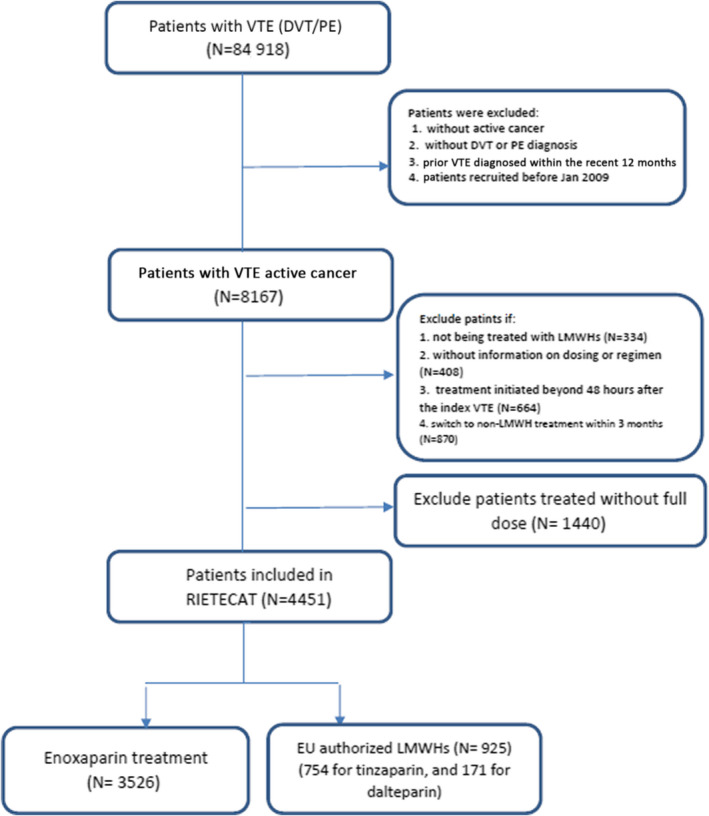
From January 2009 to June 2018, 4451 patients with active cancer received full doses of the study drugs: enoxaparin, 3526 patients; and dalteparin or tinzaparin, 925 (754 + 171) patients. There was limited difference in VTE recurrences (2.0% vs 2.5%) and mortality rate (19% vs 17%) between the enoxaparin and dalteparin or tinzaparin subgroups. However, there was a slight numerical increase in major bleeding (3.1% vs 1.9%). Propensity score matching confirmed that there were no differences in the risk for VTE recurrences (adjusted hazard ratio [aHR], 0.81; 95% confidence interval [CI], 0.48-1.38), major bleeding (aHR, 1.40; 95% CI, 0.80-2.46), or death (aHR, 1.07; 95% CI, 0.88-1.30) between subgroups.
In RIETECAT, in patients with cancer and VTE receiving full-dose enoxaparin or dalteparin or tinzaparin, no statistically significant differences were observed regarding effectiveness and safety outcomes over a 6-month period.
静脉血栓栓塞症(VTE)是癌症患者常见的并发症,也是发病和死亡的主要原因。
RIETECAT研究的目的是比较依诺肝素与达肝素或替扎肝素在成人活动性癌症患者VTE二级预防中的长期有效性和安全性。
我们使用多中心、跨国RIETE注册研究的数据,比较使用全剂量依诺肝素与达肝素或替扎肝素的活动性癌症和急性VTE患者6个月内VTE复发、大出血或死亡的发生率,并使用多变量Cox比例风险模型分析主要终点。
2009年1月至2018年6月,4451例活动性癌症患者接受了全剂量研究药物:依诺肝素组3526例;达肝素或替扎肝素组925例(754例 + 171例)。依诺肝素组与达肝素或替扎肝素组在VTE复发率(2.0% 对2.5%)和死亡率(19% 对17%)方面差异有限。然而,大出血有轻微的数值增加(3.1% 对1.9%)。倾向评分匹配证实,亚组之间在VTE复发风险(调整后风险比[aHR],0.81;95%置信区间[CI],0.48 - 1.38)、大出血(aHR,1.40;95% CI,0.80 - 2.46)或死亡(aHR,1.07;95% CI,0.88 - 1.30)方面无差异。
在RIETECAT研究中,癌症合并VTE且接受全剂量依诺肝素或达肝素或替扎肝素的患者,在6个月期间的有效性和安全性结局方面未观察到统计学上的显著差异。