Department of Psychology and Neurosciences, Leibniz Research Centre for Working Environment and Human Factors, Dortmund, Germany.
International Graduate School of Neuroscience, Ruhr-University Bochum, Bochum, Germany.
Elife. 2022 Jun 6;11:e69308. doi: 10.7554/eLife.69308.
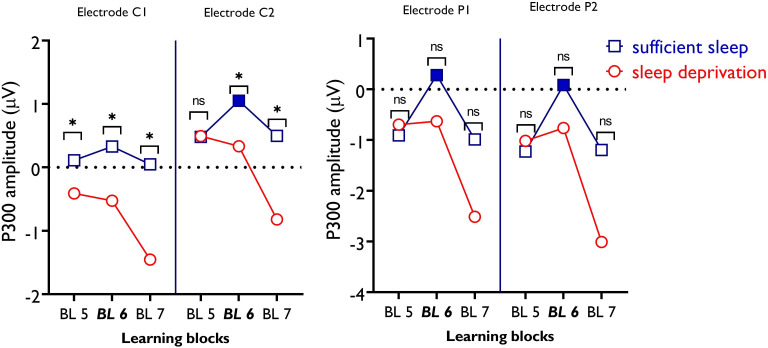
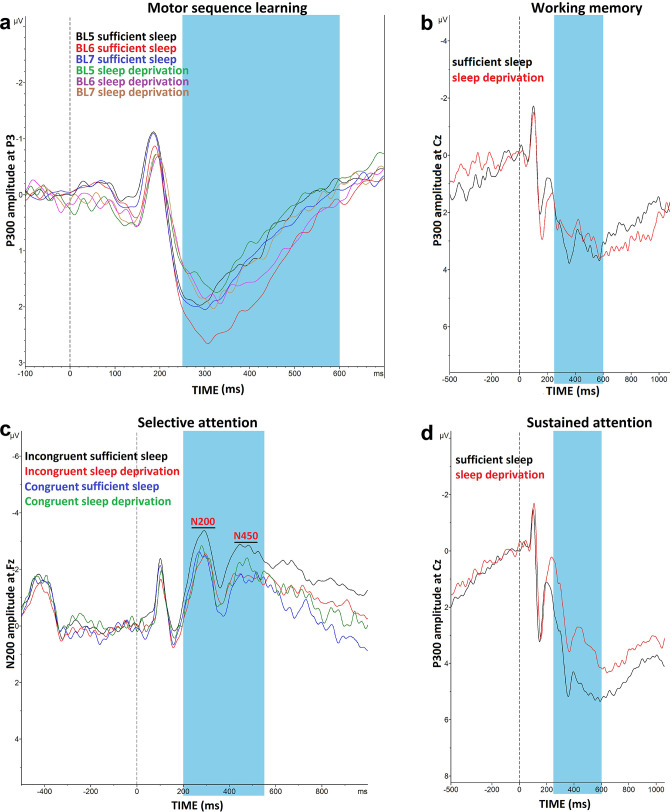
Sleep strongly affects synaptic strength, making it critical for cognition, especially learning and memory formation. Whether and sleep deprivation modulates human brain physiology and cognition is not well understood. Here we examined how overnight sleep deprivation vs overnight sufficient sleep affects (a) cortical excitability, measured by transcranial magnetic stimulation, (b) inducibility of long-term potentiation (LTP)- and long-term depression (LTD)-like plasticity via transcranial direct current stimulation (tDCS), and (c) learning, memory, and attention. The results suggest that sleep deprivation upscales cortical excitability due to enhanced glutamate-related cortical facilitation and decreases and/or reverses GABAergic cortical inhibition. Furthermore, tDCS-induced LTP-like plasticity (anodal) abolishes while the inhibitory LTD-like plasticity (cathodal) converts to excitatory LTP-like plasticity under sleep deprivation. This is associated with increased EEG theta oscillations due to sleep pressure. Finally, we show that learning and memory formation, behavioral counterparts of plasticity, and working memory and attention, which rely on cortical excitability, are impaired during sleep deprivation. Our data indicate that upscaled brain excitability and altered plasticity, due to sleep deprivation, are associated with impaired cognitive performance. Besides showing how brain physiology and cognition undergo changes (from neurophysiology to higher-order cognition) under sleep pressure, the findings have implications for and optimal of noninvasive brain stimulation.
睡眠强烈影响突触强度,对认知,特别是学习和记忆形成至关重要。睡眠不足是否会调节人类大脑生理和认知尚不清楚。在这里,我们研究了一夜之间的睡眠剥夺与一夜之间充足的睡眠如何影响:(a)经颅磁刺激测量的皮质兴奋性;(b)通过经颅直流电刺激(tDCS)诱导长时程增强(LTP)和长时程抑制(LTD)样可塑性;(c)学习、记忆和注意力。结果表明,睡眠剥夺由于谷氨酸相关皮质易化增强而增加皮质兴奋性,并减少和/或逆转 GABA 能皮质抑制。此外,tDCS 诱导的类似 LTP 的可塑性(阳极)消失,而抑制性类似 LTD 的可塑性(阴极)在睡眠剥夺下转换为兴奋性类似 LTP 的可塑性。这与由于睡眠压力导致的 EEG θ 振荡增加有关。最后,我们表明,学习和记忆形成、可塑性的行为对应物以及依赖皮质兴奋性的工作记忆和注意力在睡眠剥夺期间受损。我们的数据表明,由于睡眠剥夺导致的脑兴奋性增加和可塑性改变与认知表现受损有关。除了显示睡眠压力下大脑生理和认知如何发生变化(从神经生理学到更高阶认知)之外,这些发现对非侵入性脑刺激的应用和优化具有启示意义。