Department of Biological Sciences, Vanderbilt University, Nashville, Tennessee, United States of America.
Vanderbilt Microbiome Innovation Center, Vanderbilt University, Nashville, Tennessee, United States of America.
PLoS Genet. 2022 Jun 6;18(6):e1010227. doi: 10.1371/journal.pgen.1010227. eCollection 2022 Jun.
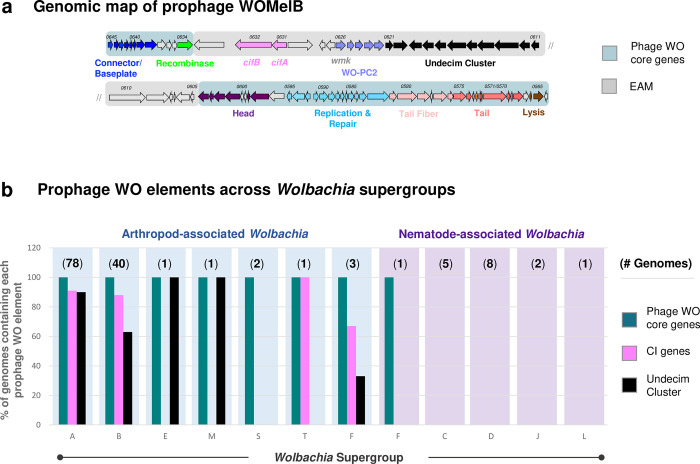
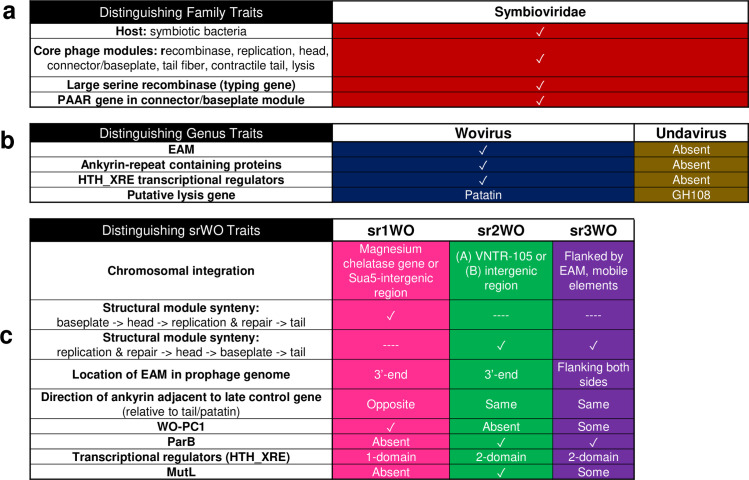
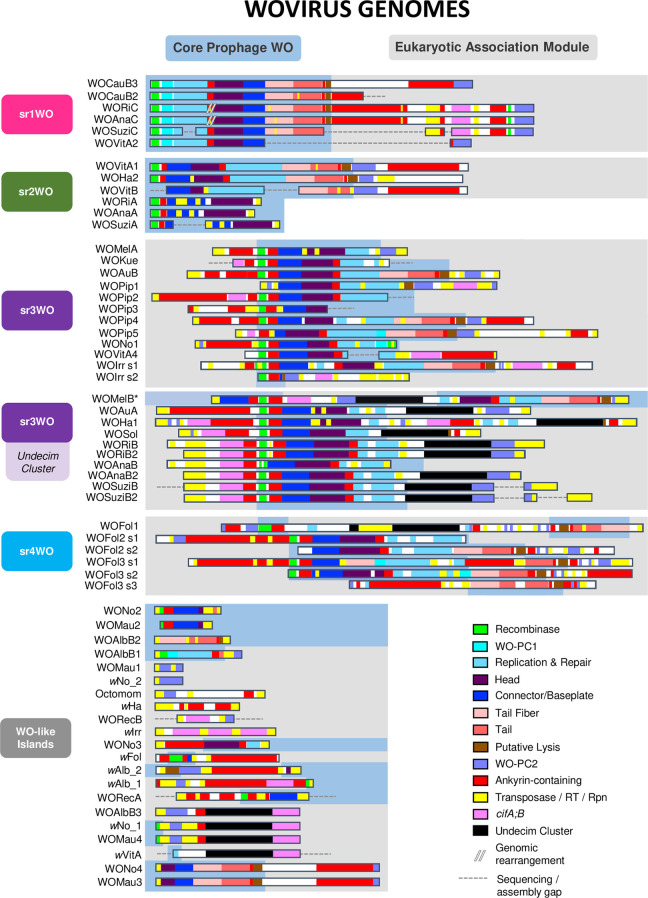
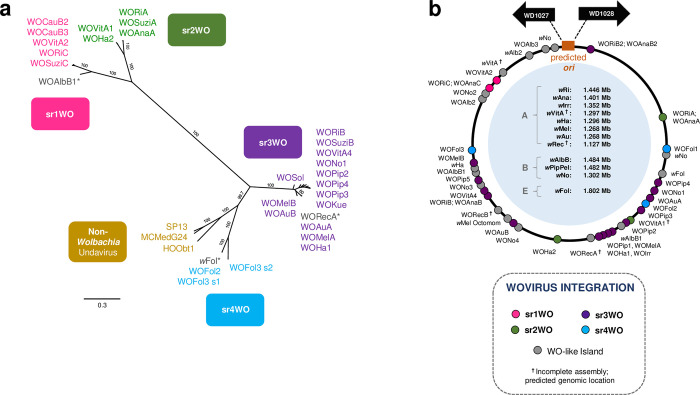
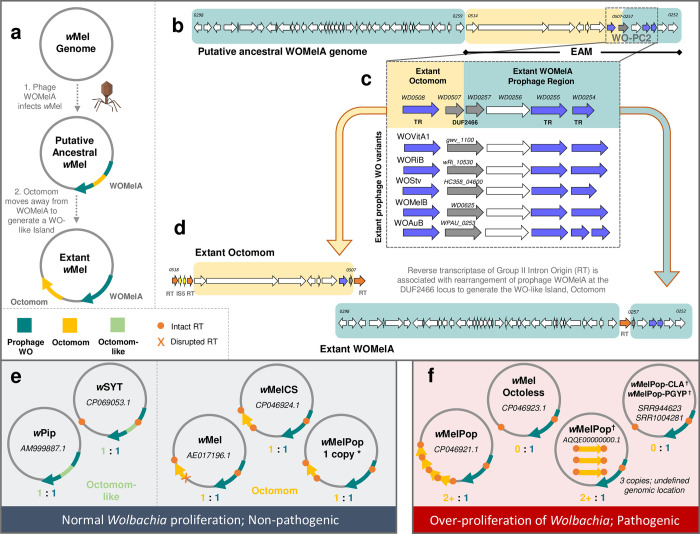
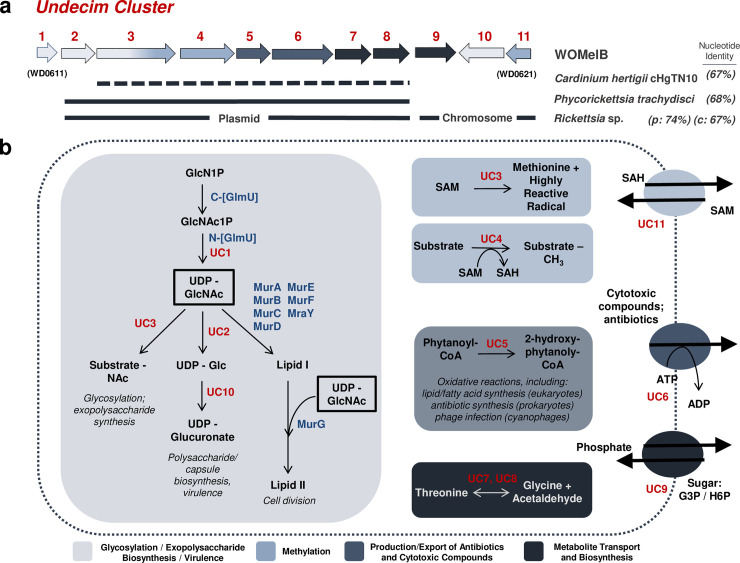
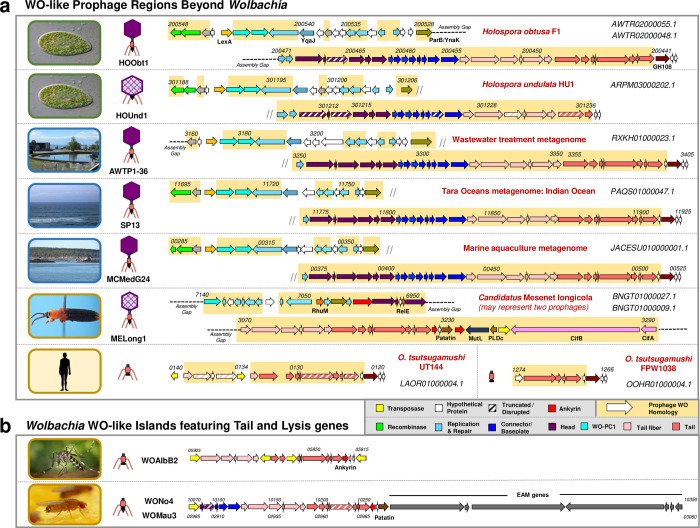
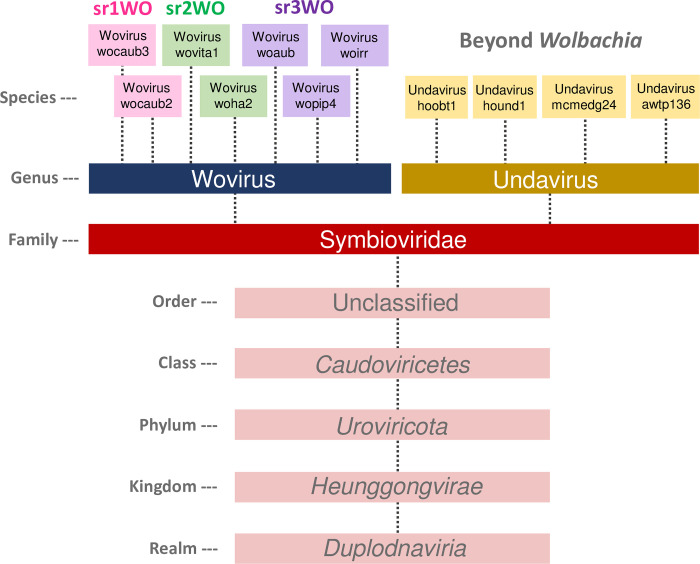
Wolbachia are the most common obligate, intracellular bacteria in animals. They exist worldwide in arthropod and nematode hosts in which they commonly act as reproductive parasites or mutualists, respectively. Bacteriophage WO, the largest of Wolbachia's mobile elements, includes reproductive parasitism genes, serves as a hotspot for genetic divergence and genomic rearrangement of the bacterial chromosome, and uniquely encodes a Eukaryotic Association Module with eukaryotic-like genes and an ensemble of putative host interaction genes. Despite WO's relevance to genome evolution, selfish genetics, and symbiotic applications, relatively little is known about its origin, host range, diversification, and taxonomic classification. Here we analyze the most comprehensive set of 150 Wolbachia and phage WO assemblies to provide a framework for discretely organizing and naming integrated phage WO genomes. We demonstrate that WO is principally in arthropod Wolbachia with relatives in diverse endosymbionts and metagenomes, organized into four variants related by gene synteny, often oriented opposite the putative origin of replication in the Wolbachia chromosome, and the large serine recombinase is an ideal typing tool to distinguish the four variants. We identify a novel, putative lytic cassette and WO's association with a conserved eleven gene island, termed Undecim Cluster, that is enriched with virulence-like genes. Finally, we evaluate WO-like Islands in the Wolbachia genome and discuss a new model in which Octomom, a notable WO-like Island, arose from a split with WO. Together, these findings establish the first comprehensive Linnaean taxonomic classification of endosymbiont phages, including non-Wolbachia phages from aquatic environments, that includes a new family and two new genera to capture the collective relatedness of these viruses.
沃尔巴克氏体是动物中最常见的专性、细胞内细菌。它们在世界范围内存在于节肢动物和线虫宿主中,分别作为生殖寄生虫或共生体发挥作用。噬菌体 WO 是沃尔巴克氏体最大的可移动元件,包含生殖寄生基因,是细菌染色体遗传分化和基因组重排的热点,并且独特地编码一个具有真核类似基因和一套假定宿主相互作用基因的真核关联模块。尽管 WO 与基因组进化、自私遗传学和共生应用有关,但人们对其起源、宿主范围、多样化和分类学分类相对知之甚少。在这里,我们分析了最全面的 150 个沃尔巴克氏体和噬菌体 WO 组装体,为离散组织和命名整合噬菌体 WO 基因组提供了一个框架。我们证明,WO 主要存在于节肢动物沃尔巴克氏体中,其在不同的内共生体和宏基因组中有亲缘关系,分为四个变体,它们通过基因同线性相关,通常与沃尔巴克氏体染色体上假定的复制起点相对,而大型丝氨酸重组酶是区分这四个变体的理想分型工具。我们鉴定了一个新的、假定的裂解盒和 WO 与一个保守的十一基因岛的关联,称为十一基因岛,富含类似毒力的基因。最后,我们评估了沃尔巴克氏体基因组中的 WO 样岛,并讨论了一个新的模型,其中一个显著的 WO 样岛 Octomom 是从与 WO 的分裂中产生的。总之,这些发现建立了第一个全面的共生噬菌体林奈分类学分类,包括来自水生环境的非沃尔巴克氏体噬菌体,其中包括一个新的科和两个新的属,以捕获这些病毒的集体亲缘关系。